Skip to content

Are You Actually a Covered Building Under Local Law 97?
Yes, if you meet any one of three size triggers, your building is covered. A single building exceeding 25,000 gross square feet is covered on its own. Two or more buildings on the same tax lot that together exceed 50,000 gross square feet are also covered, even if each individual structure is smaller. And two or more condo buildings governed by the same board of managers that together exceed 50,000 gross square feet are treated as covered. A co-op is treated as one entity; individual condo buildings are each assessed separately. Verify your status on the DOB Covered Buildings List at beam.cityofnewyork.us.
If your co-op or condo sits right at that 25,000 sq ft edge, a 6-story, 20-unit pre-war walk-up in Astoria or a landmarked brownstone-scale building in the West Village, you are playing the same LL97 game as a 40-story tower, just with a much thinner budget. That is exactly why the hybrid path (keep the steam radiators add mini split Local Law 97 NYC co-op) is worth understanding in detail before you authorize a $500,000+ VRF scope.
How Does LL97 Actually Penalize Your Building?
Local Law 97 does not penalize energy use directly. It penalizes carbon. The DOB applies fuel-specific carbon coefficients to your metered energy consumption each year, then compares the result against your building’s annual cap. If you exceed the cap, the penalty is $268 per metric ton of CO2e over the limit.
There are four compliance periods to plan around:
- 2024–2029: Relatively moderate caps. About 89% of covered buildings currently comply.
- 2030–2034: Caps tighten by roughly 40% compared to 2024 levels. About 57% of currently-compliant buildings are projected to exceed the 2030 cap under today’s energy mix.
- 2035–2039: Caps tighten again, continuing toward the city’s 2050 net-zero target.
- 2040–2050: Progressive reductions to net-zero.
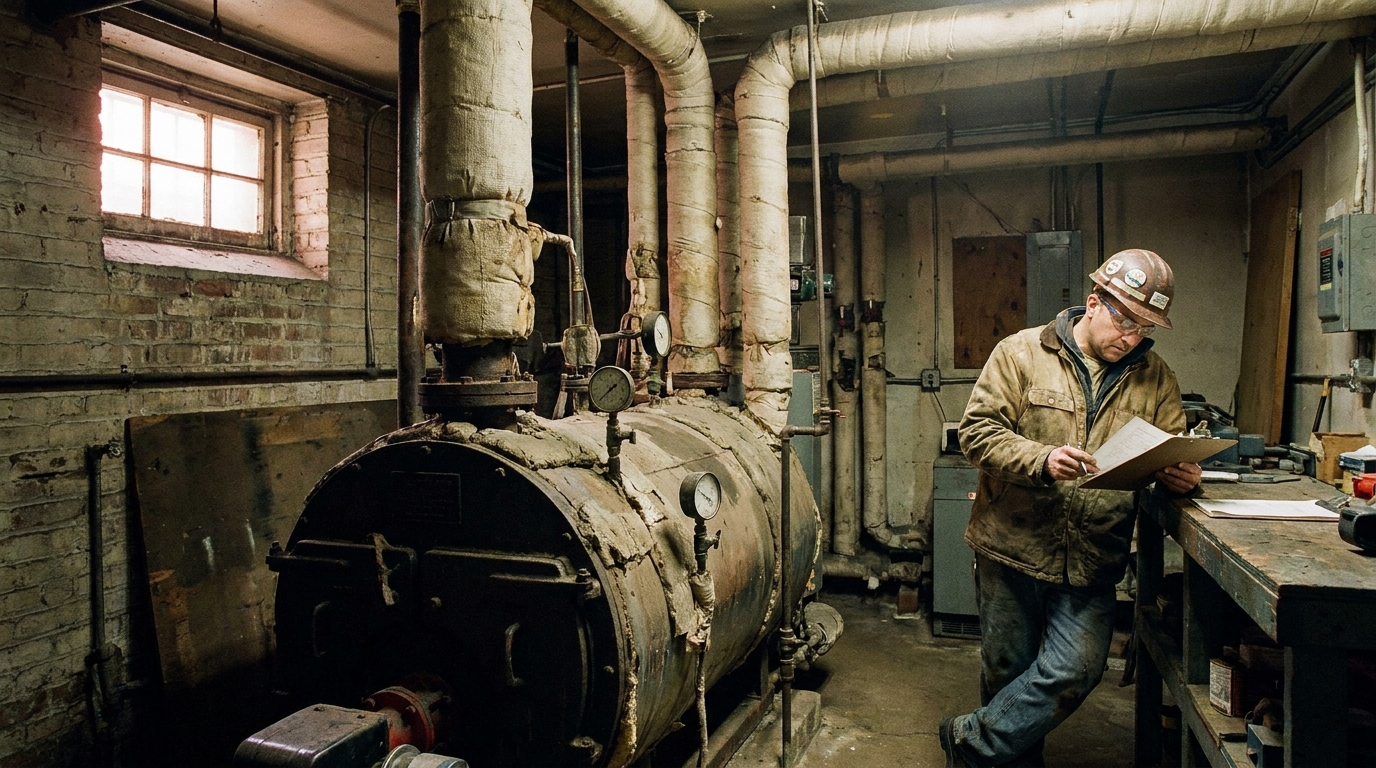
A building that passes 2024 can still face substantial annual fines starting in 2030 without any change to its systems. For a threshold-adjacent co-op, say 27,000 sq ft running a gas-fired one-pipe steam boiler, the math often shows that a partial shift of heating load to grid electricity cuts enough CO2e to clear the 2030 cap without tearing out the steam system.
Why Does Switching Load to Electricity Actually Lower Your Score?
Natural gas and fuel oil carry high carbon coefficients under LL97’s methodology, every therm of gas burned in your boiler is counted at a fixed CO2e rate set by the city. Grid electricity carries a lower coefficient, and that coefficient is scheduled to drop significantly in 2030 as the state adds more renewable generation. The electricity coefficient for the 2030 compliance period is approximately 50% cleaner than the 2024 coefficient, reflecting New York State’s renewable energy commitments.
In practical terms: if mini splits handle shoulder-season load (roughly October through mid-December and March through May) plus a meaningful share of mild winter heating, say, down to 25°F, your boiler fires only on design-day events. NYC’s design temperature is about 12°F. Cold-climate “Hyper-Heat” mini splits (Mitsubishi’s line, for example) hold near rated heating output down to roughly 5°F and produce some heat as low as -17°F. That means your steam backup is genuinely reserved for the 10–15 coldest days per year, not the entire heating season. Every BTU shifted from gas steam to electric mini split improves your CO2e score.
Hybrid vs. Full VRF Conversion: Which Path Is Right?
The table below compares the two main routes for a threshold-adjacent NYC co-op.
| Factor | Hybrid: Mini Splits + Steam Backup | Full VRF/Heat Pump Conversion |
|---|---|---|
| Upfront cost (typical 20-unit pre-war) | $160,000–$280,000 | $400,000–$700,000+ |
| Con Edison electrical service upgrade | Often avoidable, steam handles peak load | Usually required; riser/panel work adds cost and timeline |
| LL97 carbon score improvement | Moderate to significant (shoulder + mid-winter load shifted) | Maximum possible reduction |
| Con Edison Clean Heat rebate | Option 2 (partial): ~$1,000–$2,500 per apartment | Option 1 (full removal): up to $4,000–$5,000 per apartment |
| Board/shareholder disruption | Low, radiators stay, per-unit install only | High, boiler decommission, riser work, common areas |
| Design-day comfort risk | None, radiators deliver perimeter radiant heat at extremes | System must be sized for 12°F with no fallback |
| Federal 25C/25D tax credit (2026) | Not available, expired December 31, 2025 | Not available, expired December 31, 2025 |
For most threshold-adjacent co-ops, the hybrid path clears the 2030 cap while spending roughly 40–50% of what a full conversion costs. Full electrification remains the right answer if you are also planning a major facade or riser project and can bundle the cost, or if your 2035–2039 compliance modeling shows the hybrid still falls short.
What Does the Con Edison Clean Heat Rebate Actually Pay for a Hybrid Setup?
This is the trade-off no one spells out cleanly. The Con Edison Clean Heat program has two distinct paths:
- Option 1 (full replacement): The fossil-fuel system must be removed or permanently disabled. For apartments in a multifamily building, this pays $4,000 per unit (or $5,000 in a Disadvantaged Community). To claim it, your boiler cannot remain in service, not even as backup.
- Option 2 (partial / backup retained): Keeping the boiler operational drops the per-apartment incentive to $1,000 per unit (or $2,000 in a DAC). The rebate is filed by a participating contractor and netted against the invoice at time of installation.
The rebate itself is capped at 70% of project cost (85% in a Disadvantaged Community), so even at Option 2 amounts it meaningfully reduces net cost per unit. For a 20-unit co-op in a non-DAC neighborhood, Option 2 produces $20,000 in total building incentive, real money, but not a game-changer on a $200,000 scope. The LL97 penalty avoidance math typically outweighs the rebate gap for buildings genuinely at risk of exceeding their 2030 cap.
Note that the federal 25C and 25D residential energy tax credits expired on December 31, 2025. A heat pump placed in service in 2026 does not qualify. The LL97 compliance and Con Edison rebate math now stands entirely on its own. See our detailed breakdown of Con Edison Clean Heat rebates for NYC co-ops and condos for current per-unit incentive tiers.
How Does the Electrical Service Reality Change for a Hybrid Plan?
Pre-war NYC buildings, the six- and seven-story brick structures that make up the bulk of threshold-adjacent co-ops in Brooklyn Heights, the Upper West Side, or Inwood, frequently have 200-amp or smaller service with aging risers. A full heat-pump conversion that replaces a steam boiler must size electrical capacity for design-day heating load, which often triggers a Con Edison service upgrade, new risers, and panel replacements in every unit. That work alone can run $50,000–$150,000 on top of equipment cost, and the Con Edison interconnect timeline adds months.
A hybrid plan sidesteps most of that. Each mini split in a typical co-op apartment draws 15–20 amps on a dedicated 20-amp circuit. Adding one or two units per apartment requires a panel inspection and possibly a sub-panel addition, but not a building-wide service upgrade, because the steam boiler still carries the coldest-day load. Our full breakdown of when a Con Edison electrical service upgrade is actually required covers the load letter and timeline specifics.
Where Does Article 321 Fit Into This Plan?
Article 321 of the NYC Administrative Code provides a prescriptive compliance pathway for certain covered buildings, primarily affordable and rent-regulated housing, but its listed measures are useful benchmarks for any co-op optimizing its steam system alongside a mini-split install. The prescriptive measures include:
- Thermostatic radiator valves (TRVs) on individual radiators
- Master steam venting on mains and risers
- Steam trap replacement and maintenance
- Pipe and distribution insulation
- Boiler temperature setpoint controls and outdoor reset
- Envelope air-sealing
Stacking these measures with a mini-split install is the smartest sequencing for a threshold-adjacent building. Properly tuned one-pipe steam with TRVs and master venting reduces overheating losses and lowers boiler runtime, meaning the steam system fires less often, the mini splits cover more hours of the heating season, and the LL97 carbon score improves from both directions. Budget roughly $1,500–$4,000 per apartment for TRVs and a steam-trap survey before you start the mini-split scope.
What Does a Board Actually Need to Approve?
Co-op and condo boards evaluating a hybrid mini-split plan weigh three things: condenser placement, per-unit electrical metering (who pays for the electricity the mini split uses), and aggregate building load impact. Getting a clear answer on all three before presenting to the board dramatically shortens approval timelines.
| Board Concern | Hybrid Mini Split Answer | Full Conversion Answer |
|---|---|---|
| Condenser placement | Per-unit: roof, rear yard, or facade with LPC review if applicable | Central rooftop plant, one decision, larger footprint |
| Who pays operating cost | Individual shareholder’s electric bill (sub-meter or direct meter) | Central system: requires allocation methodology in house rules |
| Building electrical load impact | Incremental per apartment; rarely triggers service upgrade | Full design-day load shift; almost always triggers upgrade |
| Alteration agreement / COI | Required per unit, straightforward standard form | Complex building-wide contract; engineering sign-off required |
| DOB permit | Required; typically Alt-2 per apartment | Required; typically Alt-1 for building-wide mechanical change |
Boards approving individual unit installations also need a proper certificate of insurance from the installing contractor. Our guide to mini split installation COI requirements for NYC co-op and condo boards covers the exact coverage amounts and additional insured language most co-op counsel requires.
If your building is in an LPC-designated historic district, common for brownstone blocks in Brooklyn or Manhattan, condenser visibility from the street triggers a Certificate of No Effect or a full LPC application. Plan that review into your timeline before board sign-off.
Common Mistakes to Avoid
- Assuming you pass 2030 because you pass 2024. About 57% of buildings currently within the 2024 cap will exceed the 2030 cap without further action. Run your building’s 2030 projection before concluding no action is needed.
- Sizing mini splits for cooling only. Units selected purely for summer BTU load often underperform in heating mode. Confirm heating capacity at 12°F outdoor, not just rated cooling BTU.
- Skipping steam-system tuning before adding mini splits. An overheating steam system forces shareholders to open windows in January, mini splits then fight that heat loss. TRVs and master venting should come first.
- Claiming Option 1 rebate while keeping the boiler. Con Ed requires the fossil system be removed or permanently disabled for Option 1. Attempting to claim Option 1 while retaining backup steam is a program violation.
- Overlooking the tax-lot aggregation rule. A small building on a shared tax lot with an adjacent structure may be pulled into LL97 even under 25,000 sq ft individually. Check the BBL, not just your building’s square footage.
- Installing condensate without planning the drain path. Interior-wall head placement in pre-war apartments creates real condensate routing challenges. Resolve this before finalizing head locations, see our guide on mini split condensate drain solutions for NYC apartments.
Frequently Asked Questions
Can we keep our one-pipe steam boiler and still reduce our Local Law 97 carbon score?
Yes. LL97 measures metered energy consumption multiplied by fuel-specific carbon coefficients. Shifting heating load from gas or oil steam to grid electricity, even partially, directly reduces the carbon calculation. Mini splits handling shoulder-season and moderate-winter load, with steam reserved for extreme cold days, produces a measurable CO2e reduction without decommissioning the boiler.
Will we lose the Con Edison Clean Heat rebate if we keep the boiler?
You will receive the smaller Option 2 rebate rather than the full Option 1 amount. For apartments in a multifamily building, Option 2 pays $1,000 per unit ($2,000 in a Disadvantaged Community), compared to $4,000 per unit ($5,000 in a DAC) under Option 1, which requires the fossil system to be removed or permanently disabled. The rebate is netted against your invoice by a participating contractor and is capped at 70% of project cost.
Does adding mini splits require a building-wide electrical service upgrade?
Not usually under the hybrid plan. Each mini split draws 15–20 amps on a dedicated circuit. Because the steam boiler still carries design-day peak load, the building’s total electrical demand increase is incremental rather than transformative. Full heat-pump conversions, by contrast, almost always require a Con Edison service upgrade since they must size electrical capacity for the coldest winter day.
We comply with the 2024 LL97 cap. Do we still need to act?
Likely yes. Roughly 57% of buildings currently within the 2024 cap are projected to exceed the 2030 cap. The 2030 limits are approximately 40% stricter, and the penalty is $268 per metric ton of CO2e over the cap, assessed annually. A threshold-adjacent building running a gas boiler for its full heating season may find itself meaningfully over the 2030 cap even if it passes 2024 comfortably.
What permits does a mini split installation require in a NYC co-op?
A DOB permit is required, typically filed as an Alteration Type 2 for individual apartment work. The co-op board also requires an alteration agreement and a contractor COI naming the building as additional insured. If the building is in an LPC historic district, a Certificate of No Effect or full LPC application is required before condenser placement is finalized. Detailed permit requirements are covered in our guide on whether you need a DOB permit for a mini split in NYC.