

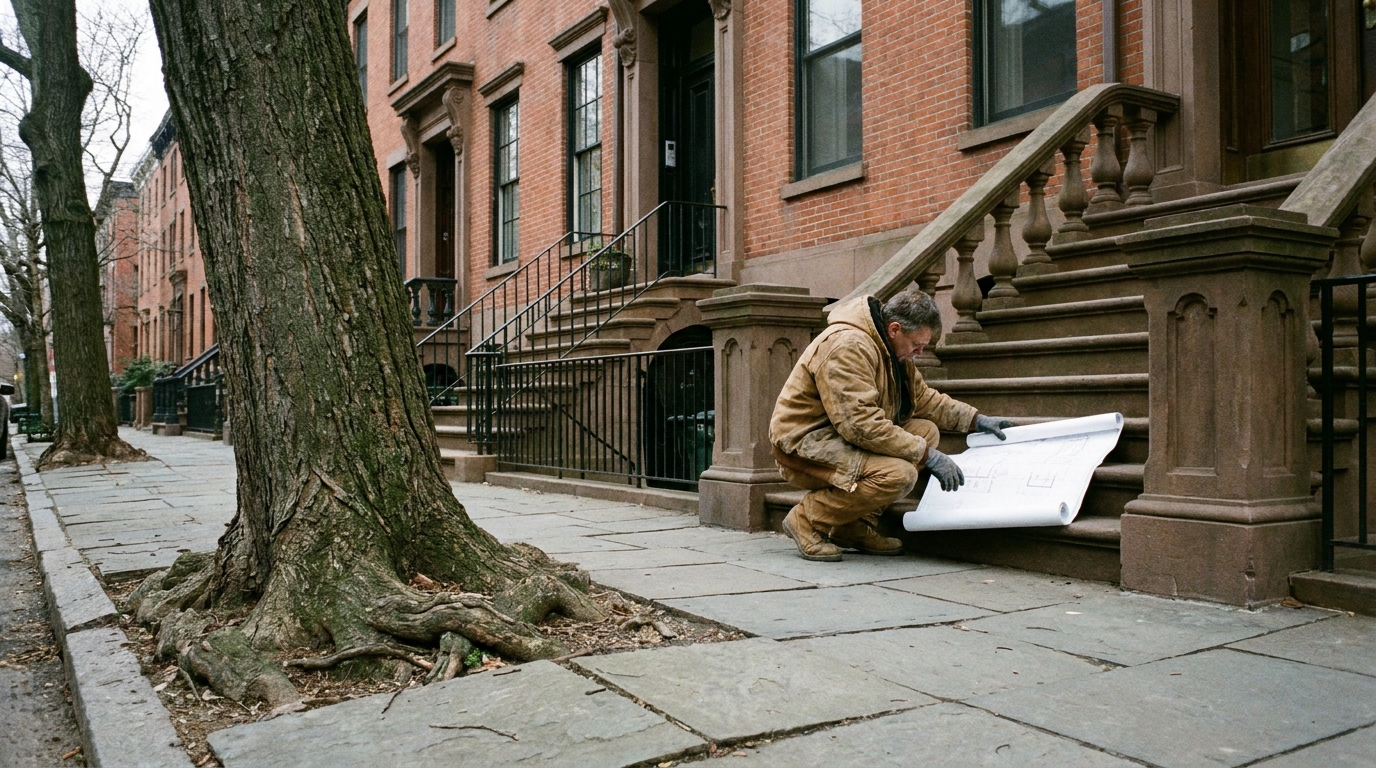
Do You Need a DPR Tree Work Permit to Install a Mini Split Condenser Near a Street Tree in NYC?
Yes, and it is a separate permit from your DOB mechanical filing. If any part of your mini split condenser near street tree NYC permit scope falls within 50 feet of a city-owned street tree, NYC Parks (DPR) requires a Tree Work Permit before work begins. This applies whether you are pouring a condenser pad, trenching the sidewalk for a line set or electrical conduit, or excavating the areaway. The DOB mechanical permit does not satisfy this requirement.
If you, a contractor, or any other entity are looking to perform work on or within 50 feet of a tree under City jurisdiction, you must obtain a Tree Work Permit from NYC Parks prior to the start of construction. Examples of work that need a permit include installing a sidewalk, installing a driveway, and installing a utility line, all of which directly map to condenser pad pours, electrical conduit runs, and refrigerant line-set trenches common to front-yard mini split installs in Brooklyn and Manhattan brownstones.
What Is the 50-Foot Rule and How Does It Define the Critical Root Zone?
The 50-foot rule is the DPR trigger distance: any construction activity within 50 feet of a city tree in the public right-of-way requires a permit, even if the work never contacts the tree itself. Within that radius, the critical root zone (CRZ) is the area where roots are most vulnerable to compaction, cutting, and grade change.
Anyone performing excavation or trenching work within 50 feet of a City tree must possess a Tree Work Permit to avoid unsafe or hazardous conditions that may be detrimental to any City tree. No cutting or otherwise damaging of tree roots is permitted. For a typical Brooklyn brownstone with a street tree between the curb and the sidewalk, the 50-foot radius commonly extends past the stoop, through the areaway, and into the front yard, meaning almost any front-yard condenser placement triggers the rule.
It is incumbent upon the applicant to ascertain whether or not there are any trees or tree roots situated within the city right of way. Check your title survey first: if the tree is on city property (curb strip), DPR owns it; if it is inside your lot line, the city does not have jurisdiction but you are still responsible for roots that extend into the right of way.
How the DPR Permit Process Works: Step-by-Step Sequence
The permit sequence matters. Get the DOB job number first, then apply to DPR. Reversing the order wastes time and can stall your DOB sign-off.
- File your DOB mechanical permit and obtain a Job Number. For construction permits, include a letter explaining the project, why tree work is needed, and the Department of Buildings Job Number.
- Prepare a tree survey. Provide a survey or layout showing where the trees are. Your contractor or a licensed arborist marks each tree within 50 feet of the work zone on the site plan.
- Submit to the Borough Forestry Office at least 20 business days before work begins. Construction-related tree work permit applications must be received at least 20 business days prior to the start of work.
- Await Forester site visit. A Parks and Recreation Forester will visit the site to check if the proposed work is acceptable and make changes if needed, and will talk to you about the proposal.
- Receive the permit. The permit will be given no earlier than five business days before you start work. Plan a buffer of at least six weeks from application to start date.
- Complete work and pass final Forester inspection. The Forester must sign off after the job before DPR closes the permit.
Contractor Requirements
The company must have the right insurance; bigger projects may need a performance bond; and at least one person must be a certified arborist or have similar experience. For HVAC installs, this means your mechanical contractor must partner with, or subcontract to, an ISA Certified Arborist who carries NYC Parks indemnification coverage. Any damage to existing trees during construction is the contractor’s responsibility, and the contractor must perform remedial work to damaged trees at the contractor’s expense.
Penalties: What Happens If You Skip the Tree Work Permit?
Skipping the DPR permit is a misdemeanor, not just a paperwork violation. Violations and misdemeanors are punishable by a fine not to exceed $15,000 and/or imprisonment for up to one year. If the condenser pad pour or trench damages roots, DPR can assess restitution based on the tree’s appraised value, some illegal removal cases in NYC have reached six figures. A stop-work order from DPR also freezes your DOB permit, delaying the entire install.
Condenser Placement Options: Comparing Front Yard, Rear Yard, and Roof
Where the condenser physically goes determines whether the DPR permit is required at all. Use this table to evaluate your options before committing to a location.
| Location | DPR Tree Permit Likely? | Zoning Allowed (1-2 Family)? | Typical Added Cost |
|---|---|---|---|
| Front yard pad (within 50 ft of street tree) | Yes, required | Yes, if within 3 ft of street wall and screened by vegetation | Permit + arborist fee: $800–$2,500 |
| Rear yard ground mount | Rarely (only if rear street tree within 50 ft) | Yes, easiest path | Lowest; standard install |
| Roof mount | No (no excavation) | Yes, required for 3+ family buildings | Rigging adds $3,500–$10,000 |
| Side-yard bracket (party-wall side) | Possibly, if within 50 ft of a side-street tree | Yes, with setback compliance | Moderate; bracket hardware + filing |
For 3-family and larger buildings, rear-yard or roof mount is required by the Zoning Resolution. For 1-2 family brownstones, a front-yard pad is zoning-legal if it meets the screening and setback rules, but still triggers the DPR permit whenever a street tree is nearby. See our guide on mini split party wall placement in NYC rowhouses if a side-yard bracket is your fallback.
How the Zoning Screening Rule and the DPR 50-Foot Rule Conflict
This is the collision point no other HVAC guide addresses. The NYC Zoning Resolution permits a condenser in the front yard of a 1-2 family residence, provided it is within 3 feet of the street wall and fully screened from the street by vegetation. That vegetation screen is exactly where a street tree’s root zone lies, and planting or excavating near an existing street tree to install screening vegetation may itself require a DPR permit.
| Rule | Authority | Requirement | Conflict Point |
|---|---|---|---|
| Front-yard condenser screening | NYC Zoning Resolution §26-51 | Condenser within 3 ft of street wall; fully screened by vegetation | Planting near tree root zone may trigger DPR permit |
| 50-foot street tree rule | NYC Parks / DPR | Any work within 50 ft of city tree requires Tree Work Permit | Front-yard pad is almost always inside 50 ft radius |
| Critical root zone (CRZ) protection | NYC Parks Tree Protection Protocol | No cutting, compaction, or grade change within CRZ | Pad concrete pour and trench can compact or sever roots |
The practical resolution: if the Forester determines the condenser pad location conflicts with the CRZ, they will require you to move the pad or use a non-excavation alternative (gravel bed, rubber anti-vibration feet on existing concrete). If no compliant front-yard position exists, you pivot to a rear-yard mount or a roof lift. For roof logistics, see our guide to mini split condenser crane lifts in NYC.
What to Do When the Root Zone Blocks Your Only Viable Condenser Spot
If the Forester rules out your front-yard pad, these are your next moves in order of cost:
- Rear-yard ground mount: Run the line set through the building interior or along the party wall. Longest refrigerant run, but lowest total cost and no DPR exposure.
- Rear-yard or side-yard bracket: Attaches to the facade above grade; no excavation, no root conflict. Requires DOB filing and facade attachment review.
- Roof mount: Eliminates all ground-level conflicts. Adds rigging cost ($3,500–$10,000 depending on building height and access). For buildings requiring a crane or sidewalk shed, DOT street-closure permits add lead time. In general, it takes up to six weeks upon receipt of a complete permit application to review a construction permit near parks. Stack that with your 20-business-day DPR notice and your DOB filing window, and plan a minimum 10-week pre-construction runway for any front-yard scenario with a street tree.
If you are unsure whether your DOB filing qualifies for expedited review, our breakdown of mini split self-certification at NYC DOB explains the speed-versus-audit tradeoffs for brownstone owners.
Common Mistakes to Avoid
- Pulling only the DOB permit and assuming you are covered. The DPR Tree Work Permit is a separate application to a separate agency. DOB approval does not notify or satisfy DPR.
- Starting work before the 20-business-day DPR notice period expires. Even if the permit is approved, starting too early is a violation.
- Letting the HVAC contractor self-certify tree proximity. Only a DPR Forester can determine whether the CRZ is impacted; the installer’s judgment is not sufficient.
- Pouring a concrete pad without a gravel or permeable base option. A Forester may require a permeable surface to protect roots; a poured concrete pad may be rejected outright within the CRZ.
- Trenching the sidewalk for the electrical conduit or line set without a permit. A Tree Work Permit is required for any sidewalk repair or restoration performed within 50 feet of a City tree, and a new trench qualifies.
- Ignoring the zoning screening requirement. Even a legally placed front-yard condenser needs full vegetation screening toward the street; an unscreened unit is a separate DOB violation.
Frequently Asked Questions
Does a DPR Tree Work Permit cost money?
The permit itself carries no flat fee for construction-related applications, but you bear the cost of any required tree protection measures, arborist fees, remedial work, and a performance bond if DPR requires one for larger excavations. Budget $800–$2,500 for arborist coordination and protection installation on a typical brownstone front-yard condenser project.
What if the street tree is more than 50 feet from my condenser pad but the sidewalk line-set trench passes within 50 feet of it?
The permit is triggered by each individual work activity, not just the condenser pad location. If any portion of the trench for your electrical conduit or refrigerant line set passes within 50 feet of the tree, that trench segment requires a Tree Work Permit. Map every work element separately when assessing your exposure.
Can I do the DPR application myself, or does my HVAC contractor do it?
Either the property owner or the contractor can apply, but the contractor bears liability for any tree damage during the job. In practice, the HVAC contractor or their arborist subcontractor should lead the application because they must certify compliance with the Tree Protection Protocol and carry the required insurance.
Does the 50-foot rule apply to trees on my private property, or only to city street trees?
The DPR 50-foot rule applies only to trees under NYC Parks jurisdiction, typically street trees in the curb strip between the sidewalk and the roadway. Trees on your private lot are not covered by DPR, though they may be subject to other rules. Always check your title survey to confirm whether a tree is city-owned before assuming DPR has no jurisdiction.
My building has three units. Can I still do a front-yard condenser pad?
No. The NYC Zoning Resolution permits at-grade front-yard condensers only for single- and two-family residences. A three-family or larger building must roof-mount the condenser. The DPR tree permit question becomes moot for the front yard, but a roof mount avoids the CRZ conflict entirely, at the cost of additional rigging and, potentially, a crane filing.