

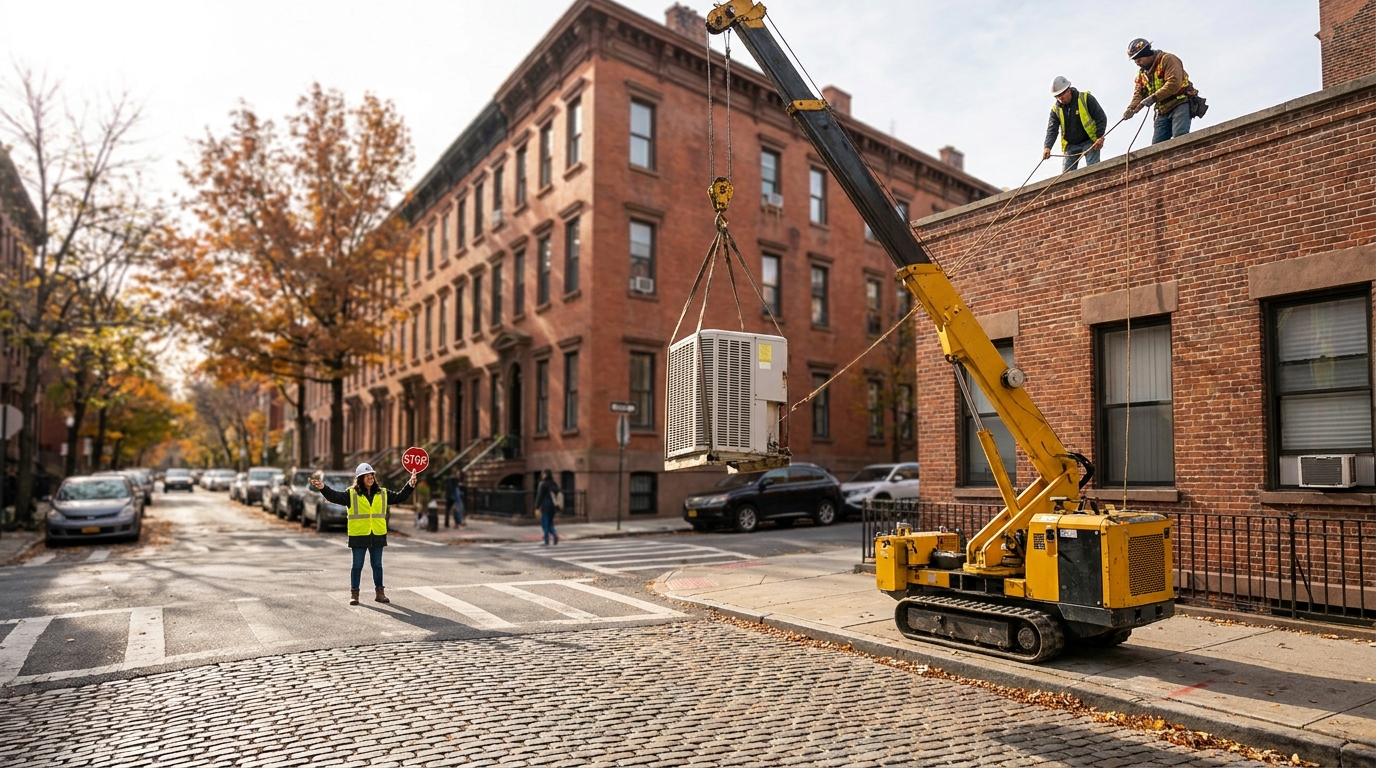
Do You Actually Need a Crane to Get a Mini Split Condenser on an NYC Roof?
For the majority of NYC jobs, the answer is no. A mini split condenser crane lift NYC is a mid-rise and high-rise problem, not a brownstone problem. A typical residential outdoor unit weighs between 100 and 400 pounds. On a three- or four-story rowhouse in Carroll Gardens, Astoria, or Bed-Stuy, a trained crew of three to five technicians can hand-carry or strap-carry the condenser up interior stairs and set it on rooftop dunnage with no hoisting equipment at all. The stair-carry labor surcharge typically runs $200 to $600 depending on the building’s stair configuration, which is far cheaper than any crane day.
The crane question becomes real when the building exceeds five or six stories and has no freight elevator, when the courtyard or setback makes rooftop access impractical, or when the condenser is oversized for a multi-zone or VRF system. If any of those conditions apply, every section below is mandatory reading before you schedule a crane.
What Lift Method Is Right for Your Building?
Use the table below to match your building type to the correct lift strategy before calling anyone for permits.
| Building Type | Typical Stories | Recommended Lift Method | Rough Added Cost |
|---|---|---|---|
| Brownstone / rowhouse (no elevator) | 3–5 | Hand/stair carry by crew | $200–$600 labor surcharge |
| Walk-up or low-rise with courtyard access | 3–6 | Portable aluminum gantry or HVAC material lift | $70–$125/day rental |
| Mid-rise with freight elevator | 6–12 | Freight elevator + rooftop davit or utility crane (~500 lb rated) | $300–$800 staging + labor |
| Mid-rise / high-rise, no freight access | 7+ | Street-deployed mini crane (DOT + DOB permits required) | $3,500–$10,000 crane day |
| High-rise, complex VRF / large condenser | 12+ | Full mobile crane or tower crane assist | $8,000–$18,000+ installed |
The rental market does provide lighter alternatives. Condensing-unit material lift rentals in NYC run roughly $70 to $125 per day, and portable rooftop davit systems rated around 500 pounds are available for jobs where a single-zone unit fits inside that limit. These options sidestep every street permit, which is the real prize.
If your building sits in a flood zone, the condenser elevation requirement may also constrain where on the roof it can land. See our guide on mini split condenser placement in an NYC flood zone for the FEMA base-flood-elevation rules before you finalize the landing zone.
What Three Permits Does a Street-Deployed Crane Require in NYC?
A mini split condenser crane lift NYC that uses a street-deployed crane triggers three separate approval tracks, each with its own agency, timeline, and professional requirements. Missing any one of them exposes you to stop-work orders, fines, and potential liability.
1. The DOB Mechanical Permit (Base Install)
Every mini split installation in NYC requires a DOB mechanical permit, pulled by a licensed contractor. Homeowners cannot self-permit. The mechanical permit covers the refrigerant piping, electrical connections, and placement of the condenser itself. The crane and DOT permits are layered on top of this base permit, not substitutes for it. The system cannot legally be placed in service until a DOB inspection signs off on the mechanical work. See our full breakdown of why DIY mini split installs in NYC void your permit, warranty, and insurance for the consequences of skipping this step.
2. The DOB Alt-2 Permit with EQ-Construction Equipment Work Type (Mini Crane)
NYC defines a mini crane as a mobile (wheel or tread mounted) crane with a boom length, including jibs or any extensions, not exceeding 50 feet, and with a manufacturer’s rated capacity of three tons or less. Cranes may be manufactured and marketed as mini cranes but are not considered such in New York City if they exceed those parameters.
An Alt-2 permit, with the EQ-Construction Equipment work type selected, must be obtained prior to the use of a mini crane. This permit is filed at the appropriate DOB borough office, not online through DOB NOW in the same way a standard mechanical permit is processed.
The plans filed with the permit application must be developed by a New York State licensed Professional Engineer. At a minimum, the plans must detail the machine make and model, capacity, pertinent site conditions, location and configuration of the crane, maximum and minimum swing radius and load path of the boom and load, and minimum clearance for the boom, as well as pick and landing zones, pedestrian and traffic controls, loads imposed and any reinforcements needed, tiebacks to secure the machinery, and wind thresholds.
Exceeding the 50-foot boom or 3-ton capacity threshold means the machine is no longer a mini crane under NYC definitions, and the filing requirements escalate significantly to a full crane and derrick authorization with a DOB-licensed Class A or B Hoisting Machine Operator.
3. The DOT Street-Construction Permit (Crane on the Street)
A DOT street-construction permit is required for crane, bulldozer, or other heavy construction equipment storage on the street, as well as for temporarily closing a roadway for street or roadway construction. This is a separate filing from the DOB Alt-2 and must be obtained through NYC DOT’s NYCStreets Permit Management system.
Closing or blocking a street, sidewalk, plaza, or any other public way to set up, store, or work the machine needs a permit from the New York City Department of Transportation, involving separate paperwork, a separate agency, and a separate lead time. On a Manhattan or Downtown Brooklyn street with minimal setback, that typically means a lane closure and possibly a pedestrian walkway in the roadway before the crane can even deploy.
A DOT Sidewalk Crossing Permit is also required if motorized equipment must cross the sidewalk where no approved curb cut exists, and NYC limits this to a maximum of two sidewalk crossings per 300 linear feet of block frontage. Additionally, be aware that a mobile crane rental on a New York block is not just a machine: it is a curb lane or a full street closure, outriggers on the roadway, sometimes a sidewalk closed and a pedestrian route rerouted, and parking suspended on both approaches, all of which require DOT street permits, every one of which a construction embargo suspends. Check DOT’s Protected Streets listing and construction embargo calendar before setting a crane date, especially around the winter holidays or major events in Midtown.
Who Files What? The Permit Responsibility Matrix
| Document / Permit | Filed By | Agency | Key Requirement |
|---|---|---|---|
| DOB Mechanical Permit | Licensed contractor | NYC DOB | Required for all mini split installs; DOB inspection before system goes live |
| DOB Alt-2 (EQ-Construction Equipment) | NYS-licensed PE (stamped plans) + licensed contractor pulls permit | NYC DOB Borough Office | Required before mini crane is used on site |
| PE-stamped crane lift plans | NYS-licensed Professional Engineer | Filed with DOB Alt-2 | Machine specs, swing radius, pick/land zones, load path, wind thresholds |
| DOT Street-Construction Permit | Registered DOT permittee (contractor with Permittee ID) | NYC DOT via NYCStreets | Required to place crane or close lane/sidewalk; expires weekly for cranes |
| DOT Sidewalk Crossing Permit | Registered DOT permittee | NYC DOT | Required if motorized equipment crosses sidewalk without curb cut |
| HMO License (Crane Operator) | Crane operator personally | NYC DOB | Required as of November 7, 2024 for all mini crane operators |
As of November 7, 2024, an HMO license issued by the Department of Buildings is required to operate an articulating boom crane, mini crane, or rotating telehandler in New York City. Three new classes of Limited Hoisting Machine Operator License have been established: a Limited HMO License for Articulating Boom Cranes, one for Mini Cranes, and one for Rotating Telehandlers. When you vet your crane vendor, confirm the operator holds the correct DOB-issued limited HMO license for the specific machine being used.
Note that DOT crane permits expire weekly, not over a standard 90-day window like most street-construction permits. If the crane day slips due to weather, the permit must be renewed before the machine goes back on the street.
Pre-Crane Survey Checklist: What to Confirm Before You File Anything
Skipping this checklist is how crane days turn into crane weeks. Your PE and contractor need every item below before the Alt-2 plans can be drawn.
- Boom reach vs. building height and street setback: Measure the horizontal distance from the crane’s street position to the rooftop landing zone. The boom must reach the target without sweeping over occupied adjacent properties beyond what the plans account for.
- Pick zone clearances: Identify overhead utilities, tree canopy, scaffolding, and fire escapes in the swing arc. LPC rules may apply if the building or its neighbor is in a historic district.
- Landing zone and dunnage: Confirm the roof deck can bear the condenser’s point load plus any dunnage frame. Older Brooklyn and Manhattan brownstone roofs with deteriorated joists may need temporary shoring before the condenser lands.
- Outrigger ground conditions: Check for vaults, subsurface utilities, and cellar extensions under the roadway. A written site-condition statement is required with the DOT street permit.
- Street width and parking lane: Determine whether a single lane closure suffices or whether a full block closure is needed. Full closures require 24-hour advance NYPD and FDNY notification.
- Wind threshold plan: NYC crane operations follow DOB wind protocols. Identify the maximum sustained wind speed at which the pick will be aborted and who makes that call.
- Protected street status: Check the DOT Protected Streets Listing. Work on protected streets requires additional confirmation numbers and may be restricted on certain days.
Co-op and Condo Overlay: What Buildings Add on Top of City Requirements
City permits are necessary but not sufficient for a co-op or condo building in Manhattan, Brooklyn Heights, or the Upper West Side. Managing agents layer on their own logistics requirements, and failing to meet them can push your crane day weeks into the future.
- Certificate of Insurance naming the managing agent: The COI must list the management company and often the board as additional insureds before any contractor or crane vendor is allowed on the property. Review our guide to mini split installation COI requirements for NYC co-op and condo boards for the exact endorsement language boards expect.
- Delivery windows: Many mid-rise and high-rise buildings restrict contractor activity to 9 AM to 11 AM or 9 AM to 5 PM on weekdays only. Crane vendors charge standby rates, often $95 to $165 per hour, if the crew arrives and the building has not cleared them for access.
- Freight elevator reservation and staging floor: Where a freight elevator exists, the condenser is typically delivered to a service floor and staged there while the rooftop rigging path is confirmed clear, then moved to the roof. Coordinate both the elevator reservation and a staging area in advance.
- Alteration agreement: Most co-op alteration agreements require board pre-approval for any work affecting the roof or building envelope. Submit the Alt-2 permit application and crane plans to the managing agent as part of the alteration package, not as an afterthought.
If your building’s costs are pushing into the $8,000 to $18,000 range for a front-facing or roof-condenser installation, explore whether financing alternatives like C-PACE heat pump financing for NYC co-ops can spread the capital cost over time before the board approves the project.
What Does a Crane Day Actually Cost for a Mini Split in NYC?
Budget for a crane day in the $3,500 to $10,000 range for a standard mini-crane setup, which covers the crane rental, the licensed operator, the flagging crew, and the DOT permit fee. That range shifts higher when the boom must reach farther, when the building is in a dense Manhattan block requiring a full-width street closure, or when the PE fee for stamped crane plans is included separately. Front-facing rooftop condenser jobs with structural dunnage work at co-ops price at the upper end, with total installed costs in the $8,000 to $18,000 range driven partly by the crane lift and partly by added structural work at the landing zone.
Crane-day costs do not include the base mechanical permit, the PE fee for the Alt-2 plans (often $800 to $1,500 separately), or the DOB inspection fee for sign-off on the mechanical installation. Build all of these into your project budget before presenting numbers to a board or an owner.
Common Mistakes to Avoid
- Assuming the crane vendor handles the DOT permit. Many crane rental companies in Brooklyn and Queens provide the machine and operator only. Confirm in writing who is pulling the DOT street-construction permit before the job is scheduled.
- Treating a marketed “mini crane” as automatically qualifying under NYC’s definition. A machine sold as a mini crane that has a boom exceeding 50 feet or a capacity above 3 tons does not qualify under NYC DOB rules. The filing requirements and operator license class change immediately.
- Filing the Alt-2 without PE-stamped plans. The permit application requires a NYS-licensed PE’s stamped drawings at submission. Filing without them causes rejection and delays the project by weeks.
- Scheduling the crane day during a DOT construction embargo. Holiday-season and special-event embargoes suspend all DOT street permits. The DOB Alt-2 approval is unaffected, but the crane cannot legally occupy the street until the embargo lifts.
- Skipping the sidewalk crossing permit. If the crane must cross the sidewalk to access the street, a separate DOT Sidewalk Crossing Permit is required. Operating without it is a distinct violation even when the street permit is valid.
- Overlooking the licensed operator requirement. As of November 7, 2024, an unlicensed operator on a mini crane is a reportable violation. Do not accept a crane vendor’s assurance that the operator is “certified” without confirming the specific NYC DOB-issued Limited HMO License for mini cranes.
- No pre-crane roof structural review. Assuming the roof deck can handle condenser point loads without a PE review is a common shortcut that leads to stop-work orders after the unit is already up.
Frequently Asked Questions
Do I need a permit for a mini crane to lift a mini split condenser onto an NYC roof?
Yes. Any mini crane deployed on a New York City construction site requires a DOB Alt-2 permit with the EQ-Construction Equipment work type selected, filed with PE-stamped plans before the crane is used. If the crane occupies the street, a separate DOT street-construction permit is also required. These are in addition to the base DOB mechanical permit for the mini split installation itself.
What is NYC’s official definition of a mini crane, and why does it matter?
NYC defines a mini crane as a mobile (wheel or tread mounted) crane with a boom length, including jibs and extensions, not exceeding 50 feet and a manufacturer’s rated capacity of 3 tons or less. A crane marketed as a mini crane that exceeds either threshold is not treated as such by DOB, which means the Alt-2 filing path does not apply and a full crane-and-derrick authorization with a Class A or B HMO is required instead.
Who needs a license to operate a mini crane in NYC?
As of November 7, 2024, the operator must hold a NYC DOB-issued Limited Hoisting Machine Operator License for Mini Cranes. The prior standard of a manufacturer’s certification for the specific make and model is still technically available as an exception under the original DOB Industry Notice for mini cranes, but the November 2024 rule mandates a DOB-issued license for any operator working on a job site requiring a construction superintendent. Confirm which license the operator holds before signing a crane rental agreement.
Can a brownstone owner skip the crane entirely for a rooftop mini split condenser?
In most cases, yes. Residential condensers typically weigh 100 to 400 pounds. On a three- to five-story Brooklyn or Manhattan brownstone without a freight elevator, a trained crew of three to five technicians can hand-carry the unit up interior stairs for a surcharge of $200 to $600. A portable aluminum gantry or HVAC material lift rental ($70 to $125 per day) extends that option to slightly taller or more awkward buildings. A crane is usually only warranted above five or six stories or for oversized multi-zone condensers.
Does a DOT construction embargo cancel my crane day?
It cancels the DOT street permit, which means the crane legally cannot occupy the street during the embargo period. The DOB Alt-2 approval is unaffected by the embargo. Crane dates are most vulnerable to holiday embargoes in late November through early January and to special-event embargoes around the UN General Assembly in September. Check the DOT Special Traffic Advisory page for current embargo dates before scheduling, and build a buffer date into the contract with your crane vendor.