

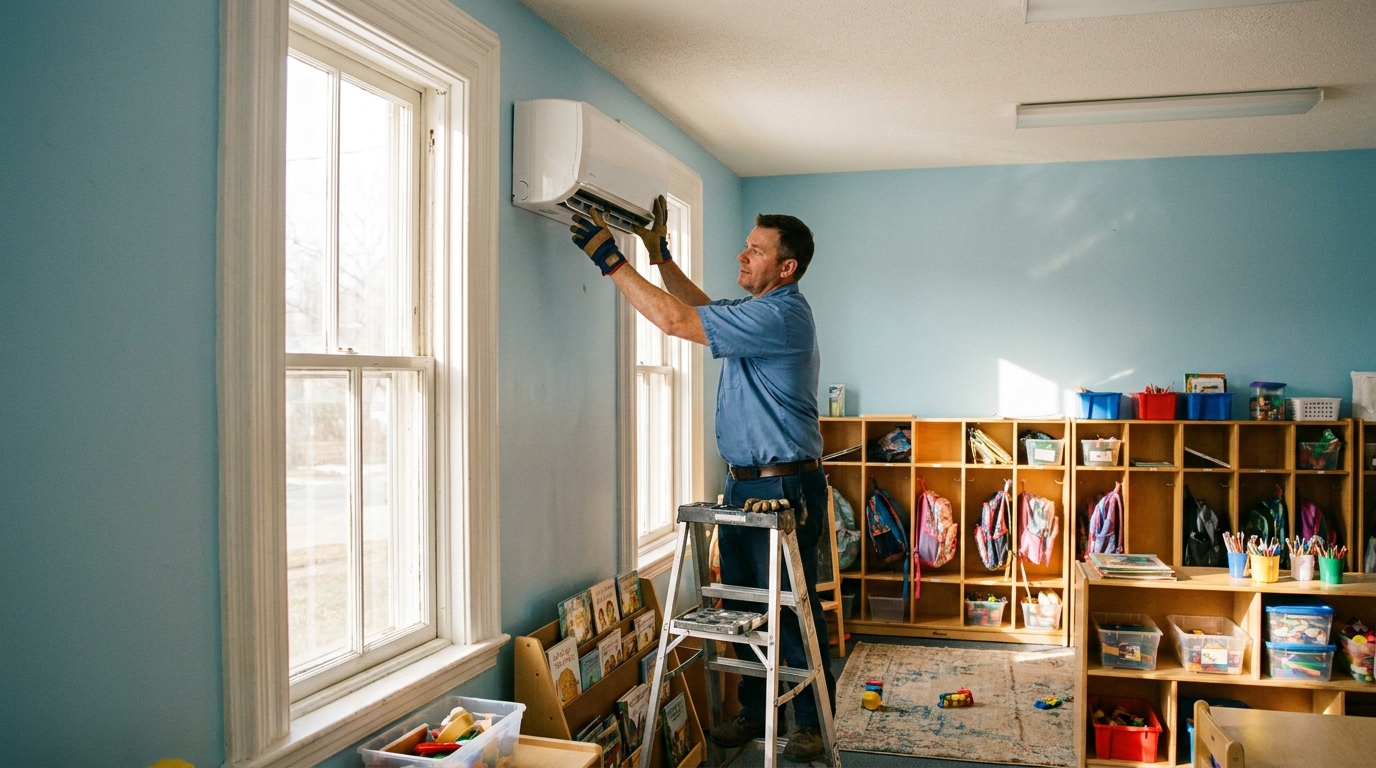
Does a NYC Daycare Legally Need Air Conditioning?
Yes, and the legal basis is narrower and more specific than most operators realize. A mini split for NYC daycare cooling compliance must satisfy two distinct mandates inside a single code section: a winter floor temperature requirement and a heat-advisory cooling obligation. Neither can be met with a summer-only window unit or a winter-only radiator alone.
Under Article 47 Section 47.57(d), when outdoor temperatures are below 55°F and children are on premises, permittees must maintain indoor air temperatures between 68°F and 72°F in all rooms, areas, and spaces used by children. That is a maximum as well as a minimum: running the boiler wide open until classrooms hit 80°F is also a violation.
On designated heat-advisory, excessive heat warning or watch, or ozone or other air-pollution advisory days, Article 47 Section 47.57(e) requires permittees to maintain the physical comfort of children and staff by providing adequate facility ventilation and/or air conditioning. NYC’s summers now produce multiple advisory days per season, so this is an operational reality, not a hypothetical.
There are roughly 2,200 child care centers in New York City, all subject to these rules. A ductless mini split heat pump provides both the 68–72°F winter heat and heat-advisory summer cooling from a single refrigerant system, something no window AC or steam radiator can do alone.
Who Is Covered by Article 47 vs. NYS Licensing?
The compliance path depends entirely on how your program is licensed, and mixing them up wastes time and money.
| Program Type | Governing Authority | Temperature/Cooling Standard | Inspection Body |
|---|---|---|---|
| Center-based group child care (5+ children, 5+ hrs/week, 30+ days/year) | NYC DOHMH, Article 47 | 68–72°F winter; heat-advisory AC mandate | DOHMH (unannounced) |
| Home-based family day care (typically fewer than 7 children) | New York State OCFS | NYS OCFS regulations, not Article 47 | NYS OCFS |
| Religious-school NPR programs | NYC DOHMH (complaint-based) | Article 47 applies; rarely proactively inspected | DOHMH (complaint-triggered) |
Home-based family day care is generally licensed and inspected by New York State Office of Children and Family Services, not under NYC Article 47. The compliance owner differs, so the permit and equipment strategy differs too. This guide focuses on center-based Article 47 programs operating in the five boroughs.
What DOB Permits Does a Mini Split Trigger in a Daycare?
Most daycare HVAC installs will require a DOB work permit. Understanding the threshold prevents both compliance failures and costly surprises mid-project.
A work permit or equipment use permit is generally not required to install a common window AC unit, unless the unit exceeds three tons or 36,000 BTU/hr; however, if the mini-split system exceeds three tons or 36,000 BTU/hr, you are required to obtain a permit from the Department of Buildings.
For a typical NYC daycare, 36,000 BTU is a low ceiling. A single classroom of 500–600 sq ft in a pre-war Bronx or Brooklyn building can require 12,000–18,000 BTU on its own; a three-room center with a nap room, a main classroom, and a reception area can easily land at 36,000–48,000 BTU total. That means most multi-room daycare installs are above the permit threshold.
Beyond the BTU threshold, new split systems in commercial occupancies generally require a DOB work permit with plans filed by a licensed Professional Engineer (PE) or Registered Architect (RA), regardless of total tonnage. Additional DOB filing triggers include a new outdoor unit, refrigerant penetrations through the building envelope, roof or terrace condenser placement, core drilling, and electrical changes. A daycare conversion or build-out will typically involve several of these simultaneously.
For installs where a PE files stamped plans and a contractor pulls the work permit, the process runs through DOB NOW: Build under the Mechanical Systems work type. If your project involves a rooftop condenser requiring a crane lift, see our guide on mini split condenser crane lift logistics and DOT street-closure permits before scheduling the job. If you are weighing whether a self-certification path is appropriate, review the self-certification tradeoffs for NYC DOB filings with your PE first.
The Ventilation Gotcha: Why a Mini Split Alone Is Not Enough
This is the most consequential gap that no competing guide addresses, and it can derail a DOHMH inspection even when your temperatures are perfect.
A ductless mini split recirculates indoor air through its evaporator coil. It does not draw outdoor air into the space. That is acceptable for temperature control, but NYC Mechanical Code Table 403.3.1.1 imposes a separate outdoor air ventilation requirement based on occupancy type. For “Day care (through age 4),” the code requires 10 CFM per person of outdoor airflow in the breathing zone, plus 0.18 CFM per square foot of floor area.
Run the numbers for a 600 sq ft classroom with 20 children and two teachers: (22 persons × 10 CFM) + (600 sq ft × 0.18 CFM/sq ft) = 220 + 108 = 328 CFM of outdoor air required. A mini split provides zero of that.
This means a mini split for NYC daycare cooling compliance requires a separate, dedicated outdoor-air ventilation strategy. The three most common approaches in NYC’s existing building stock are:
- Energy Recovery Ventilator (ERV): Introduces outdoor air while recovering heat or coolth from exhaust air. Best choice for well-sealed classrooms; minimizes the conditioning load added by fresh air.
- Dedicated Outdoor Air System (DOAS): A separate small air-handler conditions and delivers only outdoor air; the mini split handles all sensible and latent load. Standard approach for new construction or full gut renovations.
- Operable windows (existing buildings): Accepted as a ventilation strategy in some older pre-war buildings with large operable double-hung windows, but difficult to control and will not satisfy mechanical code on its own without an engineered analysis signed by a PE.
Your PE must confirm which path satisfies both NYC Mechanical Code Section 403 and DOHMH’s Article 47 facility standards before DOB filing. Installing a beautiful multi-zone mini split and then failing a DOHMH inspection for inadequate ventilation is an avoidable outcome.
How to Size and Zone a Mini Split for a Daycare: Room-by-Room Strategy
Daycare floor plans create zoning challenges that a standard residential install does not. Each space has different occupancy density, solar exposure, and operational hours.
| Space Type | Key Sizing Factors | Zoning Recommendation | Special Consideration |
|---|---|---|---|
| Main classroom (ages 0–4) | High occupant density (25/1,000 sq ft), west or south exposure | Dedicated indoor head, independent setpoint | Size to hold 68–72°F at NYC design outdoor temp of ~13°F |
| Nap room | Lower activity level during sleep; sound sensitivity | Separate zone; specify a low-noise indoor head (<26 dBA at low fan) | Run on “sleep” or lowest fan speed during rest period |
| Reception/lobby | High infiltration from door openings, variable occupancy | Separate zone or shared with office | Oversizing common here; manual J load calc required |
| Kitchen/pantry | Internal heat gain from appliances | Separate zone or exhaust-only | Exhaust ventilation is mandatory; coordinate with ERV design |
| Staff office/director’s room | Low occupancy density, equipment heat | Shared zone with lobby acceptable | Lowest-priority zone in a load-shedding scenario |
NYC Energy Code allows sizing to a 72°F indoor design temperature. AirSync sizes daycare systems to hold the full 68–72°F band through New York City’s approximately 13°F outdoor design temperature in winter and 89°F dry-bulb / 74°F wet-bulb in summer. Undersizing the heating capacity is the most common field error: specifying a unit by its cooling BTU without verifying the heating output at low outdoor temps will leave classrooms cold on a January morning when a DOHMH inspector walks in.
Multi-Zone Mini Splits vs. Multiple Window ACs: Compliance and Cost Compared
Many operators still run one or two window ACs per room. Here is how that approach compares to a multi-zone ductless system across the compliance dimensions that matter for a daycare permit holder.
| Factor | Window AC (per room) | Multi-Zone Mini Split Heat Pump |
|---|---|---|
| Article 47 winter heating (68–72°F) | No, cooling only | Yes, heat pump covers both |
| Article 47 heat-advisory cooling | Yes, cooling only | Yes |
| DOB permit required? | Only if >36,000 BTU per unit | Yes for new split system; PE/RA plans required |
| Annual NYC cooling equipment inspection | Per unit; more units = more inspections | System-level inspection; fewer discrete units to track |
| Window guard compliance | Conflicts with window guard law; requires bracket permit | No window obstruction; no window guard conflict |
| Energy efficiency | EER 10–12 typical | SEER2 18–22 typical; inverter-driven |
| Indoor air quality | Recirculates; no filtration upgrade path | Multi-stage filtration; washable filters; allergy reduction |
| Nap room noise | Typically 45–55 dBA at low fan | Low-profile heads: 20–26 dBA at low fan |
For daycare operators also managing window guard compliance under the NYC window guard law, a mini split eliminates the annual conflict between guard installation and window AC bracket requirements. See our guide on the window guard law and NYC mini splits for the full picture.
Common Mistakes to Avoid
- Specifying cooling BTU only. Daycare operators often size a mini split for summer cooling and discover the unit cannot hold 68°F in January. Always verify heating output at 5°F to 13°F outdoor ambient, not just the rated heating capacity at 47°F.
- Treating the mini split as the ventilation system. A mini split recirculates indoor air and does not supply the 10 CFM per person outdoor air required by NYC Mechanical Code for day care (through age 4) occupancy. Skipping an ERV or DOAS will cause a DOHMH violation even if temperatures are perfect.
- Assuming home-based family day care follows Article 47. Home-based programs are governed by NYS OCFS, not DOHMH. The permit path, the inspection regime, and the applicable temperature standards are different.
- Installing without a DOB work permit. A multi-room daycare install almost always exceeds 36,000 BTU and always involves a new outdoor unit and refrigerant penetrations, both of which independently trigger DOB filing. An unpermitted install can void your DOHMH permit to operate.
- Ignoring the 72°F ceiling in Article 47.57(d). The code sets a band, not just a floor. Oversized equipment that hunts between 65°F and 78°F is still a violation, even if average temperatures look fine.
- Forgetting the nap room acoustics requirement. DOHMH inspectors evaluate facility comfort holistically. A loud indoor head running during naptime is a documented finding. Specify heads rated at or below 26 dBA at the lowest fan speed for nap rooms.
- Routing the condensate drain incorrectly. Daycare inspectors look at water damage and mold risk carefully. A poorly sloped condensate line that pools or backs up will generate a health code finding independent of temperature compliance.
Financing and Incentives for Daycare Operators
Commercial mini split heat pump installs at NYC daycares may qualify for Con Edison Clean Heat rebates, which are capacity-based and apply to commercial properties. The NYSERDA EmPower+ program and C-PACE financing are additional tools, though eligibility depends on building ownership structure and income qualification. Nonprofit-operated daycares in particular should evaluate all three before committing to a financing path. For a detailed walkthrough of how cooling assistance programs work and what they actually fund, see our guide on HEAP cooling assistance and mini splits in NYC.
Frequently Asked Questions
Does Article 47 require air conditioning in every NYC daycare classroom?
Article 47 Section 47.57(e) requires that on designated heat-advisory, excessive heat warning or watch, or ozone or air-pollution advisory days, permittees maintain the physical comfort of children and staff by providing adequate facility ventilation and/or air conditioning. The mandate activates on advisory days, which in NYC now occur multiple times each summer. DOHMH expects permittees to have a compliant system in place before an advisory is declared, not after.
What is the Article 47 indoor temperature range for NYC daycares in winter?
When outdoor temperatures are below 55°F and children are on premises, permittees must maintain indoor air temperatures between 68°F and 72°F in all rooms, areas, and spaces used by children. Both limits are enforceable: a space that reaches 74°F because the boiler is not controlled is as much a violation as one that drops to 65°F.
Does a mini split for a NYC daycare always need a DOB permit?
A work permit is generally not required for a window AC unit unless it exceeds three tons or 36,000 BTU/hr; however, if a mini-split system exceeds three tons or 36,000 BTU/hr, a DOB permit is required. Beyond the BTU threshold, new split systems in commercial occupancies also trigger filing requirements when they involve new outdoor units, refrigerant line penetrations, or electrical modifications. Most multi-room daycare installs will require a PE/RA-filed work permit.
Can a mini split satisfy the NYC Mechanical Code ventilation requirement for a daycare?
No. A mini split recirculates indoor air and does not supply outdoor air. NYC Mechanical Code Table 403.3.1.1 requires 10 CFM per person plus 0.18 CFM per square foot of outdoor airflow for day care (through age 4) occupancy. A separate ventilation strategy, such as an ERV or DOAS, is required to meet this obligation. Your PE must confirm the compliant approach before DOB filing.
What is the difference between a center-based daycare and a home-based family day care for HVAC compliance?
Center-based group child care programs serving five or more children for five or more hours per week over more than 30 days per year are regulated by NYC DOHMH under Article 47, which imposes the 68–72°F winter temperature band and the heat-advisory cooling mandate. Home-based family day care is generally licensed and inspected by New York State OCFS under separate regulations, and the Article 47 temperature and cooling standards do not directly apply. The permit path, inspection frequency, and equipment requirements differ between the two.