Skip to content

What Does “Replace PTAC with Mini Split NYC” Actually Mean for Your Apartment?
When you replace PTAC with mini split NYC, the indoor head mounts high on an interior wall and the outdoor condenser mounts outside the building, meaning the existing under-window sleeve opening becomes a hole you must seal, insulate, and patch. The PTAC sleeve and the mini split system are completely separate things. No ranking page covers this clearly, so let’s walk through every decision you actually face.
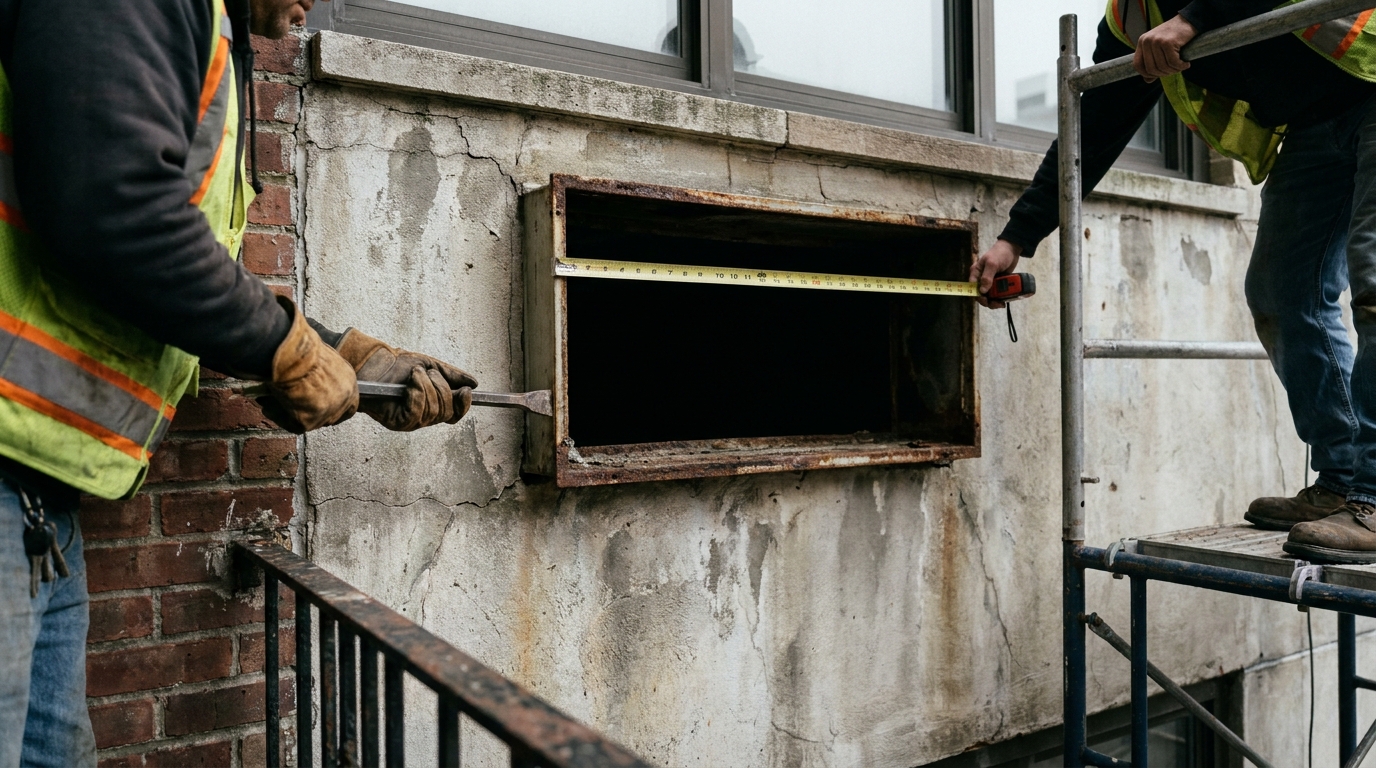
What Are the Real Sleeve Dimensions in My NYC Building?
Your sleeve size determines whether a like-for-like swap is even possible. Measure before you do anything else.
- 42″ W × 16″ H, Standard PTAC sleeve. The most common dimension in postwar NYC towers (Kips Bay, Murray Hill, Third Ave corridors) and hotels.
- 26″ W × 15″ H, Compact PTAC sleeve found in smaller bedrooms and studios in older buildings. Very limited modern chassis selection.
- 36″ W × 19″ H, Through-wall split-system sleeve, standard for split condensing chassis from several NYC suppliers.
- Non-standard (e.g., 40″ W), Older buildings sometimes have oddball openings that won’t accept any standard modern chassis. This is one of the strongest triggers to go ductless instead.
A 42″ PTAC sleeve will not accept a 36″ through-wall split chassis without modification. And a ductless mini split needs neither, its indoor head mounts on the wall above the old sleeve location entirely.
Reuse the Sleeve vs. Go Fully Ductless: Which Is Right for You?
This is the core fork. Here is how the two paths compare side by side.
| Factor | Reuse Sleeve (Through-Wall Chassis) | True Ductless Mini Split |
|---|---|---|
| Sleeve required | Yes, must match chassis dimensions exactly | No, sleeve opening gets sealed/patched |
| Exterior condenser | No separate outdoor unit | Yes, facade bracket, terrace, or rooftop |
| Board approval difficulty | Lower, facade grille stays unchanged | Higher, outdoor condenser touches common elements |
| DOB permit | Usually not required for like-for-like swap | Required for new outdoor unit, refrigerant penetration, electrical |
| Efficiency / noise | Moderate, PTACs are notoriously loud in heat mode | Better, inverter-driven, quieter, lower electrical draw |
| Non-standard sleeve | Forces custom equipment or sleeve modification | Irrelevant, sleeve gets sealed |
| Water damage risk | Remains, sleeve penetration is a known insurance claim driver | Removed, sealed wall eliminates through-wall water path |
Rule of thumb: If your sleeve is standard 42″ × 16″ and your board is conservative, a through-wall chassis swap is the path of least resistance. If your sleeve is non-standard, your building is 1950s–70s Kips Bay-era concrete, or you want genuine noise and efficiency improvement, a true ductless split is worth the extra board work. See our comparison of mini split vs PTAC for NYC apartments for a deeper efficiency breakdown.
What Happens to the Old PTAC Sleeve When You Go Ductless?
This is the question no other guide answers. When you install a ductless mini split, the PTAC sleeve opening must be dealt with in one of three ways:
- Full patch and insulate: Remove the metal sleeve, fill the opening with matching masonry or poured insulation, apply weatherproof exterior patch, finish interior wall. This is the cleanest result and removes the water-damage risk permanently. It requires building management sign-off on the facade patch.
- Insulated cap plate: Leave the sleeve frame in place, install a rigid foam-insulated steel cap on the exterior, and finish the interior. Faster and less invasive, but the facade grille may still show. Some boards accept this; others require a full patch.
- Repurpose as a fresh-air intake: In some postwar concrete buildings with no operable windows, a sealed louvered exterior grille can serve as a code-compliant fresh-air intake. Requires mechanical-engineer sign-off and DOB review.
Whatever approach you choose, the interior wall cavity must be insulated to at least the surrounding wall’s thermal performance. An unsealed or poorly insulated former sleeve is a significant draft and condensation source in a NYC winter, and a source of apartment insurance claims that boards track closely.
Where Does the Condenser Go in a Postwar High-Rise?
This is the other question that stops ductless conversions cold. In a postwar tower, a rear-yard ground mount is not available on floor 12 or floor 20. Your options are:
- Facade bracket: The most common placement for mid-rise units. The condenser bolts to a steel bracket anchored into the building exterior. This is a common-element modification requiring board consent, structural review, and typically a DOB filing. Boards will want to see noise data, NYC DEP caps exterior equipment at 42 dBA at the property line. Read our guide on mini split condenser noise in NYC and the 42 dBA DEP limit before you choose a placement.
- Private terrace or balcony: If you have exclusive-use outdoor space, this is often the easiest path. The board still needs to approve penetrations through the terrace slab or parapet, but you are not modifying shared facade.
- Shared rooftop: Available in some buildings via a dedicated riser chase. The condenser sits on a roof curb with refrigerant lines running down to your unit. This adds cost (crane or rigging, longer line set, insulated riser chase) but is sometimes the only option in landmarked buildings where the facade cannot be altered. Roof access must be negotiated in the alteration agreement.
If your building is in a NYC Landmarks Preservation Commission (LPC) district, common in parts of the Upper West Side, Greenwich Village, and Brooklyn Heights, facade brackets are typically prohibited and a rooftop condenser with no visible exterior equipment is required.
Condenser Placement Options at a Glance
| Placement | Who Controls It | DOB Filing | Typical Added Cost |
|---|---|---|---|
| Facade bracket | Common element, board consent required | Yes | Structural review + filing |
| Private terrace/balcony | Exclusive use, board consent for penetrations | Usually yes | Lower than facade |
| Shared rooftop | Common element, board + riser access negotiation | Yes | +$2,000–$4,000 for rigging/long line set |
What Will the Co-op or Condo Board Actually Require?
For a like-for-like PTAC swap in an existing sleeve, most NYC co-op and condo boards treat the job as routine equipment replacement and do not require a full alteration agreement. For a PTAC-to-ductless conversion, where you are adding an exterior condenser, sealing the sleeve, and running new refrigerant lines, the board treats it as an alteration touching common elements.
Standard board requirements for a ductless conversion typically include:
- Alteration agreement signed by the unit owner (co-op shareholder) or unit purchaser (condo owner of record) and countersigned by the board or managing agent.
- Certificate of insurance (COI) from the contractor naming the building and managing agent as additional insureds. The standard NYC threshold is $2M/$4M general liability plus a $5M umbrella.
- DOB filing for any new outdoor unit, refrigerant penetrations, core drilling through the facade or slab, and new electrical service. A like-for-like PTAC swap in an existing sleeve generally does not trigger a new permit; a ductless conversion does.
- Mechanical-engineer drawings for buildings with stricter alteration agreements. Some boards require stamped drawings showing condenser placement, line-set route, and condensate drain path before they will approve.
- Noise documentation, equipment spec sheets showing the condenser’s sound rating in dBA, especially if the unit faces a courtyard or light well where neighbors could be affected.
Board-to-installed timelines run roughly 4–10 weeks on a clean condo install. Mitchell-Lama-era buildings and organized co-ops with full board review cycles can run 3–6 months, especially for building-wide projects. Start the approval process before the summer heat arrives. Your contractor must hold EPA Section 608 certification to handle mini split refrigerant, this is a licensing checkpoint that separates a licensed HVAC firm from a handyman. For a full permit walkthrough, see Do You Need a Permit to Install a Mini Split in NYC?
One electrical note: a ductless mini split typically requires a dedicated 15–30A circuit depending on the model. If your current PTAC ran on a shared circuit or a 208V feed from a three-phase panel, your electrician must verify compatibility before you order equipment. Our guide on electrical panel upgrades for mini splits in NYC covers what to check.
Common Mistakes to Avoid
- Leaving the old sleeve hole uninsulated. An empty or poorly capped former PTAC sleeve is one of the largest thermal and air-leakage defects in a NYC apartment wall. Seal it fully before winter.
- Assuming a like-for-like PTAC swap means any new chassis will fit. Dimensions vary: 42″ × 16″, 26″ × 15″, 36″ × 19″, and non-standard openings all exist across NYC’s postwar building stock. Measure first.
- Starting demo before board approval. In a co-op or condo, removing the PTAC and drilling for condenser lines before the alteration agreement is signed can result in a stop-work order and a restoration-at-owner-expense clause in your proprietary lease.
- Hiring an unlicensed contractor. EPA Section 608 certification is legally required for anyone handling refrigerant in mini split work. A handyman who skips the refrigerant step voids your equipment warranty and creates a code violation.
- Ignoring the condensate drain path. A ductless mini split produces condensate that must drain somewhere. In a high-rise without an exterior drain option near the indoor head, the drain solution must be planned before installation, not after. See our guide to mini split condensate drain solutions in NYC apartments for interior-wall options.
- Underestimating board timeline. Ordering equipment before you have alteration agreement approval in writing leads to storage costs and scheduling delays. Get written approval first.
Frequently Asked Questions
Do I need a DOB permit to replace a PTAC with a mini split in NYC?
A like-for-like PTAC chassis swap in an existing sleeve generally does not require a new DOB permit. A conversion to a ductless mini split, which adds a new outdoor unit, refrigerant penetrations through the facade or slab, and potentially new electrical service, does require DOB filing. Your contractor should confirm the specific triggers for your building type and scope of work before starting.
What happens to the old PTAC sleeve when I install a ductless mini split?
A ductless mini split does not use the PTAC sleeve at all, the indoor head mounts on the wall and the condenser goes outside. The old sleeve opening must be removed and patched with matching masonry plus insulation, capped with an insulated steel plate, or in some cases repurposed as a fresh-air intake with mechanical-engineer approval. Leaving it unsealed creates a major draft and water-intrusion risk.
Where does the mini split condenser go in a NYC high-rise apartment?
Options are a facade bracket (board consent and DOB filing required), a private terrace or balcony (board consent for penetrations), or a shared rooftop via a riser chase (board negotiation plus additional cost for rigging and a longer line set). A rear-yard ground mount is generally not available above the first few floors of a postwar tower.
Will my co-op or condo board approve a PTAC-to-mini-split conversion?
Most NYC boards are increasingly open to ductless conversions, but the approval is not automatic. You will need an alteration agreement, a COI from your contractor ($2M/$4M GL plus $5M umbrella is the NYC standard), DOB filing for the outdoor unit and penetrations, and sometimes mechanical-engineer drawings. A clean package from a licensed contractor significantly improves approval speed.
My building has a non-standard PTAC sleeve size. What are my options?
If your sleeve is an oddball dimension (for example, 40″ wide), modern standard PTAC and through-wall chassis may not fit without modification. You can have a custom steel sleeve fabricated, modify the opening to accept a standard chassis, or use the non-standard dimension as a reason to go fully ductless, in which case the old sleeve gets sealed and the indoor head mounts on the wall independently of the old opening.