Skip to content

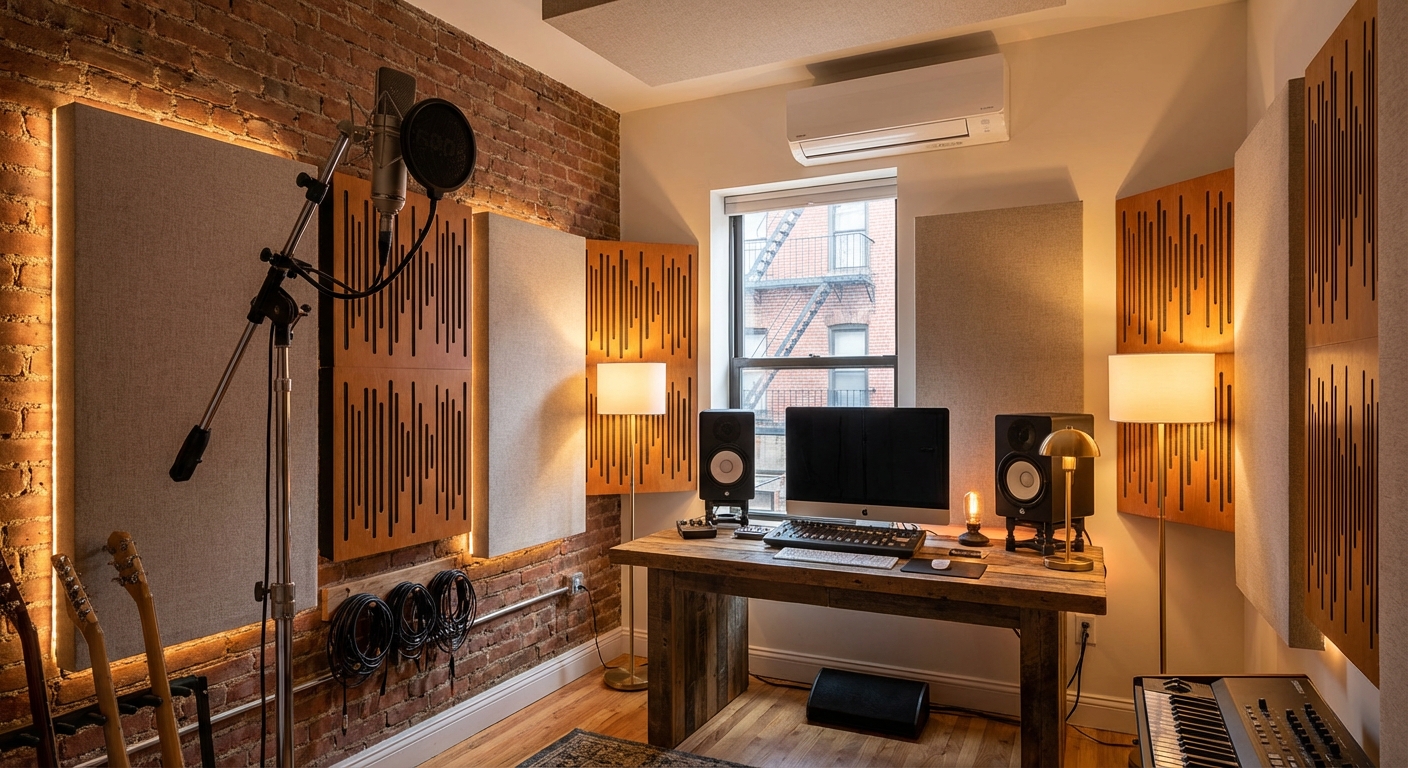
Why Standard Cooling Kills Home Recordings
A quiet mini split for a home studio in NYC solves the problem that every NYC-based producer, podcaster, and voice artist deals with: how to keep the room comfortable without introducing noise into recordings. A window AC unit at full speed produces 50 to 60 dB of broadband noise that no amount of post-production noise reduction can fully remove without degrading the audio. A portable AC is even worse at 52 to 65 dB, with additional low-frequency compressor vibration that travels through the floor.
Most home studio operators in NYC either sweat through recording sessions with the AC off or accept compromised audio quality with it on. A mini split eliminates the tradeoff: at 19 to 22 dB on low speed, the indoor unit produces less noise than the ambient sound floor of a well-treated room in a NYC apartment (typically 25 to 35 dB from building HVAC, plumbing, and street noise transmission).
Best Mini Split Models for Studio Use
| Model | Indoor Noise (Low) | Indoor Noise (High) | Best For |
|---|---|---|---|
| Fujitsu RLS3H Halcyon | 18 dB | 44 dB | Vocal recording, podcasting (quietest available) |
| Mitsubishi MSZ-FH Deluxe | 19 dB | 44 dB | Music production, mixing rooms |
| Daikin Emura FTXS | 19 dB | 43 dB | Podcast studios, streaming rooms |
| Mitsubishi MSZ-GL Standard | 21 dB | 46 dB | Practice rooms, editing suites |
For critical listening and recording environments (vocal booths, mixing rooms, mastering suites), the Fujitsu RLS3H at 18 dB offers the lowest noise floor. For general music production and podcasting, any of the 19 dB models are effectively inaudible against the background noise of a NYC apartment.
Installation Strategies for Minimal Noise Impact
The published dB rating is only part of the equation. How and where the unit is installed determines the actual noise in the room:
- Mount location. Install the indoor unit on the wall opposite the primary microphone position. Sound travels in a straight line; placing the unit behind the mic’s rejection pattern (the null point of a cardioid pattern) minimizes pickup even if the unit is audible in the room.
- Vibration isolation. Use rubber vibration-dampening pads between the mounting bracket and the wall. This prevents compressor vibration from transmitting through the wall structure into the room. The difference between a rigidly mounted and an isolation-mounted unit can be 3 to 5 dB of structure-borne noise.
- Outdoor condenser placement. The outdoor unit produces 54 to 58 dB. If the studio wall faces the condenser, vibration and airborne noise can transmit into the recording space. Place the condenser on a different wall or on a ground pad at maximum distance from the studio room. If placement options are limited, a vibration-dampening condenser pad ($30 to $50) and rubber isolation feet reduce transmission significantly.
- Line set routing. Refrigerant flowing through the line set can produce a faint swooshing sound during compressor speed changes. Routing the line set through a wall cavity rather than surface-mounting it on the studio wall reduces audibility. Insulating the line set with additional acoustic wrap ($20 to $40 in materials) adds another layer of isolation.
Operating the Mini Split During Sessions
For Critical Recording (Vocal Tracking, Acoustic Instruments)
Set the mini split to “Quiet” or “Silent” mode before the session begins. This locks the fan to its lowest speed and limits compressor output. Pre-cool the room to 2 to 3 degrees below your target temperature 30 minutes before recording starts. During the session, the system maintains temperature with minimal cycling at the quietest possible fan speed.
Some producers prefer to turn the system off entirely during vocal takes (a 15 to 30 second silence) and turn it back on between takes. With smart controls, this can be done from a phone without leaving the recording position. The room stays comfortable for 10 to 15 minutes after the system is turned off, more than enough for multiple vocal takes.
For Podcasting and Streaming
Podcasting microphones (dynamic mics like the Shure SM7B or Electro-Voice RE20) have tighter pickup patterns and lower sensitivity than condenser mics, making them less susceptible to picking up a 19 dB mini split. In most cases, the mini split can run continuously on “Quiet” mode during a podcast session with no audible impact on the recording. Test with your specific mic and room before committing to a workflow.
For Music Production and Mixing
During mixing and production (not recording), the mini split can run at any speed since there is no open microphone. The concern shifts to acoustic interference with critical listening. At 19 to 22 dB, the mini split does not interfere with monitoring at normal studio levels (75 to 85 dB SPL). For mastering-level critical listening at lower volumes, switch to “Quiet” mode.
Acoustic Treatment and Mini Split Interaction
If your home studio is acoustically treated (absorption panels, bass traps, diffusers), the treatment also reduces the perceived noise from the mini split. Absorption panels on the wall near the indoor unit attenuate the already-quiet fan noise by another 2 to 4 dB. The combination of a 19 dB mini split and moderate acoustic treatment creates a recording environment where the HVAC is genuinely inaudible on even sensitive condenser microphones.
Costs for Home Studio Installations
A single-zone mini split for a dedicated studio room costs $3,000 to $5,000 installed. If you also want comfort in an adjacent room (control room, lounge, or bedroom), a two-zone system runs $5,500 to $7,500. After Con Edison and NYSERDA rebates ($3,000 to $5,500) and the federal tax credit (up to $2,000), net cost drops to $1,000 to $3,500.
For more on quiet models across all room types, see our quietest mini split guide. For home office installations, see our home office installation guide.
Get a Studio-Specific Assessment
AirSync HVAC installs mini splits in home studios across NYC. We evaluate the room’s acoustic needs, recommend the quietest model for your setup, and plan condenser placement to minimize noise transmission into the recording space. Call (718) 619-4993 or request a quote online. 0% financing from $100/month is available.