Skip to content


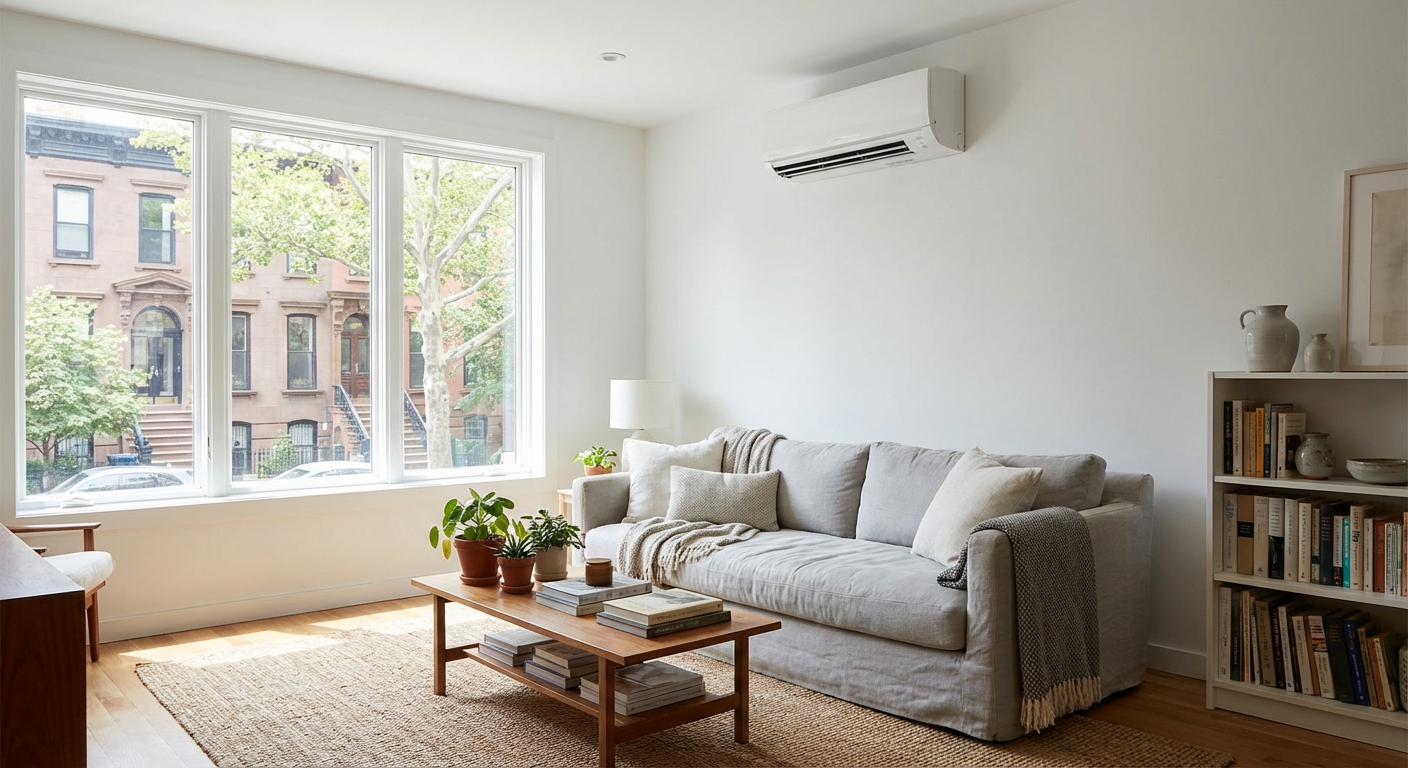
What Whole-Home Mini Split Coverage Looks Like
Replacing window AC with a whole-home mini split in NY means installing one outdoor condenser connected to three, four, or five indoor head units distributed across the house. Each room gets its own zone with independent temperature control, and every unit provides both cooling and heating through a single system. The window units, along with the seasonal hassle of installing and removing them, are eliminated permanently.
A typical New York home between 1,200 and 2,400 square feet needs three to five zones for complete coverage. The outdoor condenser sits on a ground-level pad, a wall bracket, or a rooftop platform depending on the property layout. Refrigerant lines run through small wall penetrations (3 inches in diameter) to each indoor head, with no ductwork required.
Costs for a Complete Window AC Replacement
| Home Size | Zones Needed | Cost Before Rebates | Cost After Rebates |
|---|---|---|---|
| 1-bedroom apt (600-800 sq ft) | 1 to 2 | $3,500 to $6,500 | $1,500 to $3,500 |
| 2-bedroom home (900-1,200 sq ft) | 2 to 3 | $5,500 to $9,000 | $2,500 to $5,000 |
| 3-bedroom home (1,400-1,800 sq ft) | 3 to 4 | $7,500 to $11,000 | $3,500 to $6,500 |
| 4+ bedroom home (2,000+ sq ft) | 4 to 5 | $9,500 to $13,000+ | $4,500 to $8,000 |
The “after rebates” column reflects typical Con Edison Clean Heat ($2,000-$4,500), NYSERDA ($1,000-$3,000), and federal 25C tax credit (up to $2,000) stacking. For detailed rebate information, see our rebate stacking guide.
Room-by-Room Planning
Not every room needs its own dedicated zone. Effective whole-home planning prioritizes the rooms where comfort matters most and where window units were doing the heaviest lifting:
- Living room / main gathering area: Usually the largest zone at 12,000 to 18,000 BTU. This is the room where the family spends the most waking hours and where the temperature difference from window units to mini splits is most noticeable.
- Primary bedroom: A dedicated 9,000 to 12,000 BTU zone with its own thermostat. The ability to set a sleeping temperature (65°F to 68°F) independent of the rest of the house is one of the most appreciated features of zoned systems.
- Second floor / hot rooms: Upper-floor bedrooms that absorb attic heat in summer are the rooms that suffered most with window units. A zone dedicated to the second floor often includes a single 12,000 to 15,000 BTU unit serving a hallway or landing that distributes conditioned air to adjacent rooms.
- Home office or bonus room: Rooms used during specific hours benefit from zoned scheduling: the system runs only when the room is occupied, saving energy compared to cooling the entire house.
What Changes When the Window Units Come Out
Homeowners who make the switch consistently report several immediate quality-of-life improvements beyond temperature control:
- All windows fully functional. Every window opens, closes, and locks completely. No more foam panels, accordion inserts, or gaps that let in dust, insects, and street noise.
- Dramatically quieter. Window units at full speed generate 50 to 60 dB. A mini split at low speed produces 19 to 22 dB. In bedrooms, this difference transforms sleep quality.
- Natural light restored. Window AC units block 30 to 50 percent of the window opening. Removing them brings back light and views that have been blocked for years.
- No seasonal hassle. No spring installation, no fall removal, no storing heavy units in closets, no risk of dropping a unit out the window (a real safety concern in NYC, subject to Local Law 11 inspections).
- Improved security. Window-mounted AC units are a known vulnerability in ground-floor and fire-escape-adjacent apartments. Mini splits keep all entry points sealed.
- Year-round heating. Window ACs only cool. The mini split system also heats, replacing or supplementing whatever heating system was in place.
Energy Savings: Real Numbers
A household running four window AC units (8,000 BTU each) through a NYC summer spends roughly $220 to $320 per month on cooling electricity at Con Edison rates. The same four rooms cooled by a multi-zone mini split system costs $100 to $170 per month, a reduction of $100 to $150 monthly.
Over the May-through-September cooling season, that translates to $500 to $750 in annual cooling savings. Add the heating efficiency gains (the heat pump mode is 2.5 to 4x more efficient than electric baseboard heat), and total annual energy savings reach $1,200 to $2,500 depending on your current heating source. For the full breakdown, see our energy savings guide.
Get a Whole-Home Quote
AirSync HVAC provides free in-home assessments that include a room-by-room zone plan, Manual J load calculation, rebate eligibility check, and itemized pricing for a complete window AC replacement. Call (718) 619-4993 or request a quote online. 0% financing from $100/month is available so you can make the switch now and start saving immediately.