Skip to content

What Happens to Your Oil Tank During an Oil Tank Removal Heat Pump Conversion NYC Project?
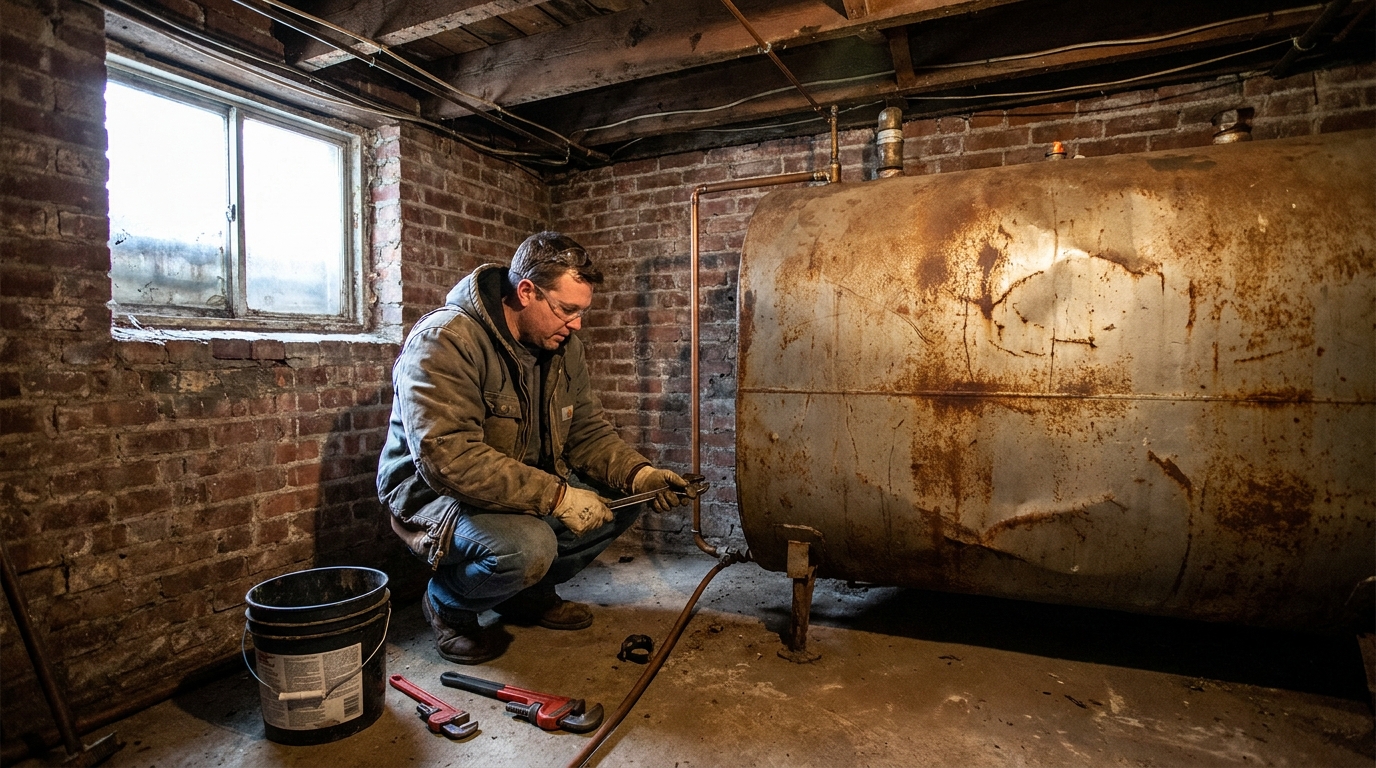
When you switch from oil heat to a heat pump in a New York City brownstone or townhouse, you have two legal options for the basement oil tank: physically remove it, or decommission it in place. For most owners, full removal is the right answer. This guide explains the NYC-specific rules, real cost ranges, the paperwork trail that protects you at resale, and how the tank work fits into your broader oil-to-heat-pump conversion in a NYC brownstone.
Do You Have to Remove the Tank If You Switch to a Heat Pump?
Not automatically, but NYC code and NYS fire code create hard deadlines once the tank stops being used. Under NYS Fire Code, a tank left unused for 90 or more days must be emptied, have its piping capped and plugged, and have its vents maintained. A tank unused for roughly 12 months must be disabled in place or fully removed and closed to NYSDEC standards, which typically includes draining, cleaning, and soil testing. If you plan to keep oil as a backup and run the burner even occasionally, the clock does not start, but the moment you decommission the burner as part of a full heat-pump conversion, the 90-day rule applies immediately.
NYSDEC generally does not regulate home heating-oil tanks under its Petroleum Bulk Storage program if the tank is under 1,100 gallons. However, NYC DOB and FDNY still require permits and inspections for a standard 275-gallon basement tank. That means there is no regulatory shortcut just because your tank is below the DEC threshold.
Remove vs. Abandon In Place: Which Is Right for Your NYC Brownstone?
NYSDEC strongly encourages removal over abandonment. If oil contamination is found in the soil, abandonment is not an option, cleanup and remediation are required before any in-place closure is allowed. New York soil-remediation costs are among the highest in the nation due to strict cleanup standards and high disposal costs, so discovering contamination late is far more expensive than testing early.
For brownstone and townhouse owners with a standard above-ground 275-gallon basement tank, physical removal is almost always cheaper long-term. Banks and buyers routinely require an environmental assessment or evidence of tank removal at closing. A tank that was abandoned in place years ago can become a renegotiation point, or a deal-killer, when you sell.
| Factor | Remove the Tank | Abandon In Place |
|---|---|---|
| Upfront cost (above-ground, NYC) | $800–$1,500+ | Lower initially |
| Soil testing required? | Yes, at closure | Yes, and ongoing if contamination found |
| NYSDEC stance | Strongly preferred | Discouraged; prohibited if contamination present |
| Impact on future sale | Clean disclosure, no buyer concern | Common renegotiation trigger |
| Long-term liability | Low once removed and documented | Ongoing; contamination risk persists |
| Allowed for underground tanks with contamination? | Yes (after remediation) | No |
What Does Oil Tank Removal Cost in NYC?
NYC sits at the high end of New York State pricing for all phases of this work. Above-ground tank removal, which covers the most common 275-gallon basement setup in a brownstone, runs roughly $600–$1,500 statewide, with NYC on the higher end of that range. Underground removal starts from around $1,500 and can climb significantly depending on depth and access. A tank sweep or GPR scan to confirm there is no buried tank costs $300–$500 for most New York properties, and NYC lots with multiple buildings can cost more.
The single biggest cost driver specific to NYC brownstones and townhouses is physical access. Narrow staircases and limited basement egress make cutting and removing a tank harder and slower than in a suburban setting, and that extra labor shows up in the quote.
| Service | NY Statewide Range | NYC Typical Range |
|---|---|---|
| Above-ground tank removal (275 gal, basement) | $600–$1,500 | $900–$1,500+ |
| Underground tank removal | $1,500–$4,000+ | $2,500–$5,000+ |
| Tank sweep / GPR scan | $250–$500 | $300–$500+ |
| Soil testing (basic) | $200–$600 | $300–$700 |
| FDNY permit | N/A | $200–$600 |
| Soil remediation (if contamination found) | Varies widely | Among highest in US |
Who Files the Paperwork in NYC, FDNY, DOB, and DEC?
NYC has its own permitting layer on top of state requirements. The Fire Department of New York is the primary permitting authority for all oil-tank work. All oil-tank work, installation, removal, or modification, requires an FDNY permit. The contractor must hold an FDNY oil burner installer license; unlicensed contractors cannot legally perform this work in the five boroughs. FDNY permit costs run $200–$600 depending on scope and building type, and processing typically takes two to four weeks, one of the longest permit timelines in the region, so plan accordingly.
If excavation extends into the public right-of-way or requires structural work, NYC DOB permits are also needed. In practice, a reputable removal contractor handles both the FDNY affidavit and DOB notification, but you should confirm this in writing before signing any contract. The homeowner’s job is to keep copies of every document: the FDNY closure permit, the contractor’s affidavit, the soil-test results, and any DEC correspondence. These records are what a title company, bank, or buyer will ask for at closing.
NYSDEC only steps in directly if contamination is found or if the tank meets registration thresholds (combined capacity of 1,100 gallons or more aboveground, or 110 gallons or more underground). For a single 275-gallon basement tank, DEC involvement is limited unless a spill is discovered during removal, at which point a formal DEC spill case opens and remediation becomes mandatory.
What Is the Tightness-Test Risk and Why Does It Matter Before You Commit?
A tightness test checks whether the tank and connected piping hold pressure without leaking. A failed test on an old tank or supply line can trigger a NYS DEC spill case, an expensive and time-consuming process that has caught NYC co-op and townhouse owners off guard. Getting a tightness check before you finalize the conversion budget is the most cost-effective risk-management step available. If the test passes, you have documentation that the system was intact when decommissioned. If it fails, you know before the heat pump contractor mobilizes, and you can price remediation into the overall project rather than discovering it mid-job.
How Does Tank Decommissioning Fit Into the Heat Pump Conversion Timeline?
The oil tank work should happen before the heat pump installation is complete, not after. Here is a practical sequence for a NYC brownstone:
- Step 1, Heat load assessment and heat pump design: Size the system and confirm electrical service. See our guide on electrical panel upgrades for heat pump installations in NYC if your service is under 200A.
- Step 2, Pre-removal tightness test and tank sweep: Identify contamination risk before committing to a timeline.
- Step 3, Apply for FDNY permit: Allow two to four weeks for processing. Coordinate with the HVAC contractor so both scopes are ready to move together.
- Step 4, Pump out remaining oil: Any residual fuel oil is pumped and disposed of at a certified facility. Some oil dealers will credit the balance against a final delivery.
- Step 5, Physical removal and soil test: The tank is disconnected, cut down if necessary for egress, removed, and the contractor takes soil samples at the tank footprint.
- Step 6, FDNY affidavit and DOB filing: The contractor submits the signed affidavit to FDNY and notifies DOB. You receive copies for your files.
- Step 7, Heat pump installation and Con Edison incentive application: With the old system fully decommissioned, you qualify for full-electrification incentive tiers.
Do Con Edison Rebates Cover Any Part of the Tank Removal?
The Con Edison Clean Heat program does not pay for tank removal directly. However, decommissioning the oil system and going fully electric unlocks the top incentive tier for air-source heat pumps, up to $10,000 for single-family and small multifamily homes in the Con Edison service territory. Partial-load systems (where oil is kept as backup) are subject to case-by-case review and may qualify for a lower tier. Doing the tank work as part of the conversion, rather than keeping oil on standby, is what gets you to the maximum rebate. Review the full program details in our breakdown of EmPower+ vs. Con Edison Clean Heat rebates for NYC homeowners to understand which program fits your income and building type.
Common Mistakes to Avoid
- Hiring an unlicensed contractor. In NYC, only contractors with an FDNY oil burner installer license may legally decommission a tank. Using an unlicensed crew can void insurance, result in fines, and create title problems.
- Skipping the tightness test. Discovering a leak during removal rather than before it means a DEC spill case opens mid-project, with no budget set aside for cleanup.
- Choosing abandon-in-place to save money upfront. Banks and buyers consistently flag in-place tanks at closing. The short-term savings rarely offset the long-term negotiating loss.
- Not getting the FDNY permit timeline into the project schedule. A two-to-four week permit window can delay the heat pump installation if it is not planned in advance.
- Failing to keep documentation. The FDNY affidavit, soil test results, and closure permit are what you present at resale. Lost paperwork means re-testing at your expense, years later.
- Assuming DEC registration thresholds exempt you from all oversight. A 275-gallon tank is below DEC’s PBS threshold, but FDNY and DOB requirements still fully apply in NYC.
Frequently Asked Questions
Can I keep my oil tank as a backup and still get Con Edison heat pump rebates?
Possibly, but at a lower incentive tier. Con Edison Clean Heat pays the highest rebates, up to $10,000, for full-load heating systems where the heat pump serves as the primary and sole heat source. Systems designed with oil backup are reviewed on a case-by-case basis and may qualify for partial-load rates. For most single-family brownstone owners, the rebate difference makes full decommissioning the better financial decision.
Who handles the FDNY permit, me or my contractor?
Your licensed tank removal contractor handles the FDNY permit application and submits the post-removal affidavit. The contractor must hold an FDNY oil burner installer license to do this work legally. You should request copies of all filings and the final FDNY closure letter for your own records before the contractor leaves the job.
How long does oil tank removal take in a NYC brownstone?
The physical removal typically takes one day for a standard above-ground 275-gallon basement tank. The FDNY permit processing takes two to four weeks and is the main scheduling constraint. Plan for the permit lead time, not the removal day itself, when setting your heat pump installation target date.
What happens if contaminated soil is found under my tank?
If soil samples come back positive for petroleum contamination, a NYSDEC spill case opens. Remediation is required before the site can be closed, and abandonment in place becomes prohibited. New York soil-remediation costs are among the highest in the nation. This is why a pre-removal tightness test and soil sweep are worth the $300–$700 investment before committing to a project timeline or budget.
Does oil tank removal affect my LPC or landmark approvals for the heat pump?
Oil tank decommissioning is interior basement work and does not require Landmarks Preservation Commission review. However, the heat pump condenser placement on a landmarked brownstone exterior does. See our guide to mini-splits in NYC landmark and historic districts for the LPC approval process so both scopes are coordinated from the start.