

Does a NYC ADU Need Its Own Heating and Cooling System?
Yes, but with a specific nuance: mini split ADU NYC installs are popular precisely because the code does not require a fully separate utility service from the street. What Appendix U Section U103.5 of the NYC Building Code, added by Local Law 127 of 2024, actually demands is that every ADU have separate controls, disconnects, and shutoffs for heating, cooling, electrical, and gas systems. A ductless mini-split heat pump satisfies that requirement with its own dedicated thermostat, its own disconnect, and zero shared air pathways with the main dwelling.
Both Local Laws 126 and 127 became effective June 16, 2025, and DOB began accepting most ADU applications in DOB NOW: Build on September 30, 2025. If you are designing your HVAC scope now, the Appendix U separate-controls rule is the first code driver you need to understand before you choose any equipment.
What Does Appendix U Section U103.5 Actually Require for HVAC?
The code text is precise. Under BC Section U103.5.1, a primary dwelling and an ADU must each have return air openings that are not taken from the other dwelling unit, and separate climate controls. That is it, two hard requirements. No shared air handlers, no shared thermostats.
A conventional forced-air extension of the main home’s central system fails on both counts: the supply trunk and return plenum cross unit boundaries. A ductless mini-split passes both counts by design: the indoor head has its own air path, its own refrigerant circuit, and its own remote or wall control. The DOB FAQ states plainly that ADUs must have separate controls, disconnects, and shutoffs for heating, cooling, electrical, and gas systems, while water supply can be shared with separate shutoffs. A mini-split install also avoids adding gas piping to the ADU entirely, which eliminates the separate gas shutoff requirement for HVAC equipment and reduces the overall permit complexity.
Which of the Five NYC ADU Types Are You Building?
Appendix U recognizes five ADU placements, one per tax lot. The right mini-split configuration differs by type. The table below maps each type to the appropriate system and indoor head style.
| ADU Type (Appendix U Section) | Typical Size / Story | Sprinkler Required? | Recommended Mini-Split Config | Best Indoor Head Style |
|---|---|---|---|---|
| Above-grade in 1-family (U201), incl. attic or enlargement | Studio to 1BR, one floor | Attic: yes; other above-grade: no | Single-zone, 9,000–18,000 BTU | Wall-mount; ceiling cassette for open-plan |
| Basement or cellar (U202) | Studio to 1BR, sub-grade | Yes, all subgrade ADUs | Single-zone, 9,000–18,000 BTU | Floor-mount or low-wall (avoids ceiling height constraints) |
| Fire-wall-separated in 2-family (U203) | Studio to 2BR | Yes, if subgrade | Single- or 2-zone, up to 24,000 BTU | Wall-mount per room; ceiling cassette open-plan |
| Detached backyard cottage (U204) | Up to 800 sq ft, 1 story / ~15 ft | Yes | Single- or 2-zone, 12,000–24,000 BTU | Wall-mount per room |
| Manufactured home ADU | Varies | Per manufacturer specs | Single-zone wall-mount | Wall-mount |
Basement and cellar ADUs are prohibited in DEP 10-year rainfall flood risk areas, coastal flood risk areas, and FEMA Special Flood Hazard Areas, a location check that can push your project toward an above-grade or detached type before you ever select equipment. If your lot is in a flood zone, read our guide on mini split condenser placement in a NYC flood zone before finalizing the system design.
For basement ADUs specifically, note that all subgrade ADUs must be sprinklered, must meet radon and vapor mitigation standards, and must have a 1-hour fire separation from the primary dwelling, with the boiler enclosed behind a 1-hour fire barrier. A ductless system eliminates the ductwork coordination problem that would otherwise arise from running supply and return penetrations through that fire-rated assembly.
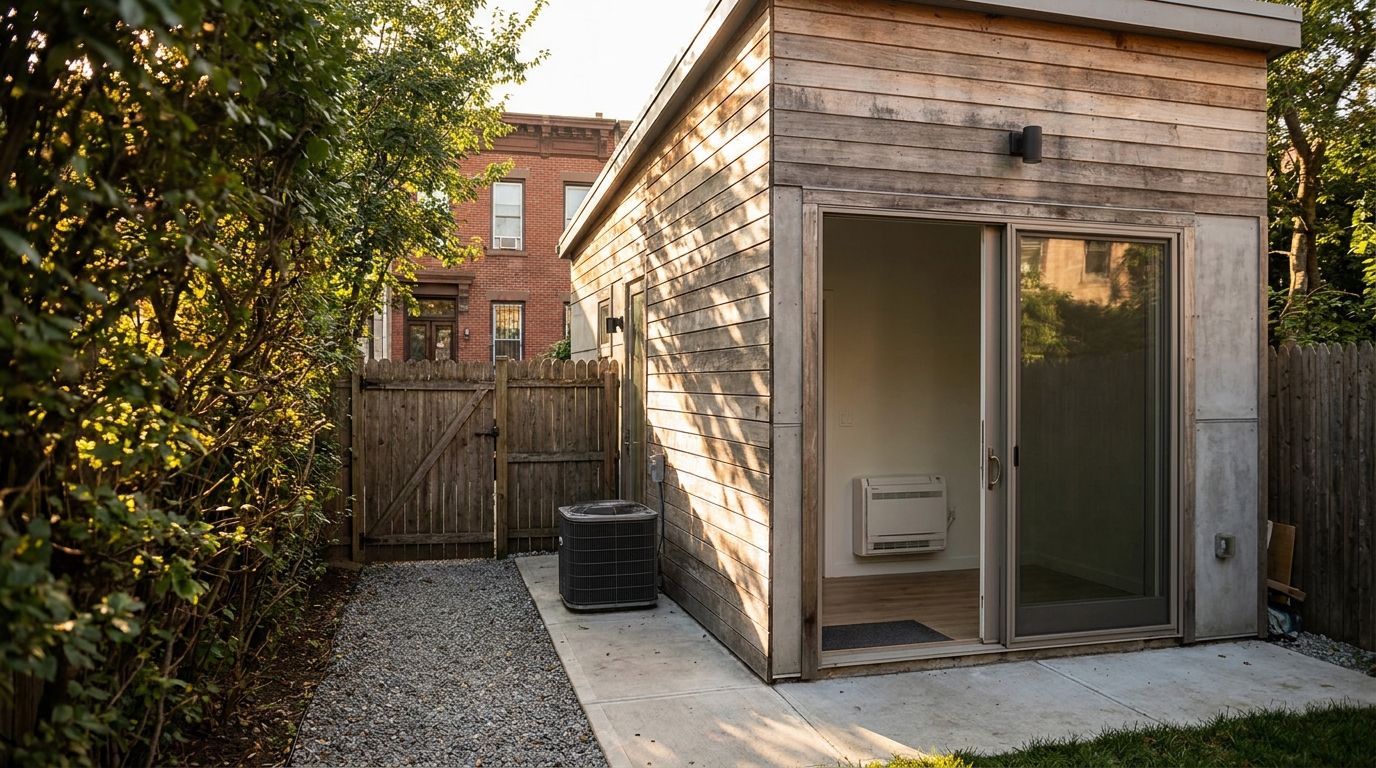
Where Can the Condenser Go in a Detached Backyard ADU?
The detached backyard ADU, the Brooklyn or Queens homeowner’s backyard cottage, creates the most complex condenser-placement picture. Multiple rules layer on top of each other:
- Setbacks: The structure itself must be at least 10 feet from the main residence and 5 feet from property lines. The condenser cannot be placed so that it violates those setbacks or obstructs the required 5-foot-wide clear street access path along the side of the lot.
- Noise limit: NYC DEP enforces a 42 dBA limit measured at the property line. A condenser placed flush against the rear fence in a tight Queens backyard can exceed that threshold at the neighbor’s property line. Select a low-sound-rated unit and plan for at least 3–4 feet of clearance from any fence or wall on the neighbor’s side.
- Line-set routing: For a detached ADU, the refrigerant line set must travel from the indoor head to a condenser on the ADU’s exterior, not on the main house or across the party wall. Keep the line set on the ADU lot, routed through or along the ADU structure, so there is no question of party-wall or easement issues. See our related post on mini split party wall routing in NYC rowhouses for the boundary principles that apply to shared lot lines.
- Backyard ADU zoning: Backyard ADUs are not permitted in historic districts, R1-2A, R2A, and R3A districts outside the Greater Transit Zone, or the Special Bay Ridge District west of Ridge Boulevard or south of Marine Avenue. Confirm zoning eligibility before any HVAC design work.
A rear-yard ADU is capped at 800 square feet and no more than 1 story or approximately 15 feet in height. At that size, a single-zone 12,000–18,000 BTU cold-climate heat pump is correctly sized for most studio-to-one-bedroom layouts. A 2-zone system reaching 24,000 BTU covers a two-room configuration without crossing the DOB permit threshold.
When Does a Mini Split in an ADU Require a DOB Permit?
In NYC, a mini-split install requires a DOB permit when the system exceeds 3 tons (36,000 BTU/hr). Nearly every correctly sized ADU system, single-zone 9,000 to 18,000 BTU, or a 2-zone system at 24,000 BTU, falls below that threshold on the mechanical side. However, the ADU project itself is always a filed job. HVAC work is included in the stamped plan set prepared by the Registered Design Professional (licensed architect or engineer) who files the ADU application. The HVAC scope is documented in that RDP-stamped set even if it does not independently trigger a separate Mechanical Systems (MS) work type filing.
ADU applications are filed in DOB NOW: Build as either an Alt-CO-GC job (ADU within the same building) or a New Building-GC job (detached or fire-wall-separated ADU). The Certificate of Occupancy must note the ADU per ZR 12-10 and BC Appendix U. A licensed HVAC contractor with a Home Improvement Contractor (HIC) license must perform the install. Attempting this as a DIY project voids equipment warranties, invalidates any DOB filing, and eliminates insurance coverage, the full rundown is covered in our post on why DIY mini split installs fail in NYC.
Why a Cold-Climate Mini-Split Heat Pump, Not a Gas Furnace or PTAC?
A cold-climate mini-split heat pump handles both heating and cooling from a single system, operating as the ADU’s only year-round HVAC source without a gas furnace or a second Con Edison gas service. Modern cold-climate units maintain full rated heating output down to roughly 5°F and can produce some heat down to approximately -13°F, more than adequate for NYC winters in all five boroughs. That performance eliminates the second gas meter and second gas service entirely, which simplifies the utility separation requirement: there is no gas piping to the ADU HVAC equipment, so only a dedicated electrical circuit and disconnect are needed for the system.
Comparing the realistic options for a NYC ADU:
| System Type | Satisfies Separate-Controls Rule? | Requires New Gas Service? | Ductwork Through Fire-Rated Assembly? | Qualifies for Con Edison / NYSERDA Rebates? | Right for ADU? |
|---|---|---|---|---|---|
| Cold-climate mini-split heat pump (ductless) | Yes, own thermostat, own disconnect | No | No | Yes | Best fit |
| Extension of main home’s forced-air system | No, shared air handler and return | Possible | Yes, penetrates fire separation | No | Code violation |
| Electric baseboard + window AC | Yes, separate controls | No | No | No, not a heat pump | Poor efficiency; no rebates |
| Gas furnace + separate AC | Yes, if fully separate | Yes, second meter likely | Yes, ducts through walls | No | High cost; complex permitting |
| PTAC unit | Yes, self-contained | No | No | No, not a heat pump | Sleeve required; limited heating |
What Rebates Apply to a Mini Split ADU NYC Install?
An ADU mini-split install on a qualifying one- or two-family home can access the same rebate stack as any other residential heat pump project in NYC. The federal IRA Section 25C tax credit expired on December 31, 2025 and is not available for 2026 installations. The state and utility programs, however, remain active.
- Con Edison Clean Heat: Up to $8,000 for a single-family home in a non-Disadvantaged Community (DAC), rising to $10,000 in a DAC-designated area, under the Category 2b full-load-plus-decommissioning tier. Income-qualified households can combine Con Edison rebates with NYSERDA EmPower+ funding.
- NYSERDA EmPower+: Income-qualified households at or below 80% AMI can receive up to $8,000 toward a heat pump through the HEAR component of EmPower+. Households at 80–150% AMI qualify for 50% coverage up to program caps.
- NYS Clean Heat base layer: Most NYC homeowners qualify for the statewide NYS Clean Heat program regardless of income, with amounts set by Con Edison for properties in its service territory.
Because the ADU is on an owner-occupied lot (the zoning lot must be the primary residence of an owner at initial ADU occupancy), the homeowner typically qualifies as the applicant for these programs. A Con Edison Clean Heat participating contractor submits the rebate application on the homeowner’s behalf. Switching to the right Con Edison rate plan for a heat pump install can also reduce ongoing operating costs, see our breakdown of the Con Edison heat pump rate plan options in NYC.
What About the DOB Pre-Approved Plans Library for Backyard ADUs?
Starting with the September 2025 DOB service notice, NYC’s Office of Technical Certification and Research (OTCR) began accepting submissions from Registered Design Professionals seeking to place generic backyard ADU designs into a Pre-Approved Plans library. When a pre-approved plan is used for a site-specific project, site-specific elements are assessed to determine whether a new filing is necessary. For homeowners, this means RDPs may eventually be able to offer lower-cost plan sets for standard detached ADU configurations, with HVAC scope already included and stamped. If your project proceeds under a pre-approved plan, confirm with your RDP exactly which mechanical scope is covered and whether the mini-split specification needs to be documented as a post-approval amendment.
Common Mistakes to Avoid
- Extending the main home’s forced-air system into the ADU. This violates U103.5.1 because the ADU’s return air is taken from the primary dwelling’s air handler. DOB will flag it; the CO will not issue.
- Placing the condenser so it blocks the required 5-foot side-yard access path. For a detached backyard ADU, an unobstructed street-access path is a fire code requirement. A condenser in that path fails the inspection.
- Installing a basement/cellar ADU in a DEP flood-risk area. Subgrade ADUs are prohibited in DEP 10-year rainfall and coastal flood-risk areas and FEMA Special Flood Hazard Areas. Check the DEP interim flood risk area map before designing anything subgrade.
- Using a non-heat-pump system and missing the rebate stack. Electric baseboard and PTACs do not qualify for Con Edison Clean Heat or NYSERDA EmPower+ rebates. A cold-climate mini-split heat pump does.
- Oversizing the system past the permit threshold. An ADU up to 800 sq ft almost never needs more than 18,000–24,000 BTU. Specifying a 36,000 BTU or larger system triggers a separate DOB mechanical permit and inspection requirements that a correctly sized unit avoids.
- DIY installation. An ADU is a filed job with a stamped plan set. Any HVAC work not performed by a licensed contractor invalidates the DOB filing, voids the equipment warranty, and can block issuance of the Certificate of Occupancy.
- Ignoring the 42 dBA DEP noise limit for the condenser. In a tight backyard shared with Brooklyn or Queens neighbors, condenser placement matters. Low-sound-rated units and adequate clearance from property lines are not optional courtesies, they are a DEP enforcement issue.
Frequently Asked Questions
Does a NYC ADU need completely separate utility meters?
No. Appendix U Section U103.5 does not require separate service lines from the street. What it requires is separate controls, disconnects, and shutoffs for heating, cooling, electrical, and gas systems. Water supply can be shared but must have separate shutoffs. A mini-split heat pump satisfies the HVAC portion with its own thermostat and dedicated electrical disconnect, without a second Con Edison electric meter being legally required by the ADU code itself (though metering may be required for billing between owner and tenant under other provisions).
Can I use a mini split in a basement ADU in NYC?
Yes, provided the basement or cellar is not located in a DEP 10-year rainfall flood risk area, coastal flood risk area, or FEMA Special Flood Hazard Area, subgrade ADUs are prohibited in those zones. In eligible locations, all subgrade ADUs must be sprinklered, meet radon and vapor mitigation standards, and have a 1-hour fire separation from the primary dwelling. A ductless mini-split is well suited to basements precisely because it requires no ductwork penetrations through those fire-rated assemblies. A floor-mount indoor head is often the best choice where ceiling height is constrained. For more on the ATR and code requirements for basement apartment legalization, see our post on central heating for basement apartment legalization in NYC.
What size mini split do I need for an NYC ADU?
A studio or one-bedroom ADU up to roughly 500 square feet typically needs 9,000–12,000 BTU. A larger one-bedroom or two-room layout up to 800 square feet generally requires 15,000–18,000 BTU, or a 2-zone system with two smaller heads if the rooms are separated. Staying below 36,000 BTU (3 tons) keeps the mechanical scope under the NYC DOB permit threshold for HVAC equipment alone, though the ADU project itself is always a filed job regardless of system size.
Does a detached backyard ADU condenser have setback restrictions?
Yes. The ADU structure must be at least 10 feet from the main residence and 5 feet from property lines. A required minimum 5-foot-wide clear street access path along the side of the lot cannot be obstructed by the condenser or any other structure. The condenser must also comply with the DEP 42 dBA noise limit measured at the property line. Plan condenser placement as part of the site plan the RDP submits in DOB NOW, not as an afterthought after construction.
What rebates are available for a mini split ADU NYC install in 2026?
The federal IRA Section 25C tax credit expired December 31, 2025 and is not available for 2026 installations. Active programs include Con Edison Clean Heat (up to $8,000 for a non-DAC single-family home, up to $10,000 in a Disadvantaged Community under the full-load-plus-decommissioning tier) and NYSERDA EmPower+ for income-qualified households (up to $8,000 for households at or below 80% AMI through the HEAR component). The NYS Clean Heat base layer is also available to most homeowners regardless of income, with amounts set by Con Edison for NYC-territory properties. A participating Clean Heat contractor submits the rebate application on the homeowner’s behalf.