Skip to content


The Short Answer: It Depends on Your Starting Point
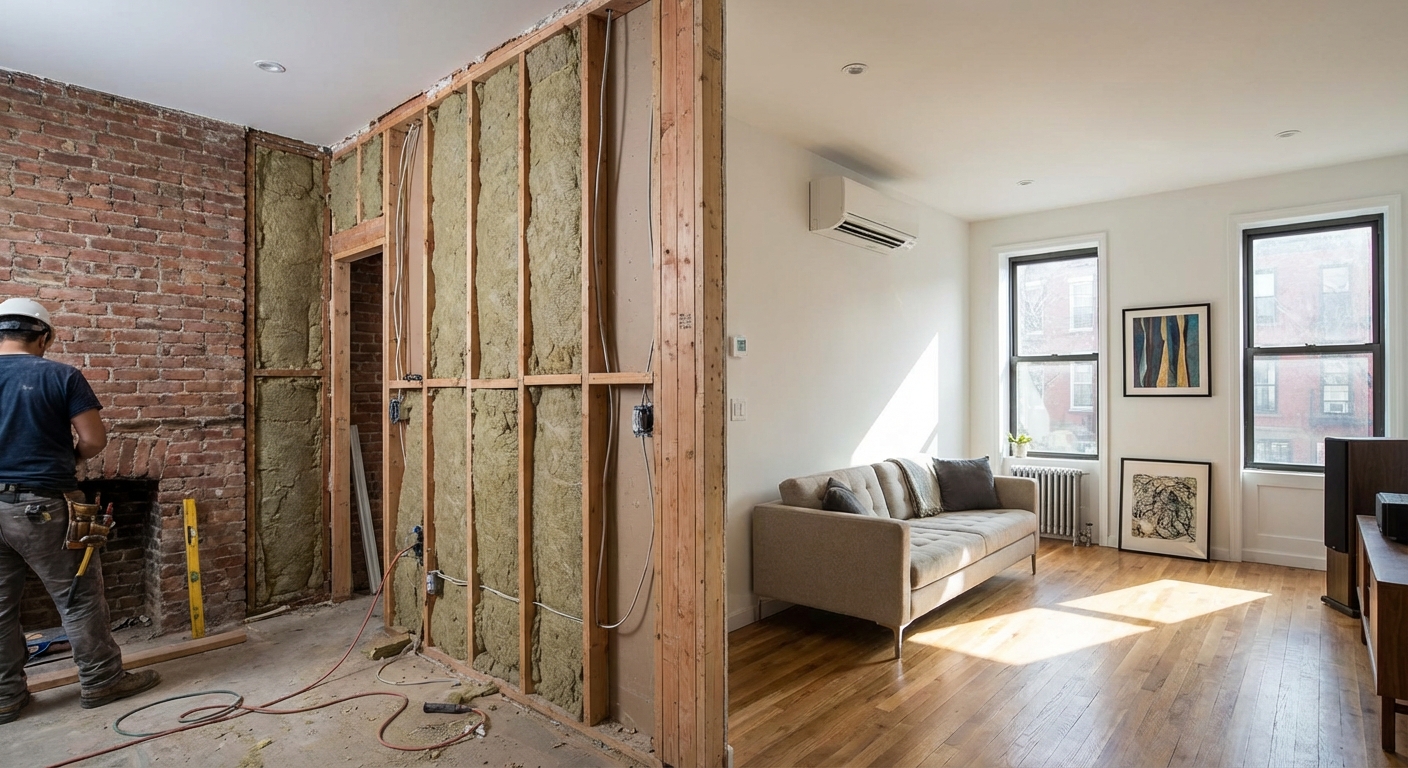
Whether insulation or a mini split comes first in your NYC home upgrade depends on two things: how poor your current insulation is, and how urgent your comfort problem is. If your home has no wall insulation and minimal attic insulation (common in pre-1970 NYC construction), insulation delivers the bigger bang per dollar. If you have some insulation but your heating/cooling system is failing or your window units are driving you crazy, the mini split provides immediate relief.
The ideal approach is to do both simultaneously. But when budget or timing forces a choice, here is the decision framework.
When to Prioritize Insulation First
Start with insulation if any of these apply:
- Your walls have zero insulation. Pre-1960 homes in NYC frequently have empty wall cavities. Adding dense-pack cellulose to bare walls reduces heating energy use by 25 to 35 percent, which is a larger immediate savings than switching heating systems.
- Your attic has less than R-19. The minimum recommended attic insulation for NYC’s climate zone is R-49. An attic with R-11 or less (3 to 4 inches of old fiberglass) loses enormous amounts of heat in winter and gains significant heat in summer. Bringing the attic to R-49 costs $1,000 to $2,500 and is the single highest-ROI energy improvement in most NYC homes.
- You plan to keep your current heating system for 3 to 5 more years. If the boiler or furnace is relatively new and functioning, insulating the building envelope reduces its workload and your energy bills without replacing equipment.
- Your home is very drafty. If you feel cold air flowing around windows, outlets, and baseboards in winter, air sealing ($500 to $1,500) combined with insulation ($1,500 to $4,000) addresses the root cause before adding new equipment.
When to Prioritize the Mini Split First
Start with the mini split if any of these apply:
- You have no air conditioning or only window units. The mini split provides both heating and cooling. If summer comfort is the driving motivation, the mini split delivers immediate improvement that insulation alone cannot.
- Your heating system is failing or expensive to repair. A boiler that needs $2,000+ in repairs is better replaced with a mini split heat pump system than patched. The mini split costs roughly the same or less than a new boiler after rebates, and it adds cooling capability.
- Specific rooms are the problem, not the whole house. If the top floor is unbearable in summer but the rest of the house is fine, a single-zone mini split ($3,000 to $5,000) solves the problem faster and cheaper than whole-house insulation.
- You want to take advantage of current rebates. Con Edison Clean Heat and NYSERDA rebates for heat pump installations are well-funded in 2026 but program budgets do change. Locking in $5,000 to $9,500 in incentives now and adding insulation later is a valid strategy.
The Combined Approach: Best Results
When budget allows, doing insulation and mini splits together produces compounding benefits:
| Approach | Estimated Cost (Before Rebates) | Annual Energy Savings | Net Cost After Rebates |
|---|---|---|---|
| Insulation only (attic + air sealing) | $2,000 to $4,000 | $400 to $800/year | $500 to $2,500 |
| Mini split only (3 zones) | $7,500 to $10,000 | $1,000 to $1,800/year | $2,500 to $5,000 |
| Both together | $9,500 to $14,000 | $1,800 to $2,800/year | $2,000 to $5,500 |
The combined savings exceed the sum of individual savings because the insulation reduces the mini split’s workload, allowing it to run at lower output and higher efficiency. The system reaches its setpoint faster, cycles less frequently, and uses less electricity per cooling or heating hour.
Rebates also stack: Con Edison Weather Ready covers insulation ($1,500 to $4,000), and Clean Heat covers the mini split ($2,000 to $4,500), plus NYSERDA ($1,000 to $3,000) and the federal tax credit (up to $2,000). Total combined rebates on a $12,000 project can reach $8,500 to $11,000. See our rebate stacking guide for the full process.
How to Evaluate Your Home’s Current Insulation
You do not need special equipment to get a rough assessment:
- Check the attic. If you can see the attic floor joists above the existing insulation, you have less than R-19 (about 6 inches). If insulation covers the joists completely, you likely have R-30 or more.
- Feel the exterior walls. On a cold winter day, place your hand on an interior wall that faces outside. If it feels noticeably cold, the wall is poorly insulated. Interior walls (between rooms) should feel close to room temperature for comparison.
- Check around outlets on exterior walls. Remove a cover plate on an outlet mounted in an exterior wall (with the breaker off). Look inside the box for insulation. If you see empty space and the back of the exterior siding or masonry, the wall cavity is uninsulated.
- Get an energy audit. A professional energy audit ($200 to $500, sometimes subsidized by utility programs) uses a blower door test and thermal imaging to identify exactly where heat is escaping. This is the most accurate way to prioritize upgrades.
Get a Combined Assessment
AirSync HVAC evaluates insulation levels alongside HVAC needs during every free site assessment. We recommend the right sequence of upgrades based on your home’s specific conditions, budget, and goals. Call (718) 619-4993 or request a quote online. 0% financing covers both insulation and mini split work in a single plan.