Skip to content


Recommended Temperature Settings by Room and Time
The best mini split temperature settings for NYC summers depend on the room’s purpose and when it is occupied. The advantage of a zoned mini split system is that each room can run at a different temperature on its own schedule, rather than forcing a single thermostat setting on the whole house.
| Room / Zone | Daytime Setting | Nighttime / Sleep | Unoccupied |
|---|---|---|---|
| Living room | 73°F to 76°F | Off or 78°F | Off or 80°F |
| Primary bedroom | Off or 76°F | 67°F to 70°F | Off |
| Home office | 72°F to 74°F | Off | Off |
| Kitchen | 74°F to 76°F | Off | Off |
| Kids’ bedrooms | 74°F to 76°F | 68°F to 72°F | Off |
These ranges assume a typical NYC apartment or home. Adjust by 1 to 2 degrees based on personal preference, sun exposure, and floor level. Upper-floor rooms facing south or west may need settings 1 to 2 degrees lower to feel the same as a north-facing ground-floor room.
Why 72°F to 76°F Hits the Sweet Spot
The Department of Energy recommends setting cooling systems to 78°F when home and 85°F when away. In practice, most NYC residents find 78°F uncomfortable during July and August when outdoor humidity pushes indoor humidity above 60 percent even with the system running. The mini split’s dehumidification capability changes the equation: at 73°F to 76°F with the moisture removed, the room feels 2 to 3 degrees cooler than the thermostat reads.
Setting the system to “Dry” mode on particularly humid days (above 80% outdoor relative humidity) reduces indoor humidity without overcooling the room. This is especially effective in garden-level and ground-floor NYC apartments that tend to trap moisture.
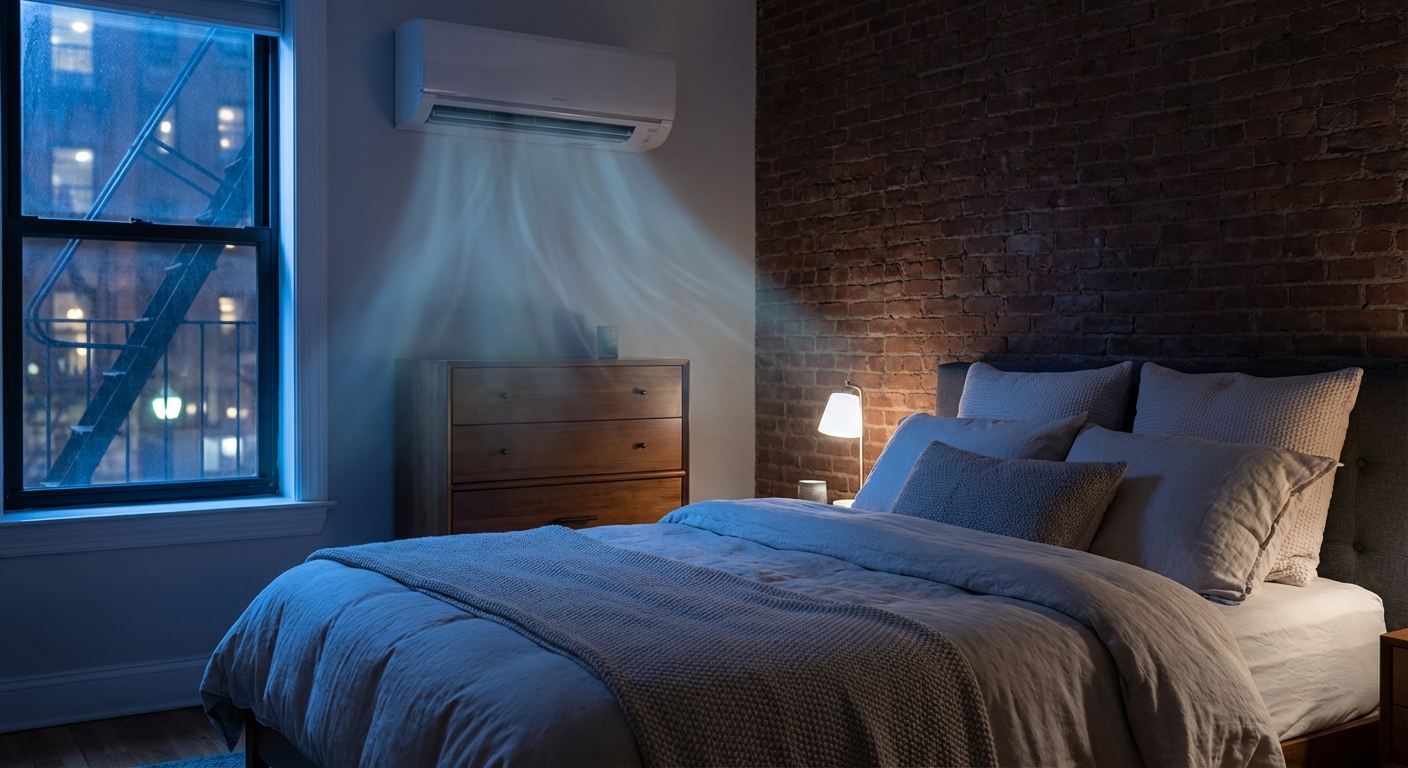
Sleep Settings: The Case for 67°F to 70°F
Sleep research consistently shows that the optimal bedroom temperature for adults is 65°F to 68°F. Most NYC residents find 67°F to 70°F the practical sweet spot during summer, accounting for the difference between central sleep studies (minimal bedding in controlled environments) and real-world conditions (a sheet or light blanket in a NYC apartment).
The mini split’s timer function or smart scheduling makes this effortless. Set the bedroom zone to begin cooling at 9:30 PM, hold 68°F through the night, and shut off or raise to 76°F at 7 AM. The other zones can be off or at higher setpoints during sleep hours, saving significant energy overnight.
How Settings Affect Your Con Edison Bill
Every degree of cooling below 78°F increases energy consumption by approximately 3 to 4 percent. The cumulative effect is significant over a NYC cooling season:
| Thermostat Setting | Estimated Monthly Cooling Cost (per zone) | % Increase vs. 78°F |
|---|---|---|
| 78°F | $25 to $35 | Baseline |
| 76°F | $28 to $40 | +8% |
| 74°F | $32 to $46 | +16% |
| 72°F | $36 to $52 | +25% |
| 70°F | $42 to $60 | +35% |
The key insight: running four zones at 74°F only during occupied hours costs less than running one central system at 72°F all day. Zoning saves money not by making each room more efficient but by eliminating waste in rooms that are empty. Use smart scheduling or timers aggressively to turn off unoccupied zones.
Optimizing for NYC’s Hottest Days
NYC heat waves (sustained temperatures above 95°F with high humidity) test any cooling system. On these days:
- Pre-cool in the morning. Set the system to 72°F from 7 to 10 AM when outdoor temperatures are still moderate. The system works efficiently during cooler hours and then maintains the temperature through the afternoon heat rather than fighting to pull it down.
- Close blinds on south and west windows. Solar heat gain through windows can add 1,000 to 3,000 BTU per hour per room during peak afternoon sun. Closing blinds or curtains reduces the cooling load and lets the mini split maintain temperature without running at maximum capacity.
- Use “Auto” fan speed. The system adjusts fan speed to match the cooling demand. Manual “High” fan speed feels more aggressive but uses more energy without necessarily cooling faster, since the compressor is the limiting factor.
- Do not set the thermostat to 60°F to cool down faster. Mini splits are inverter-driven and ramp up gradually regardless of the setpoint. Setting an extreme temperature does not cool the room faster; it just causes the system to overshoot and waste energy.
Shoulder Season Settings (May and September)
NYC’s shoulder seasons often swing between needing AC during the day and being comfortable with windows open at night. Use the mini split’s scheduling feature to run cooling from 11 AM to 6 PM and shut off in the evening. On mild days, the “Fan” mode circulates air without running the compressor, providing comfort at nearly zero energy cost.
For days that start cool and warm up, the “Auto” mode switches between heating and cooling automatically based on the thermostat setting. This is particularly useful in spring and fall when morning temperatures in the 50s jump to afternoon highs in the 70s.
Get Your System Optimized
AirSync HVAC programs optimal temperature schedules into every system we install, customized to the household’s daily routine and the home’s specific heat gain characteristics. If you already have a mini split system and want help optimizing your settings, call (718) 619-4993. For new installations, request a free in-home assessment online. For more on saving on cooling costs, see our electric bill savings guide.