

Does a Mini Split Install Trigger Lead-Paint Rules in a NYC Pre-1960 Building?
Yes, it can, and in a pre-1960 NYC co-op or brownstone the risk is real enough that you need to evaluate it before the drill goes in the wall. The concern around mini split lead paint NYC compliance sits at the intersection of two overlapping frameworks: the federal EPA Renovation, Repair and Painting (RRP) Rule and New York City’s Local Law 1 of 2004. A standard ductless install cores a roughly 3-inch line-set penetration through an exterior wall and anchors an indoor head on an interior plaster or plaster-over-lath surface. Both actions disturb painted surfaces, and in a pre-1960 building those painted surfaces are legally presumed to contain lead. Whether the disturbance is large enough to trigger formal requirements depends on specific square-footage thresholds, and on who lives in the apartment.
Why Does NYC’s Pre-1960 Stock Create a Special Lead Risk?
New York City banned residential lead paint in 1960, nearly two decades before the 1978 federal ban. The sale of lead-based paint for residential use was banned by New York City on January 1, 1960. That means the federal RRP Rule’s pre-1978 coverage already sweeps in every pre-1960 NYC building, but NYC’s own Local Law 1 goes further. New York City’s Childhood Lead Poisoning Prevention Act, commonly known as Local Law 1 of 2004, sets forth strict requirements for property owners; under this law, any multiple dwelling built before 1960 is presumed to contain lead-based paint. You do not have to test first to prove lead exists, the law assumes it does unless certified XRF testing proves otherwise.
Under Local Law 31 of 2020, owners of covered buildings were required to complete XRF lead-based paint testing of all dwelling units by August 9, 2025, and Local Law 111 of 2023 added common areas to that same deadline. The property owner must have painted surfaces tested and receive results indicating that all paint has less than 0.5 mg/cm² of lead in the paint. If your building has that XRF clearance on file, the presumption is rebutted for those surfaces. If not, every painted surface in the building is treated as lead-containing for any work that disturbs it.
What Parts of a Mini Split Scope Actually Disturb Paint?
Not all of a ductless install disturbs painted surfaces. The three elements that do are:
- Line-set core through the exterior wall. A 3-inch hole cored through brick, concrete block, or plaster-and-lath exposes and chips whatever paint sits on and around the opening, both inside and outside. The exterior disturbance from coring and sealing the penetration is typically a narrow band, often well under 20 sq ft. The interior disturbance, the wall area around the penetration, plus the escutcheon plate area, is small, usually 1 to 3 sq ft in that room.
- Indoor head mounting. Wall-hanging the evaporator unit requires drilling several anchor holes into a painted plaster or drywall surface and may require chiseling a small channel for the line cover. The disturbed paint area is typically 2 to 4 sq ft depending on the wall finish and the mounting bracket width.
- Electrical chase. If the installer cuts a channel or removes a baseboard to route low-voltage wiring, that cut disturbs additional painted surface in the same room.
Add those interior elements together in a single room and a typical install disturbs 3 to 6 sq ft of interior painted surface. That range straddles the RRP threshold. The variance matters, a clean plaster wall with a narrow mount may come in just under; an older lath-and-plaster wall requiring chase cutting and multiple anchor repairs may cross it.
What Is the EPA RRP Threshold and Does a Mini Split Cross It?
The Renovation, Repair and Painting (RRP) Rule is a federal regulation under the Toxic Substances Control Act, codified at 40 CFR 745, Subpart E. It requires contractors performing renovation work in pre-1978 housing and child-occupied facilities to be certified and to follow lead-safe work practices to prevent lead exposure from paint dust and debris.
The RRP rule does not apply to minor repair and maintenance activities that disturb 6 square feet or less of painted surface per room for interior activities, or 20 square feet or less for exterior activities. Cross either threshold and the full RRP requirements apply. Minor repair and maintenance, including minor HVAC, electrical and plumbing work, is work that disturbs 6 square feet or less of painted surface per room for interior activities or 20 square feet or less of painted surface for exterior activities, and uses none of the prohibited work practices.
Translated to a mini split scope: the exterior penetration alone almost never crosses the 20 sq ft exterior threshold. The interior work is the variable. If a single room accumulates more than 6 sq ft of disturbed painted surface from mounting, coring, and electrical work combined, the RRP Rule fires for that room. EPA interprets minor repair and maintenance so that jobs in the same room within 30 days count as one job, meaning you cannot split the head-mounting and the electrical work across two visits to stay under the threshold.
When RRP does apply: the EPA Renovation, Repair and Painting Rule applies to any paid renovation on pre-1978 housing that disturbs more than 6 sq ft of interior or 20 sq ft of exterior painted surface. Once triggered, the contractor must be an EPA Lead-Safe Certified Firm with at least one Certified Renovator on site, use lead-safe work practices, and retain records for 3 years. EPA RRP violations carry a penalty of $41,093 per violation per day.
How Does NYC Local Law 1 Layer On Top of the Federal RRP Rule?
Local Law 1 applies a different and sometimes stricter standard, keyed not to square footage but to the presence of a young child. The presumption of lead paint places a significant number of requirements on property owners for the maintenance and remediation of painted surfaces, with additional requirements if a child under six routinely spends 10 or more hours a week in the apartment where the paint exists.
When a child under 6 resides in or regularly visits the unit being worked on, Local Law 1 requires that any work disturbing lead-based paint (or paint of unknown lead content) in the dwelling follow NYC’s prescribed work practices, regardless of whether the area disturbed hits the federal 6 sq ft threshold. In practical terms, this means a small mini split mount in an apartment where a toddler lives triggers Local Law 1 work-practice requirements even if the federal RRP threshold is not met. The two regimes overlap but do not substitute for each other; you must satisfy whichever standard is stricter.
Local Law 1 applies to owners of multiple dwellings of three or more residential units built before 1960, and to multiple dwellings built 1960 to 1978 if the owner has actual knowledge of lead paint. Requirements activate when a child under 6 lives in or will live in any applicable unit. Owner-occupied townhouses (a fee-simple brownstone with one owner-occupant) fall outside Local Law 1’s “multiple dwelling” scope but remain subject to the federal RRP Rule if a contractor is hired.
Comparison: EPA RRP vs. NYC Local Law 1 for a Mini Split Install
| Factor | EPA RRP Rule | NYC Local Law 1 |
|---|---|---|
| Applies to | Pre-1978 housing, paid contractor work | Multiple dwellings (3+ units) built pre-1960 (or pre-1978 with known lead) |
| Interior trigger | More than 6 sq ft disturbed per room | Any disturbance if child under 6 resides or spends 10+ hrs/week in unit |
| Exterior trigger | More than 20 sq ft disturbed | Same child-occupancy standard applies to common areas |
| Lead presumption | No automatic presumption; triggered by pre-1978 construction | Automatic presumption in pre-1960 buildings unless XRF disproves it |
| Who must be certified | EPA Lead-Safe Certified Firm + Certified Renovator on site | Contractor must follow HPD-prescribed work practices; EPA cert satisfies this |
| Max penalty | $41,093 per violation per day | Class C immediately hazardous violation; civil penalties from HPD |
| Records retention | 3 years | Retained and producible to HPD on demand |
Who Must Be Certified, and Who Pays, by Building Type?
This is the question co-op shareholders, condo unit owners, brownstone owners, and rental landlords all ask differently. The table below maps responsibility for a permitted mini split install.
| Building Type | Who Triggers Lead Obligation | Who Must Be Certified | Who Typically Pays |
|---|---|---|---|
| Fee-simple brownstone (owner-occupied) | Owner hiring contractor in pre-1978 building | Hired HVAC firm must be EPA Lead-Safe Certified; Certified Renovator on site if >6 sq ft disturbed | Owner |
| Co-op unit (shareholder) | Shareholder via alteration agreement; building is a multiple dwelling | HVAC contractor must be EPA Lead-Safe Certified Firm; board may require proof before sign-off | Shareholder |
| Condo unit (owner) | Unit owner via alteration agreement; common wall elements governed by board | Same EPA certification requirement; condo board often requires certificate of compliance | Unit owner |
| Rental apartment (landlord-owner) | Landlord as the owner of a multiple dwelling; Local Law 1 presumption fully applies | EPA Lead-Safe Certified Firm required if >6 sq ft; Local Law 1 work practices always required when child under 6 present | Landlord |
For co-op shareholders, the alteration agreement your board requires is the practical enforcement mechanism. Many pre-1960 co-op boards in the West Village, Brooklyn Heights, and Harlem now require the HVAC contractor’s EPA Lead-Safe Certified Firm number on the alteration application alongside the standard COI and DOB permit number. If your board has not yet updated its alteration agreement to reflect lead and asbestos certification requirements, ask your managing agent, the exposure runs to the building, not just the unit.
How the Lead Question Sits Alongside the ACP-5 Asbestos Check
Owners of pre-1960 and pre-1987 NYC buildings face two environmental pre-work checks simultaneously. The DOB permit application for a mini split install in a pre-1987 building already prompts the ACP-5 asbestos certification question. Lead is a separate but parallel concern that arrives with the same scope. For a full breakdown of the asbestos side of this equation, see our guide on ACP-5 and mini split installation in NYC.
The practical workflow for a pre-1960 building is:
- Confirm whether the building has XRF results on file (Local Law 31 compliance). If yes and results are below 0.5 mg/cm², the lead presumption may be rebutted for specific surfaces.
- Have the ACP-5 asbestos survey completed by a licensed industrial hygienist before DOB permit approval.
- Verify that the HVAC contractor holds EPA Lead-Safe Certified Firm status before drilling begins.
- Confirm whether a child under 6 resides in or regularly visits the unit, this determines whether Local Law 1 applies independent of square footage.
What Do Lead-Safe Work Practices Actually Look Like on a Mini Split Install?
A properly run RRP-compliant mini split job is not dramatically different from a standard install in appearance, but the procedural steps matter for documentation:
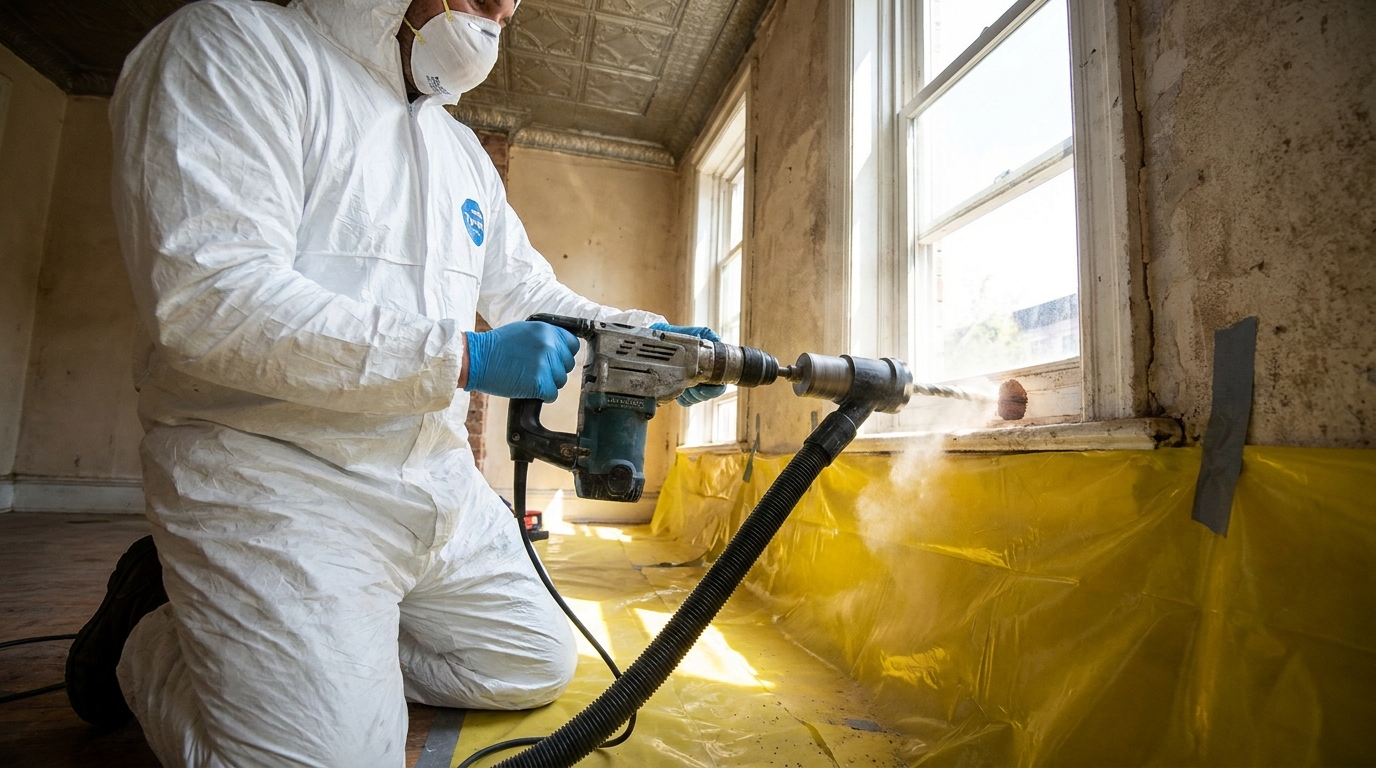
- Containment. The work area in the room receiving the indoor head is isolated with 6-mil plastic sheeting on the floor extending at least 6 feet from the work zone, and the doorway is sealed if the room connects to another occupied space.
- Wet methods. The installer mists the drill point before coring to suppress dust rather than generating a dry plume of lead-containing particles.
- HEPA vacuum. The drill and any sanding are connected to or immediately followed by a HEPA-filtered vacuum; shop vacs without HEPA filtration are prohibited under RRP.
- Debris disposal. Paint chips and plaster debris go into sealed plastic bags, not the open building trash chute.
- Post-work clearance wipe. After cleanup, a dust-wipe clearance test measures lead loading on floors (must be at or below 40 µg/sq ft), window sills (250 µg/sq ft), and window wells (400 µg/sq ft). The Certified Renovator either conducts this or arranges for a third-party clearance examiner.
- Recordkeeping. The firm retains the work order, the Renovate Right pamphlet acknowledgment signed by the owner or occupant, and the clearance results for a minimum of three years.
If your installer proposes skipping any of these steps in a pre-1960 NYC building, that is the signal to stop and find a properly certified contractor. A DIY mini split install in a pre-1960 lead-paint building compounds the risk significantly, for more on the permit and warranty consequences of going the DIY route, see our post on DIY mini split installation in NYC.
What Documentation Will Your Board or Future Buyer Demand?
Documentation failures at the time of installation create disproportionate problems at the time of resale or during board audits. For a mini split install in a pre-1960 NYC co-op or brownstone, assemble and retain:
- The EPA Lead-Safe Certified Firm number and expiration date for the HVAC contractor.
- The Certified Renovator’s credential number and the name of the individual who supervised the job.
- The signed Renovate Right pamphlet acknowledgment from the owner or adult occupant.
- Post-work clearance wipe report with specific room-level results.
- The building’s Local Law 31 XRF test results (if completed), which establish whether the lead presumption has been formally rebutted for the surfaces disturbed.
- The DOB permit and sign-off for the mini split work, which links the job to a specific scope and address.
A co-op purchaser’s attorney reviewing board minutes and alteration records will request the contractor’s certifications. A landlord receiving an HPD lead complaint after a tenant reports a child under 6 moving in will need to produce the clearance wipe. Missing these documents shifts the building owner from the position of “complied and documented” to “potentially liable.”
Common Mistakes to Avoid
- Assuming the small hole “doesn’t count.” The 6 sq ft threshold accumulates across all painted-surface disturbance in a room within 30 days, not just the drill hole itself.
- Hiring an HVAC firm with an EPA 608 refrigerant cert but no RRP cert. Refrigerant certification and lead-safe certification are completely separate credentials. Many HVAC companies hold the former but not the latter.
- Ignoring Local Law 1 because no child is currently in the unit. If a child under 6 moves in after the work, and documentation of lead-safe practices is absent, the landlord faces liability for the prior disturbance.
- Skipping the XRF check before filing the alteration. If your building completed Local Law 31 XRF testing and those surfaces tested clean, you can rebut the presumption. Not checking means you may impose RRP costs unnecessarily, or fail to impose them when you should.
- Treating lead and asbestos as the same compliance step. ACP-5 covers asbestos; RRP and Local Law 1 cover lead. A building that cleared ACP-5 is not automatically cleared for lead. Both checks are required for a permitted install in a pre-1960 building.
- Skipping post-work clearance wipes. Without a clearance report, there is no documented proof that lead-safe conditions exist after the install. That gap can void insurance coverage and trigger HPD violations.
Frequently Asked Questions
Does a mini split line-set core always trigger the EPA RRP Rule in a pre-1960 NYC building?
Not automatically. The RRP Rule requires that more than 6 sq ft of interior painted surface per room be disturbed. A single 3-inch line-set core typically disturbs 1 to 3 sq ft at the penetration point. The trigger depends on the total interior disturbance in the room from all mounting, coring, and electrical work combined. If the cumulative total stays at or below 6 sq ft, the federal RRP Rule does not apply, though NYC Local Law 1 may still apply if a child under 6 lives or regularly visits the unit.
Who is considered the “certified renovator” on an HVAC job under the RRP Rule?
The Certified Renovator must be an individual who has completed an EPA-accredited renovator training course and holds a current credential. On an HVAC install, this is typically a designated lead-trained employee of the HVAC firm, not the HVAC tech who handles refrigerant. The firm itself must separately hold EPA Lead-Safe Certified Firm status. Both certifications must be current on the day of work.
Does Local Law 1 apply to co-op shareholders or just to rental landlords?
Local Law 1 targets the owner of the multiple dwelling, which in a co-op is the co-op corporation, not the individual shareholder. However, the alteration agreement between the shareholder and the co-op board typically passes lead-safe compliance responsibility to the shareholder for work inside the unit. In practice, the shareholder must ensure their HVAC contractor meets RRP standards; the co-op board holds the building-level obligation under Local Law 1.
Can an XRF test on file from Local Law 31 eliminate the lead-safe requirement for a mini split install?
Yes, but only for the specific surfaces that tested below the 0.5 mg/cm² threshold. If the XRF results show that the wall where the indoor head mounts and the wall at the line-set penetration both tested lead-free, the RRP and Local Law 1 requirements do not apply to those surfaces. The XRF results must cover the specific surfaces being disturbed, and the building must have filed the results with DOHMH as required by Local Law 31.
Does the lead-paint question apply to brownstone owners who live in the building themselves?
Fee-simple brownstone owners who occupy the entire building are outside Local Law 1’s multiple-dwelling scope, but they are still subject to the federal RRP Rule if they hire a contractor to do the work. The RRP Rule applies to any paid work in pre-1978 housing, with no owner-occupant exemption once a contractor is involved. The contractor’s firm must still be EPA Lead-Safe Certified, and lead-safe work practices must be followed if more than 6 sq ft of interior painted surface is disturbed.
The Bottom Line for Pre-1960 NYC Buildings
A ductless mini split install in a pre-1960 NYC co-op, brownstone, or rental building sits squarely in lead-paint compliance territory. Whether the federal RRP Rule fires depends on whether the total disturbed painted area in any room exceeds 6 sq ft. Whether NYC Local Law 1 adds an additional obligation depends on whether a child under 6 lives or regularly visits the unit. Both thresholds can be crossed on a standard install, particularly when mounting, coring, and electrical work are combined in the same room within 30 days. The practical fix is straightforward: hire an HVAC contractor who is an EPA Lead-Safe Certified Firm with a Certified Renovator on staff, confirm your building’s Local Law 31 XRF status before the work begins, and retain the clearance documentation. For a broader look at the DOB filing decisions that sit alongside this environmental compliance question, the mini split self-certification vs. professional certification guide covers how permit pathway choice affects audit exposure in exactly these older buildings.