

Can a NYC Co-op Use C-PACE to Finance a Heat Pump Conversion?
Yes, and the first proof point closed in April 2026. C-PACE (Commercial Property Assessed Clean Energy) is a tax-assessment-based financing mechanism that lets a co-op corporation borrow against its building to pay for energy-efficiency and renewable-energy improvements, then repay the loan as a line item on the NYC Department of Finance property-tax bill over 20 to 30 years at a fixed rate. For a c-pace heat pump co-op nyc project, that means a board can replace an aging oil or gas boiler with a whole-building mini-split and domestic hot water heat pump system at zero cash upfront, while retaining whatever low mortgage rate it already holds.
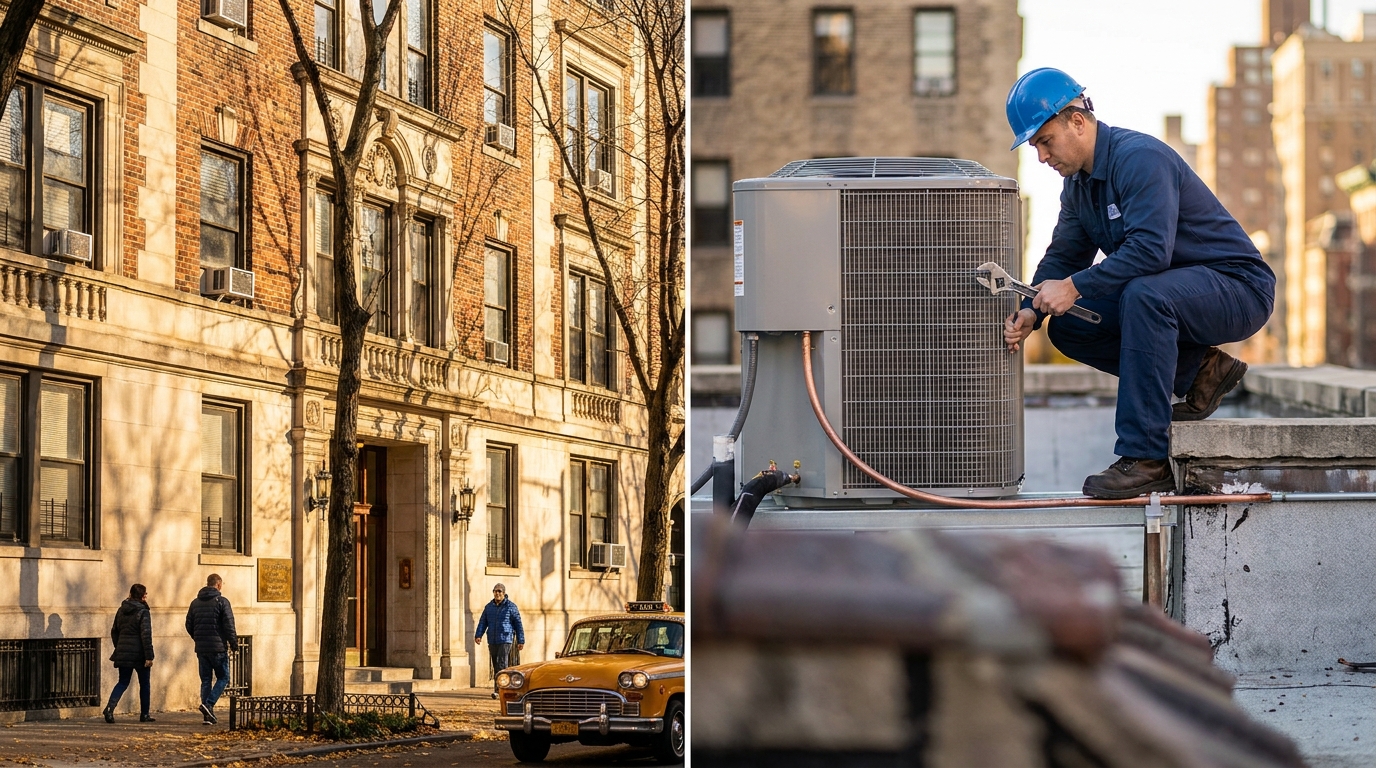
The 36-unit Upper West Side co-op at 304 West 89th St. became the first in New York City to secure funding through a C-PACE loan, which will fund the replacement of the building’s aging oil-fired boiler with heat pumps for heating, cooling, and domestic hot water. That April 2026 milestone proved the structure works for co-ops and has opened the door for every other board in the five boroughs.
How Does C-PACE Repayment Actually Work?
The repayment mechanism is the most misunderstood part. The loan is not a mortgage, a line of credit, or a mezzanine instrument. PACE is a tax-assessment-based financing mechanism providing long-term, fixed-rate financing for energy-efficiency and renewable-energy projects; PACE loans are made using private funds through pre-qualified lenders and are repaid as a charge on a building’s Department of Finance (DOF) property-tax bill.
Three features make this structure board-friendly:
- Non-acceleration: C-PACE loans cannot be accelerated, providing additional comfort to the mortgage lender that it won’t be forced to take enforcement action in the event of a default. Like a property-tax installment, only amounts currently due are owed at any moment.
- Non-recourse: C-PACE financings are non-recourse to the property owner. The lender’s recourse is limited to the benefited property.
- Transferable: The loan may be transferred upon sale of the property. A buyer inherits the assessment, similar to any outstanding property-tax obligation, so the board is not forced to pay it off at closing.
What Are the Eligibility Requirements for NYC Co-ops?
A co-op corporation qualifies if its building meets the following criteria, drawn directly from the NYC C-PACE program guidelines administered by NYCEEC:
- The property must be located in one of the five boroughs of New York City.
- PACE financing can be used for all building types in New York City, with the exception of 1-2 family residential homes.
- The project must have a Savings-to-Investment Ratio (SIR) of 1.0 or greater. This means the present value of projected energy savings must equal or exceed the loan cost over its term.
- The C-PACE loan term must be less than or equal to the weighted average useful life of the measures financed. For heat pumps and mini-split systems, useful life is typically 20 to 25 years, supporting a 20- to 25-year term.
- An ASHRAE Level 2 energy audit (or equivalent HPD Integrated Physical Needs Assessment for regulated affordable properties) must support the project scope.
- All holders of mortgages or deeds of trust on the subject property must provide consent to the C-PACE loan and the terms thereof. This is the single biggest hurdle boards face (see the section below).
Retroactive financing: In New York City, you can finance work up to three years after it has been completed. If your board already completed an electrification conversion, C-PACE can still recapitalize that expenditure and replenish reserves.
Co-op Yes, But What About Condos?
This question causes persistent confusion, and the answer has changed. The short version: co-op corporations are squarely eligible. Condos are more complicated.
| Building Type | C-PACE Eligible? | Notes |
|---|---|---|
| Co-op corporation | Yes | Corporation owns the fee; single tax lot; lender consent required from the co-op’s underlying mortgage holder only, not individual shareholders |
| Condo, individual units | No | Individual unit owners pay taxes separately; no common lien mechanism |
| Condo, common areas / HOA tax lot | Limited / evolving | NYC expanded guidelines to allow condominium buildings to be eligible for PACE, but the exact mechanism for how the lien is placed and enforcement and collection is still being worked out. |
| Condo units held in common by commercial entity | Yes | Condo units are not eligible unless multiple units are owned in common by a commercial entity. |
For most residential condos, C-PACE remains effectively unavailable at the unit level as of 2026. Co-op boards have a clear, proven path forward.
The Mortgage-Lender Consent Hurdle: How to Get Your Lender to Yes
Lender consent is the choke point that killed co-op C-PACE deals for years. Understanding why lenders balk, and what actually moves them, is the key to unlocking the financing.
Why lenders hesitate: If there is a foreclosure, the primary lender risks being paid after the C-PACE lender. The PACE benefit-assessment lien is subordinate to municipal taxes but senior to other liens, including the first mortgage. Most loan documents bar the borrower from voluntarily placing a lien ahead of the mortgage without consent.
Why lenders should consent:
- C-PACE loans cannot be accelerated, only the current quarterly installment is ever senior to the mortgage, not the full loan balance. The lender’s exposure is equivalent to a missed property-tax payment, not a second mortgage foreclosure.
- Benefit assessment liens are exempt from mortgage recording taxes, which could materially reduce closing costs, and C-PACE financings are non-recourse to the property owner.
- The improvement raises building value and reduces operating costs, improving the mortgage’s underlying collateral.
- C-PACE does not work well for buildings with mortgages securitized in CMBS, and it can be difficult to obtain lender consent from the administrative agent if consent has not been baked into the original loan documents. Portfolio lenders (NCB, local community banks) are the easiest targets; CMBS servicers the hardest.
Realistic timeline and tactics: At 304 West 89th St., securing approval from the building’s lender, Citizens Bank, took more than nine months. Boards should budget 9 to 12 months for lender consent on the first deal, separate from the 2 to 3 months needed to close the C-PACE loan itself once consent is granted.
Practical steps to accelerate consent:
- Engage a PACE-experienced attorney to draft the consent request alongside the PACE lender’s counsel, not as a surprise letter from the board’s managing agent.
- Present the non-acceleration language explicitly; many bank credit officers have never seen a PACE structure and conflate it with a mezzanine loan.
- Quantify the collateral benefit: a fossil-fuel-free building with avoided Local Law 97 fines is a stronger credit than a building staring at six-figure annual penalties.
- Ask your PACE lender whether they have a precedent consent letter from the same bank. As C-PACE loans become more widespread nationally, lenders are increasingly comfortable with the program.
- If your mortgage is held by NCB (National Cooperative Bank), note that NCB has processed PACE consent in co-op deals in other states and is familiar with the structure.
The SIR Requirement: Does a Mini-Split Conversion Pass?
The Savings-to-Investment Ratio of 1.0 is the financial gate. For a whole-building oil-to-heat-pump conversion in NYC, the math typically works because avoided costs stack from multiple directions:
| Savings Source | Typical Annual Value (per building) | Notes |
|---|---|---|
| Eliminated fuel oil spend | $30,000 – $80,000+ | Depends on building size and oil price; heat pumps deliver 2 to 4x the output per unit of electricity vs. combustion |
| Avoided LL97 carbon fines (2030 tier) | Varies; $44,184/yr projected at 304 W 89th St. by 2040 | Fines escalate; LL97 2030 limits are stricter than 2024 limits |
| Con Ed rate savings (heat pump rate plan) | $2,000 – $8,000+ | Switching to the right Con Ed rate plan for electric heat pumps reduces per-kWh cost; see our guide on the Con Edison heat pump rate plan for NYC buildings |
| Reduced boiler maintenance and fuel delivery | $5,000 – $15,000 | Eliminates annual oil tank certification, burner service contracts, and fuel delivery logistics |
The measures financed by C-PACE at 304 West 89th St. are expected to bring the co-op into compliance with and below 2050 building emissions required by Local Law 97, part of New York City’s Climate Mobilization Act. The project was structured as a 25-year fixed-rate loan, with projected savings exceeding the loan cost. To qualify for the program, the building’s projected energy savings had to meet or exceed the cost of its fixed-rate, 25-year loan.
One important recent development: proposed legislation would allow energy-efficiency measures to be financed without requiring a direct cost-saving payback and would increase the maximum C-PACE loan-to-value ratio. If passed, the SIR gate would widen further, making it easier for partial conversions to qualify.
How C-PACE Stacks With Con Ed Clean Heat and IRA Credits
C-PACE is designed to be layered with other incentives, not compete with them. Here is the correct sequencing:
- Apply for Con Ed / NYS Clean Heat rebates first. The Clean Heat rebate is netted against the invoice, and C-PACE finances the residual after the rebate, letting a co-op or condo board cover the entire capital cost out-of-pocket-free while still claiming the incentive stack. For multifamily buildings, rebates run roughly $2,000 to $5,000 per unit depending on equipment type and BTU rating. See our full breakdown of Con Edison Clean Heat rebates for NYC co-ops and condos.
- Claim federal IRA credits where applicable. The co-op corporation may claim the Section 179D commercial buildings deduction on building-wide HVAC improvements. Individual shareholders installing in-unit heat pump components can claim the 25C residential credit (up to $2,000 per unit) on their personal returns. C-PACE finances what remains after these credits reduce the net project cost.
- Finance the residual with C-PACE. The loan amount is based on the net cost after rebates and credits. A smaller loan principal means a lower SIR hurdle and smaller annual tax-bill addition.
- Explore J-51. Heat pump conversions in co-ops may also qualify for J-51 tax abatement, which further offsets holding costs. See our detailed guide on the J-51 tax abatement for heat pump conversions in NYC co-ops and condos.
C-PACE vs. Alternative Financing: Which One Should the Board Choose?
| Option | Rate / Term | Cash Required | Mortgage Impact | Best For |
|---|---|---|---|---|
| C-PACE | Fixed, 20-30 yr | $0 upfront | None; existing mortgage stays intact | Boards with a low locked-in mortgage rate they cannot afford to refinance |
| Mortgage refinance | Current market rate (7-8% in 2026) | Closing costs | Replaces existing mortgage at higher rate | Boards whose mortgages are maturing anyway |
| NYCEEC / Green loan | Below-market, shorter term | May require equity contribution | Appears on balance sheet as debt | Smaller scopes; boards without mortgage complications |
| Maintenance assessment | N/A | Paid by shareholders upfront or over time | None | Small buildings with low project cost and shareholder consensus |
The 304 West 89th St. board chose C-PACE specifically to protect its locked-in mortgage rate. Without C-PACE, the co-op’s only viable option would have been refinancing its mortgage and giving up a 2.95% interest rate secured three years ago. At current market rates of 7 to 8%, blending that into a new mortgage to cover a $1 million conversion would have cost the building far more per year than the PACE assessment.
From Energy Audit to Installed System: The End-to-End Timeline
Finance sites stop at the money. Here is what the full process looks like for a co-op undertaking a whole-building heat pump conversion, from the board vote through the first winter of all-electric heat:
- Board vote to proceed (Month 0). Authorize a feasibility study and energy audit. Most co-op proprietary leases require a supermajority for major capital projects; check your governing documents before engaging consultants.
- Energy audit and scope development (Months 1-2). An ASHRAE Level 2 audit (or LL87-compliant audit) establishes the baseline, models heat pump performance, and generates the SIR calculation. Your HVAC contractor should be involved at this stage to confirm equipment selection, condenser placement constraints, and electrical capacity needs.
- Con Ed load letter and service upgrade (Months 2-5, concurrent). A whole-building mini-split conversion almost always requires a building-wide electrical-service upgrade. Con Ed’s process for load letters and service upgrades can add 3 to 6 months to the schedule; start this in parallel with the audit, not after it.
- Mortgage-lender consent (Months 1-10+). As discussed, this is the longest and most uncertain step. Engage the PACE lender and your attorney immediately after the board vote. Do not wait for the audit to finish.
- C-PACE application and close (Months 2-3 after consent). Close typically runs 2 to 3 months once lender consent is in hand. Property owners can use NYC Accelerator’s concierge service for free and get support with necessary documentation.
- Con Ed and IRA rebate filings (before or at contract signing). File Clean Heat rebate applications before equipment is purchased so the rebate nets against the invoice and reduces the C-PACE loan principal.
- DOB permits and LPC review if landmarked (Months 3-5). A co-op in a landmark district (like 304 West 89th St., on the Upper West Side) needs Landmarks Preservation Commission approval for any exterior condenser placement. Engage LPC early; condenser location drives the entire engineering design.
- Installation (Months 5-8 depending on building size). A whole-building conversion on a 24 to 36-unit building typically runs 6 to 12 weeks of active work. Radiator removal, per-unit mini-split installation, refrigerant line routing through common shafts, and domestic hot water heat pump connection all happen in sequence. Shareholders need advance notice of unit-access days; a board letter with a room-by-room schedule reduces friction significantly.
- Per-unit metering and billing setup. Once each unit has its own mini-split, the building’s master-metering arrangement changes. If the co-op was master-metered for heat, the board must decide whether to allocate electric costs by unit or let shareholders pay their own submeters. See our guide on mini-split cooling billing in a master-metered NYC co-op for how to structure this compliantly.
Common Mistakes to Avoid
- Starting lender consent too late. Many boards begin the PACE application process and only then notify their bank. The consent process at 304 West 89th St. took over nine months. Start it the day the board authorizes the project.
- Ignoring CMBS risk. If your underlying mortgage was securitized, the servicer may not have authority to grant consent regardless of how well you present the case. Verify your mortgage structure before spending money on audit fees.
- Underestimating electrical upgrade costs. C-PACE can finance the service upgrade, but only if it is scoped into the project from the start. A last-minute electrical discovery can sink the SIR calculation.
- Netting rebates incorrectly. Con Ed Clean Heat rebates must be claimed before the C-PACE loan closes and netted against the invoice. Claiming them after the loan funds does not reduce the principal; the board absorbs the rebate as cash but the loan stays larger than necessary.
- Skipping the LPC step for landmarked buildings. A condenser placement that violates the LPC approval will trigger a stop-work order, potentially voiding the installation warranty and triggering DOB violations. Get LPC sign-off before the PACE loan closes.
- Assuming individual shareholders must consent. The program requires consent only from the mortgage held by the co-op, not from each individual unit owner. Boards sometimes delay because they fear a shareholder revolt; the lender consent you need is from the bank, not the building’s 36 apartments.
Frequently Asked Questions
How is a C-PACE loan repaid in a NYC co-op?
The repayment is structured as a benefit assessment added to the co-op corporation’s NYC Department of Finance property-tax bill, paid in quarterly installments alongside regular property taxes. The board typically passes this cost through to shareholders as a modest maintenance increase. At 304 West 89th St., the board structured it as a small annual maintenance adjustment comparable to a routine maintenance increase.
Does a C-PACE loan show up as debt on the co-op’s financial statements?
C-PACE financing is an assessment on the benefited property, not an obligation of the property owner. It is structured as a tax assessment, not a loan from the corporation’s perspective, which means it does not appear as conventional debt in the same way a mortgage does. However, co-ops should consult their accountants on disclosure obligations, as treatment can vary.
Can a co-op use C-PACE to finance a project that is already complete?
Yes. In New York City, you can finance work up to three years after it has been completed. This retroactive pathway is particularly useful for co-ops that paid for a heat pump conversion out of reserves and want to replenish liquidity without refinancing their mortgage.
What happens to the C-PACE assessment if the co-op sells the building?
The loan may be transferred upon sale of the property. The outstanding assessment passes to the buyer as part of the property, similar to an outstanding tax obligation. No prepayment is required at closing, which means the board is not forced to pay off the loan to complete a sale.
Does C-PACE finance the Con Ed electrical service upgrade required for a whole-building heat pump conversion?
Yes, as long as the service upgrade is scoped as an ancillary cost of the energy-efficiency improvement and included in the original C-PACE application. C-PACE can finance ancillary project costs beyond just equipment, including engineering, legal, and associated electrical work. The upgrade must be documented in the project scope and included in the SIR calculation.