

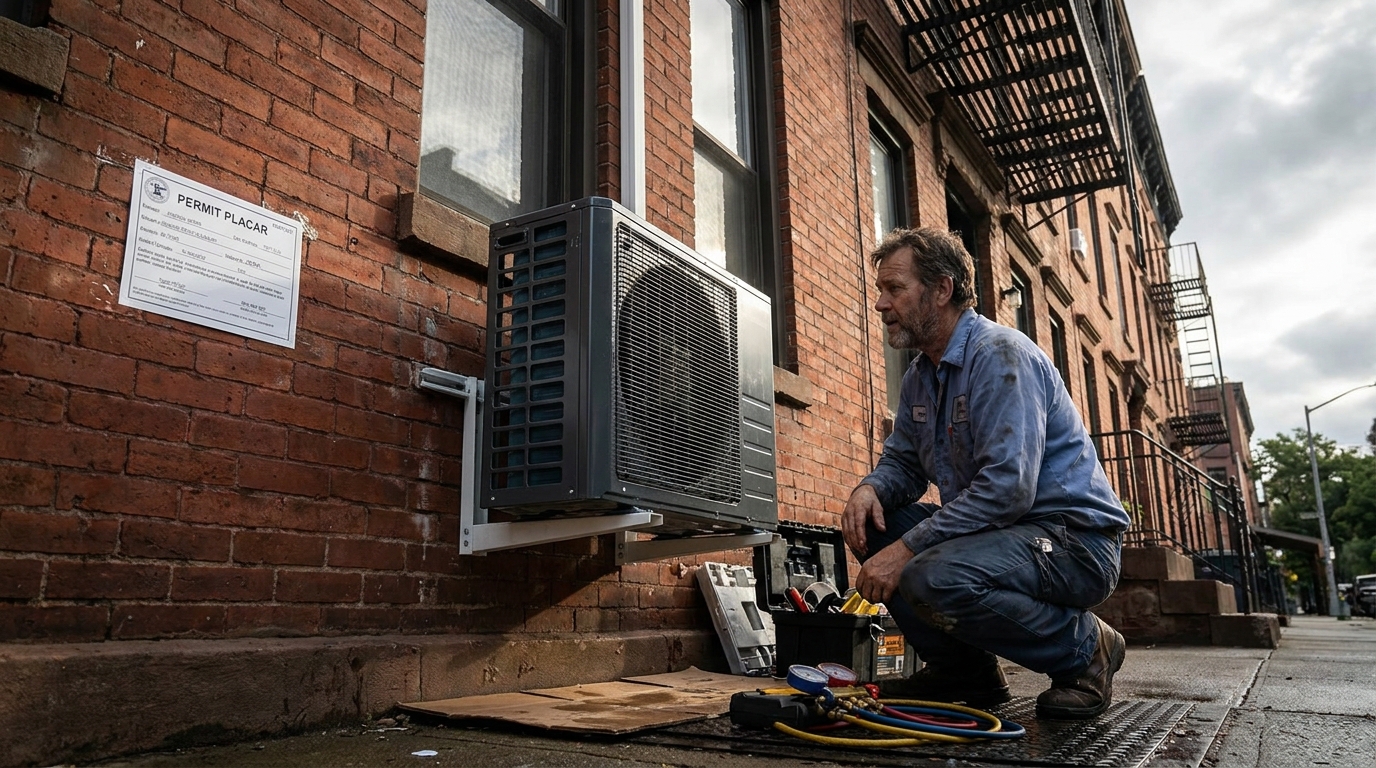
Can I Install a Mini Split Myself in NYC?
In NYC, a DIY mini split install is almost never a viable option. The city imposes a compounding stack of requirements, DOB mechanical permit, DCWP Home Improvement Contractor (HIC) license, EPA Section 608 certification, NYC-licensed electrician for the dedicated circuit, co-op or condo alteration agreement, and manufacturer warranty registration, that no single homeowner or unlicensed handyman can fully satisfy. Getting one layer wrong unravels the others.
National DIY guides tell you to “check your local codes.” This post tells you what those codes actually are for the five boroughs, and what each one costs you when skipped.
What Is the NYC Licensing Stack for a Mini Split Install?
NYC does not issue a single “HVAC license.” Instead, a compliant mini split installation in the five boroughs requires credentials from two separate city agencies, plus a federal certification, plus a trade-specific electrical license. Here is the full stack:
| Requirement | Governing Authority | Who Must Hold It | What a DIYer Forfeits |
|---|---|---|---|
| DOB Mechanical Work Permit | NYC Department of Buildings | Licensed mechanical/general contractor | Permit required before work begins; post-install permit is not accepted |
| DCWP Home Improvement Contractor (HIC) License | NYC Dept. of Consumer and Worker Protection | Any contractor doing residential work over $200 | DOB requires HIC number for Alteration permits on 1-4 family homes, co-op units, condo units, and rented apartments |
| NYC Licensed Electrician | NYC DOB | Master or Special Electrician | New circuit, panel connection, and disconnect wiring cannot legally be touched by an unlicensed person |
| EPA Section 608 Certification | U.S. EPA | Any technician who opens a refrigerant circuit | Federal violation; pre-charged DIY kits sidestep this but do not exempt you from DOB or electrical requirements |
| PE/RA Stamped Drawings | NYC DOB (filed via DOB NOW) | NYS-licensed Professional Engineer or Registered Architect | Required for new exterior condensers, roof or terrace placement, refrigerant penetrations, and core drilling |
The DCWP HIC license applies to any residential home improvement work costing more than $200. NYC Admin Code §20-386 explicitly includes heating and air conditioning systems in the home-improvement definition, and NYC DOB Operations Policy Notice #03/05 confirms that DOB requires the HIC number for Alteration permits on 1-to-4-family residences, individual co-op units, condo units, and rented apartments. A homeowner performing their own work is the narrow exemption, but that exemption does not remove the DOB permit requirement, the electrical license requirement, or the EPA certification requirement.
Electrical work for the dedicated mini split circuit is its own lane entirely. NYC requires a separately submitted electrical permit filed by a NYC-licensed electrician, and that permit must pass a DOB electrical inspection. There is no workaround for an unlicensed person wiring a 240V dedicated circuit or a disconnect.
Does a DIY Mini Split Install Void the Warranty?
The honest answer is more nuanced than most manufacturer marketing suggests, and more dangerous than most DIY guides admit. Here is how the Magnuson-Moss Warranty Act (15 U.S.C. §2302, 16 CFR Part 700) actually works:
- Blanket “void if not installed by an authorized dealer” clauses are prohibited as illegal tying. A manufacturer cannot legally void an entire warranty solely because a non-authorized party performed installation.
- What a manufacturer CAN do: deny a specific claim if it proves that the unauthorized work directly caused the failure. The burden of proof is on the manufacturer, but in practice, an improperly charged system, a mis-wired control board, or an incorrectly pitched line set gives them exactly the evidence they need.
- The real risk is the tier structure. Mitsubishi’s Diamond Contractor program, for example, gates the 12-year extended warranty tier behind registration by a certified installer. A DIY installer cannot self-register at that tier. Failing to register within 90 days drops coverage to the base tier (typically 5-year parts / 7-year compressor), regardless of whether the install itself caused any problem.
| Warranty Scenario | Coverage Outcome | NYC-Specific Risk Factor |
|---|---|---|
| Licensed Diamond/Elite contractor installs and registers within 90 days | Up to 12-year extended coverage (Mitsubishi example) | Full rebate and warranty path open |
| DIY or unlicensed install, self-registered within 90 days | Base tier only (5-yr parts / 7-yr compressor); extended tier unavailable | Cannot qualify for Diamond/Elite extended tier |
| DIY or unlicensed install, not registered within 90 days | Base tier only; registration window closed | Manufacturer can also deny claim if it proves the install caused the failure |
| Pre-charged “DIY kit” system (MRCOOL, etc.) | Varies by brand; often limited residential warranty | Still subject to NYC DOB permit + licensed electrician for the circuit; co-op boards typically reject unapproved equipment |
The “pre-charged quick-connect kit” loophole that national DIY guides promote sidesteps the EPA 608 refrigerant-handling requirement. It does not sidestep the NYC DOB mechanical permit, the licensed electrician requirement for the dedicated circuit and disconnect, or the co-op/condo alteration agreement. In a NYC context, a pre-charged DIY kit buys you nothing except a smaller refrigerant liability.
How Does a DIY Install Kill a NYC Homeowners or Co-op Insurance Claim?
This is the risk that neither national DIY brands nor generic guides discuss, and it is the one with the highest dollar exposure in NYC. Standard homeowners and renters insurance policies contain two exclusions that a DIY or unlicensed mini split install can trigger:
- Faulty workmanship exclusion: Damage caused by improper installation, water infiltration from a mis-pitched condensate line, electrical fire from an unlicensed circuit, structural damage from an improperly bracketed condenser, is excluded from coverage as a faulty workmanship loss. The insurer does not have to pay.
- Illegal acts exclusion: Work performed without required permits, or by an unlicensed contractor where licensure is required, can be characterized as an illegal act under the policy. Claims arising from that work can be denied entirely.
In NYC, where improper mounting of an exterior condenser is a documented falling-object hazard regulated by the DOB’s support-bracket rules, an unpermitted bracket failure that damages a neighbor’s property or injures a pedestrian produces personal liability that your insurer may refuse to defend. The coverage gap compounds: your own property claim is denied, and you face third-party liability without an insurer standing behind you.
For co-op shareholders, the board’s master policy adds a third layer. Most co-op alteration agreements require the shareholder’s contractor to carry a COI (typically $2M/$4M general liability plus a $5M umbrella) naming the building as an additional insured. A DIY install produces no COI. The board can declare the work a breach of the alteration agreement and compel removal of the equipment at the shareholder’s expense, a removal that itself requires a licensed contractor and a new permit. For more on what co-op boards actually require from contractors, see our guide on Mini Split Installation COI for NYC Co-op and Condo Boards.
What Happens to Your Con Edison Clean Heat Rebate With a DIY Install?
The Con Edison Clean Heat rebate is structured as a deduction from the contractor’s invoice, applied by a participating contractor enrolled in the NYS Clean Heat program. The rebate does not come to you as a check, it comes off the invoice before you pay. That mechanism has a direct consequence for DIY: you cannot access the rebate at all without a participating contractor filing the application.
The NYS Clean Heat Program Manual (Version 2, March 2026) requires that participating contractors obtain all required permits from the applicable authority having jurisdiction and install systems in compliance with all applicable laws, regulations, codes, and licensing requirements. An unpermitted DIY installation disqualifies the project from the rebate retroactively. Even if you self-installed and then tried to hire a participating contractor to “file” after the fact, the pre-inspection step, which Con Edison requires before the Notice to Proceed is issued, cannot be satisfied for already-installed work.
Depending on system size, forfeiting the Con Edison Clean Heat rebate on a NYC mini split install can mean leaving thousands of dollars on the table. For context on how that rebate program works and stacks with NYSERDA incentives, see our post on Con Edison Heat Pump Rate Plans for NYC.
What Are the Co-op and Condo-Specific Risks of a DIY Mini Split?
NYC’s housing stock is predominantly co-ops and condos, and both property types add a private contractual layer on top of the city’s regulatory requirements. A DIY mini split install in a co-op or condo typically violates three separate obligations simultaneously:
- Alteration agreement: Most boards require a signed alteration agreement before any work involving exterior penetrations, condenser placement, or structural modifications. DIY work without a signed agreement is an unauthorized alteration, and the board can require removal.
- COI requirement: The alteration agreement typically specifies minimum insurance limits and requires the contractor’s COI naming the building corporation as additional insured. A homeowner performing DIY work has no contractor COI to produce.
- Board approval of equipment and placement: Many boards require pre-approval of the specific model, condenser location, noise levels, and condensate routing. A DIY installer who skips the board approval process has no approval to show at sign-off.
In Mitchell-Lama co-ops and HDFC co-ops, the regulatory overlay is even denser, HPD approval, surcharge rules, and alteration restrictions compound the standard board process. For those buildings specifically, see our detailed breakdowns for Mitchell-Lama co-op mini split installations and HDFC co-op mini split installations in NYC.
Does a DIY Pre-Charged Mini Split Kit Get Around NYC’s Rules?
No. Pre-charged quick-connect systems like MRCOOL DIY or similar brands are marketed as a way to avoid EPA Section 608 refrigerant handling requirements, and that narrow claim is technically accurate for the refrigerant circuit. What they do not exempt you from in NYC:
- The DOB mechanical work permit, which is required for new split systems in the five boroughs regardless of how the refrigerant circuit is charged
- The NYC-licensed electrician requirement for the dedicated circuit, the disconnect, and the electrical permit
- The DCWP HIC license requirement for any residential contractor performing the mechanical work
- The co-op or condo alteration agreement and board approval process
- The PE/RA stamped drawings requirement for new exterior condenser placement, roof or terrace work, or core drilling through an exterior wall
NYC’s DOB permit requirement applies to new split systems whether or not field refrigerant handling occurs. The pre-charged kit removes one compliance problem and leaves the rest of the NYC stack fully intact.
Common Mistakes to Avoid
- Assuming a handyman can pull the permit. A handyman is not a licensed mechanical contractor and cannot file a DOB mechanical permit or hold a DCWP HIC license for HVAC work. Using a handyman for a mini split install exposes you to the same unlicensed-work insurance and warranty risks as full DIY.
- Wiring the dedicated circuit yourself. NYC requires a separately submitted electrical permit filed by a NYC-licensed Master or Special Electrician. Doing this work yourself or hiring an unlicensed electrician is a DOB violation and a fire safety risk that insurers specifically look for when evaluating claims.
- Registering the warranty yourself after a DIY install. For brands with tiered warranty programs (Mitsubishi, Fujitsu), the top extended-warranty tier requires registration by a certified installer. Self-registration after a DIY install does not qualify for the top tier, regardless of whether you complete the registration within the 90-day window.
- Skipping the board approval and doing the work while the building is empty. NYC co-op and condo boards have the right to require removal of unauthorized alterations, even after the work is complete. Removal costs fall entirely on the shareholder, and removal itself requires a licensed contractor.
- Believing a pre-charged kit makes the install permit-exempt. Pre-charged kits remove the EPA refrigerant-handling issue only. Every other NYC requirement remains in place.
- Assuming you can “permit it after the fact.” NYC DOB requires a work permit to be issued before work begins, not after. Post-installation permits are not available for HVAC work, and attempting to close out an unpermitted installation requires filing an Alteration application and potentially a Certificate of Correction.
Frequently Asked Questions
Can a homeowner legally install a mini split themselves in NYC?
A homeowner performing work on their own home is exempt from the DCWP HIC license requirement specifically. However, that exemption does not remove the DOB mechanical permit requirement, the NYC-licensed electrician requirement for the dedicated circuit, the EPA Section 608 requirement if opening a standard refrigerant circuit, or the co-op/condo board approval and alteration agreement process. In practice, a homeowner in a co-op or condo cannot legally self-install without a licensed electrician and board approval at minimum, and most DOB-filed scopes require a licensed contractor to pull the work permit.
What is the penalty for unlicensed HVAC work in NYC?
Penalties apply at multiple levels. NYC DOB can issue stop-work orders, violations, and civil penalties for unpermitted work. DCWP can penalize unlicensed contractors performing residential home improvement work over $200. Beyond regulatory penalties, the practical consequences for the homeowner include insurance claim denial, forfeiture of manufacturer warranty extended tiers, loss of Con Edison Clean Heat rebate eligibility, and potential board-ordered removal of the equipment at the owner’s expense.
Does a pre-charged DIY mini split kit avoid NYC’s permit requirements?
No. Pre-charged quick-connect systems avoid EPA Section 608 refrigerant handling requirements because the refrigerant circuit is never opened in the field. They do not avoid the NYC DOB mechanical permit, the licensed electrician requirement for the dedicated circuit and disconnect, the DCWP HIC license requirement for any residential contractor performing the install, or the co-op/condo alteration agreement and board approval process.
Will a DIY mini split install void the manufacturer warranty?
Under the Magnuson-Moss Warranty Act, a manufacturer cannot void an entire warranty solely because an unauthorized party performed the installation, that is prohibited as illegal tying. However, a manufacturer can deny a specific claim if it proves the unauthorized or improper work caused the failure. More practically, brands with tiered extended-warranty programs (such as Mitsubishi’s Diamond Contractor tier) require registration by a certified installer. A DIY installer cannot self-register at the top extended-warranty tier, so the extended coverage is simply unavailable regardless of the legal theory.
Can I lose my Con Edison Clean Heat rebate by doing a DIY mini split install?
Yes. The Con Edison Clean Heat rebate is applied by a participating contractor as a deduction from your invoice. It cannot be accessed by a homeowner directly. The NYS Clean Heat Program Manual requires that participating contractors obtain all required permits and install in compliance with all applicable licensing requirements. An unpermitted or unlicensed DIY installation disqualifies the project, and Con Edison’s pre-inspection requirement, which must occur before installation, cannot be satisfied for already-completed work. Depending on system size, forfeiting this rebate means losing thousands of dollars in available incentives.