Skip to content

What Is the NYC Noise Code Limit for a Mini Split Condenser?
The NYC noise code caps a single HVAC unit at 42 dBA and multiple units collectively at 45 dBA, measured at the receiving property line, meaning your neighbor’s side of the fence, not your own foundation. That number is the entire basis for planning mini split condenser noise NYC homeowners face. During quiet hours (10 PM to 7 AM), the 42 dBA nighttime limit applies in residential zones; daytime is generally set at 7 dBA above the ambient level, which is often harder to pin down. Because condensers run their hardest on hot summer nights, exactly when neighbors have windows open, the 10 PM cutoff is the one that generates complaints.
One critical spec-sheet trap: the “19 dB” figure printed on many indoor wall units is an indoor measurement at minimum fan speed in a lab. The outdoor condenser is what the code regulates, and it runs louder at high fan speed on a 95°F evening. Always check the outdoor sound rating at maximum compressor speed before you buy.
Why Does Condenser Placement Matter So Much in Attached NYC Homes?
In a detached suburban house, a condenser 20 feet from the property line may naturally drop below 42 dBA through simple distance. Every doubling of distance from the source reduces sound pressure by roughly 6 dB (the inverse-square law). In a Park Slope brownstone or a Ridgewood row house, your neighbor’s bedroom window may be 8 to 12 feet away. You have almost no distance buffer, so placement and physical barriers do the work distance cannot.
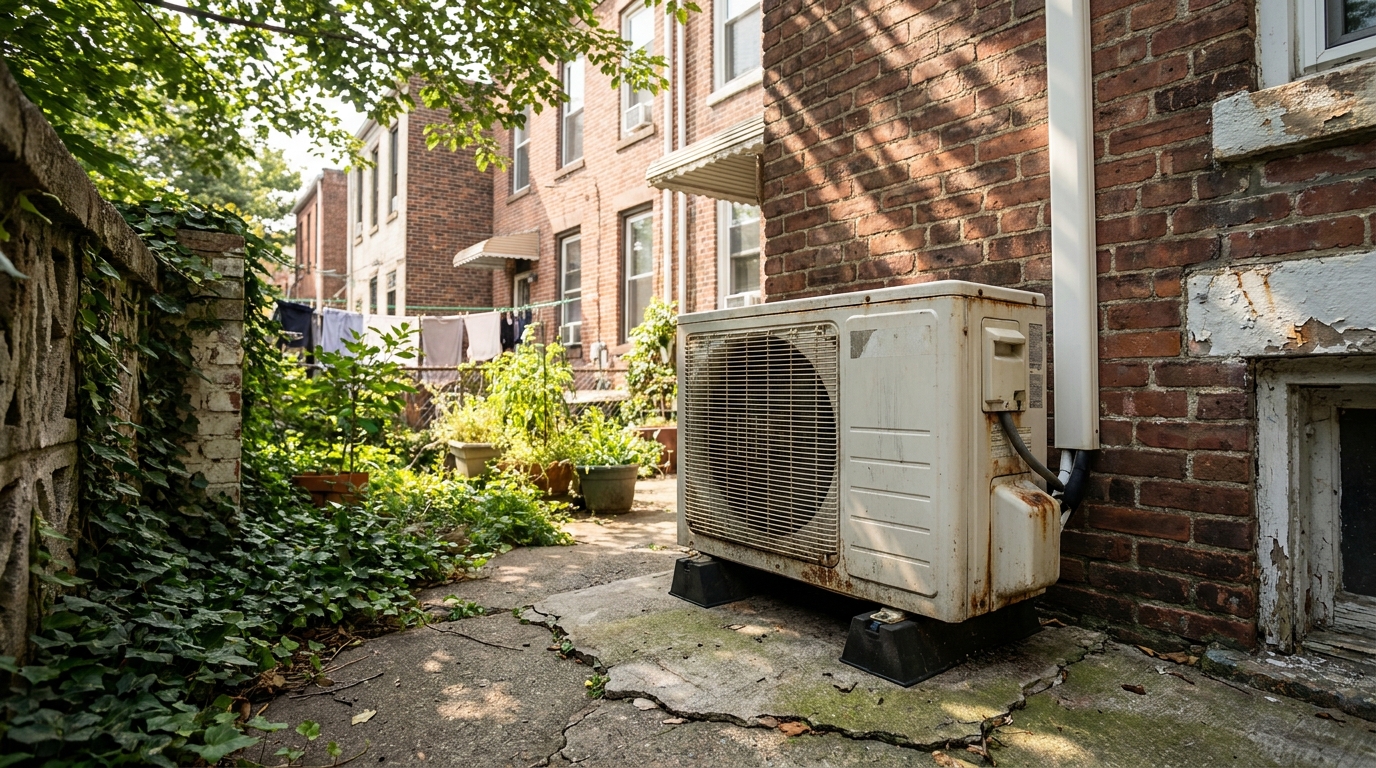
Airshafts between attached homes create a specific hazard: the narrow masonry channel acts as an echo chamber, bouncing and amplifying the condenser’s low-frequency hum. A unit that reads 48 dBA in open air can measure significantly higher at the opposing window when the airshaft focuses the sound. Roof parapet locations avoid this but introduce structural vibration through the building shell. Rear-yard placement on a concrete slab is usually the best starting point in most Brooklyn and Queens attached homes, see our full guide on where to put the outdoor condenser for a mini split in NYC for borough-by-borough siting options.
Which Placement Locations Pass the 42 dBA Limit Most Reliably?
| Location | Noise Risk | Key Condition to Meet |
|---|---|---|
| Rear yard on concrete slab | Low to moderate | Fan discharge aimed away from neighbor windows; solid fence barrier on property line |
| Roof behind parapet wall | Low if isolated | Vibration isolation mounts required; parapet acts as sound barrier to street and neighbors |
| Side yard (narrow) | High | Requires barrier and discharge aimed upward or away; often too tight for code-compliant service clearance |
| Airshaft between attached homes | Very high | Echo effect amplifies hum; avoid unless no other option and a full acoustic enclosure is installed |
| Front facade bracket | High (street + LPC risk) | Street-facing discharge violates aesthetic rules in many historic districts; noise bounces off buildings opposite |
Pre-Install Compliance Checklist: Five Steps Before You Set the Unit
- Check the outdoor dBA spec at high fan speed. Premium inverter models from Mitsubishi, Fujitsu, and Daikin are meaningfully quieter than older central-AC condensers. A unit rated under 50 dBA outdoors at max speed gives you the most margin to work with once you add barriers and distance.
- Measure the real property-line distance. Use a tape measure from the proposed unit location to the nearest neighbor’s window or property line. If it is under 15 feet, plan on adding a barrier wall even if the spec sheet looks good.
- Pick the fan discharge direction. Orient the condenser so the fan exhaust points toward open sky or your own building, never toward a neighbor’s window or airshaft opening.
- Install on vibration isolation mounts. Anti-vibration rubber pads or spring isolators prevent low-frequency hum from traveling through concrete slabs and masonry into shared walls, a common complaint trigger in rowhouse basements.
- Pull the DOB permit and check co-op or condo board rules. Many co-op boards impose rules stricter than the city’s 42 dBA code. Get written board approval before installation. Landmark districts add a separate LPC layer, see Do You Need a Permit to Install a Mini-Split in NYC? for the full permit picture.
What Mitigation Methods Actually Reduce Condenser Noise?
| Mitigation Method | Typical Noise Reduction | Best Used For |
|---|---|---|
| Compressor sound blanket | 3–5 dB | Existing units that are slightly over the limit |
| Solid barrier/shadow-box fence at property line | Up to 10 dB (example: 62 dB → 51 dB) | Rear yard or side yard installs near neighbor property lines |
| Vibration isolation mounts | Structural transmission eliminated | Roof or slab installs in attached homes with shared masonry |
| Acoustic louvers on discharge | 3–6 dB | Units in confined spaces or airshafts where redirection is needed |
| Relocate to rear yard from side/airshaft | Variable, often 5–12 dB | When existing placement is fundamentally wrong |
A solid masonry or composite barrier wall between the condenser and the property line is the highest-impact single fix. It must maintain required service clearance, typically at least 12–24 inches around the unit per the manufacturer spec, or it will trap heat and reduce efficiency. A properly designed shadow-box fence does both jobs.
What Happens If a Neighbor Files a 311 Complaint About Your Condenser?
NYC logged over 738,000 noise complaints through 311 in 2024, making noise the top 311 category citywide. An overnight condenser hum is exactly the type of residential dispute that generates a complaint. Here is the enforcement path once a complaint is filed:
- 311 intake: The complaint is logged and routed. DEP handles mechanical and HVAC equipment noise; NYPD handles residential noise complaints by ear and proximity.
- DEP inspection: A DEP inspector arrives with a calibrated sound level meter and measures at the receiving property line, your neighbor’s side. If the reading exceeds 42 dBA during nighttime hours, they can issue a notice of violation on the spot.
- Fines: General noise violations carry fines of roughly $150 to $400. HVAC-specific violations adjudicated at the Office of Administrative Trials and Hearings (OATH) can reach $1,400 or more for a first offense and substantially higher for repeat violations. Check current OATH/DEP schedules for the latest figures.
- Remediation window: After a notice of violation, you typically have the opportunity to cure before a hearing. Acting fast with a documented fix (barrier installation, mounts, or relocation) is the best outcome.
Co-op and Condo Buildings: An Extra Layer Beyond the City Code
If you own in a co-op or condo, the building’s proprietary lease or house rules can impose a noise standard lower than 42 dBA. Some Manhattan co-op boards require written certification from an acoustic engineer before approving condenser placement. Get board approval in writing before any equipment is ordered. If the board denies your preferred location, a rear-yard placement with a barrier wall is often the compromise that satisfies both the board and the DEP limit.
If your building is also converting from oil or gas heat as part of a broader electrification project, the condenser placement decision needs to happen alongside the full system design, not as an afterthought. Read more about the full conversion process in our guide to converting oil heat to a heat pump in a NYC brownstone.
Common Mistakes to Avoid
- Trusting the indoor dB spec. The marketing “whisper-quiet” figure is the indoor unit at minimum speed, not the outdoor condenser at high speed on a hot night.
- Pointing the fan discharge toward a neighbor’s window. Even a unit within the 42 dBA limit at the property line can generate a complaint if the airstream is aimed directly at a bedroom window.
- Skipping vibration isolation mounts. Structural hum through shared masonry is often the actual complaint, not airborne noise, and the DEP measurement may not even capture it fully.
- Installing in an airshaft without an acoustic enclosure. The echo-chamber effect can push a 48 dBA unit well past the 42 dBA limit at the neighbor’s window.
- Ignoring co-op or condo board approval. Board rules can be stricter than DEP code. A board complaint is separate from 311 and can require removal of the unit entirely.
- Not checking LPC rules in a historic district. Landmarked brownstone blocks in Brooklyn Heights, Harlem, and Fort Greene have placement restrictions that interact with noise compliance, a facade bracket may solve one problem but create another.
Frequently Asked Questions
What is the NYC noise code limit for a mini split condenser?
A single HVAC unit cannot exceed 42 dBA at the receiving property line in residential zones during nighttime hours (10 PM to 7 AM). Multiple units on the same property are capped at 45 dBA collectively. The measurement is taken at your neighbor’s property line, not at your own unit.
Can my neighbor call 311 on my mini split condenser?
Yes. Any neighbor can file a noise complaint through 311 at any time. DEP will route an inspector with a calibrated sound level meter. If the reading at the property line exceeds 42 dBA during quiet hours, a notice of violation can be issued against the property owner.
How do I quiet a condenser that is already installed and too loud?
Start with vibration isolation mounts if structural hum is the issue. Add a compressor sound blanket for 3–5 dB of reduction. Install a solid barrier fence between the unit and the property line for up to 10 dB of reduction. Redirect the fan discharge away from neighbor windows. If the unit is sited in an airshaft or side yard with no room for a barrier, relocation to the rear yard is often the most cost-effective long-term fix.
Do airshafts between attached NYC homes make condenser noise worse?
Yes. The narrow masonry channel between attached homes acts as an acoustic amplifier, reflecting and concentrating the low-frequency hum of the compressor. A unit reading 48 dBA in the open can measure significantly higher at the neighbor’s window when placed in an airshaft. This is one of the most common sources of DEP complaints in Brooklyn and Queens row houses.
Do co-op and condo boards have stricter noise rules than the city code?
They can. A co-op’s proprietary lease or a condo’s house rules may require decibel levels below 42 dBA, written acoustic engineer certification, or specific placement zones. Board approval is a separate process from DEP compliance, and a board can require removal of a unit that technically passes the city code if it violates building rules.