Skip to content

Why Short-Term Rental Hosts Are Upgrading to Mini Splits
Mini splits for Airbnb and short-term rental properties in NYC directly affect the two metrics hosts care about most: guest review scores and operating costs. A listing with quiet, modern climate control consistently outperforms comparable listings with window AC units in guest satisfaction ratings, particularly during summer months when cooling quality makes or breaks a stay.
The Airbnb guest experience in NYC is uniquely affected by HVAC because of the city’s climate extremes (90°F+ summers with high humidity, 15°F winters) and the noise environment (window units competing with street noise in a city where guests expect to sleep with windows closed). A mini split addresses all of these factors simultaneously.
Guest Experience Improvements
- Quiet operation. Window AC units at full speed produce 50 to 60 dB, which guests consistently mention negatively in reviews. A mini split at low speed produces 19 to 22 dB, inaudible over normal room ambiance. For listings that advertise “peaceful” or “relaxing,” this is the difference between matching and contradicting the marketing.
- Even cooling and heating. Window units create cold spots near the unit and warm zones across the room. A mini split distributes air evenly through an adjustable louvered vane, maintaining consistent temperature throughout the space.
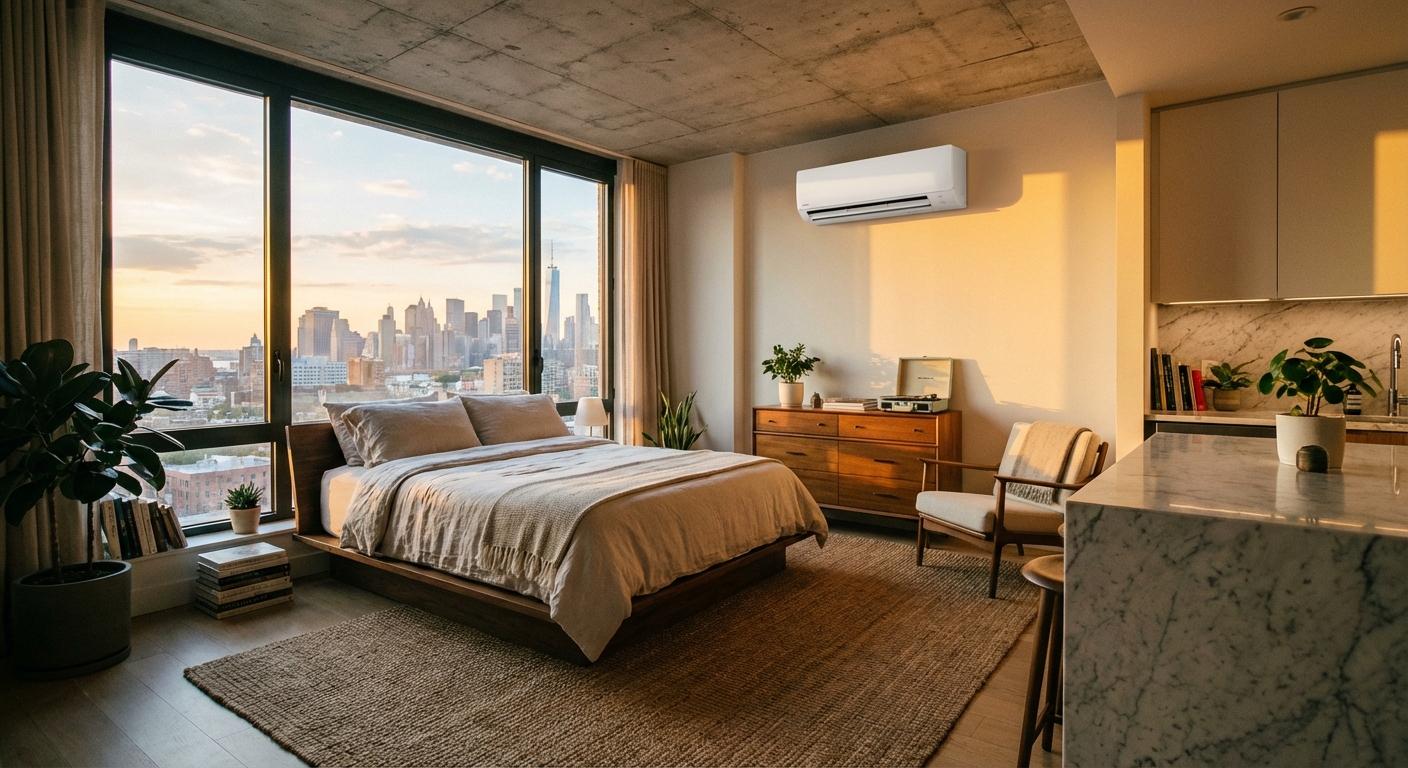
- Modern aesthetics. A sleek wall-mounted indoor unit looks intentional and clean. A window unit jammed into a frame with foam inserts looks temporary. For listings in the $150+ per night range, the visual impression of quality matters in photos and in person.
- Full window access. Removing window units restores natural light and views, two of the most photographed and valued features in NYC short-term rental listings. Better listing photos lead to higher booking rates.
- Year-round comfort. Mini splits heat and cool. Guests booking in October or April get the same level of climate control as summer visitors. Window units offer cooling only, leaving shoulder-season guests relying on whatever heating the building provides.
Energy Cost and Management Benefits for Hosts
Short-term rental properties have unique HVAC challenges: guests leave systems running at full blast when they leave for the day, turnover days require rapid temperature changes, and vacancy periods still need climate maintenance to prevent humidity damage or pipe freezing.
- Smart controls for remote management. Wi-Fi-connected mini splits let hosts set temperatures remotely between guests, turn off the system during vacancy, and pre-cool or pre-heat before check-in without being on-site. Some hosts automate this with scheduling: the system runs on a low-maintenance setpoint during vacancy and switches to full comfort mode on check-in day.
- 30 to 40% lower energy costs vs. window units. A property running two window ACs during a NYC summer spends $110 to $180/month on cooling electricity. The same property with a two-zone mini split spends $60 to $100/month. Over a 5-month cooling season, the savings are $250 to $400.
- Dehumidification during vacancy. An unoccupied NYC apartment in summer can develop mold and musty odors within days if humidity is not controlled. Running the mini split in “Dry” mode at minimal cost prevents this without overcooling the empty space.
Costs and ROI for Rental Property Owners
| Property Type | Zones Needed | Cost Before Rebates | Cost After Rebates |
|---|---|---|---|
| Studio / 1-bedroom | 1 to 2 | $3,500 to $6,500 | $1,500 to $3,500 |
| 2-bedroom apartment | 2 to 3 | $5,500 to $9,000 | $2,500 to $5,000 |
| 3-bedroom / duplex | 3 to 4 | $7,500 to $11,000 | $3,500 to $6,500 |
The ROI calculation for Airbnb properties includes both energy savings and revenue impact:
- Energy savings: $300 to $600/year vs. window units
- Higher nightly rate: Listings with modern HVAC command $5 to $15/night more than comparable listings with window ACs in most NYC neighborhoods. At 200 occupied nights/year, that is $1,000 to $3,000 in additional annual revenue.
- Better reviews and ranking: Higher guest satisfaction scores improve Airbnb search ranking, leading to more bookings. The revenue impact of moving from 4.5 to 4.8 stars is significant in competitive NYC markets.
Payback period: 1 to 2 years for most NYC short-term rental properties after rebates, when combining energy savings and revenue uplift.
NYC Short-Term Rental Regulations
NYC Local Law 18 (effective September 2023) requires short-term rental hosts to register with the Mayor’s Office of Special Enforcement and comply with specific occupancy rules. Mini split installation is a property improvement that does not trigger additional regulatory requirements beyond standard building permits. The HVAC upgrade is equally beneficial for properties operating as legal short-term rentals, medium-term furnished rentals (30+ day stays), or traditional long-term rentals.
Installation Tips for Rental Properties
- Choose durable, low-maintenance models. Rental properties see heavier use and less careful handling than owner-occupied homes. Mitsubishi and Daikin commercial-grade wall units offer slightly more robust construction for high-turnover environments.
- Lock temperature ranges. Most mini splits allow the owner to set minimum and maximum temperature limits via the installer settings, preventing guests from running the system at 60°F all day (and running up your electric bill). A range of 68°F to 76°F covers most guest preferences.
- Install a lockbox cover on the condenser disconnect. Prevents guests or unauthorized persons from turning off the outdoor unit.
- Include a simple instruction card. A laminated card explaining the remote control basics (power, temperature, mode) reduces guest confusion and prevents unnecessary support calls.
Get a Rental Property Quote
AirSync HVAC works with Airbnb hosts and rental property owners across NYC. We understand the scheduling constraints (installation during vacancy periods), the need for durable equipment, and the rebate opportunities available to property owners. Call (718) 619-4993 or request a quote online. For multi-unit properties, see our multi-family installation guide. 0% financing is available.