Skip to content

The Complete Maintenance Timeline
A mini split maintenance schedule for NYC follows a simple pattern: homeowner tasks every 2 to 4 weeks, and professional service twice per year. NYC’s climate demands both heating and cooling from the same system for 10+ months annually, which means more operating hours and faster accumulation of dust and wear than in single-season climates.
| Task | Frequency | Who Does It | Cost |
|---|---|---|---|
| Clean washable mesh filters | Every 2 to 4 weeks | Homeowner | Free |
| Check condensate drain line | Monthly (summer) | Homeowner | Free |
| Wipe indoor unit exterior | Monthly | Homeowner | Free |
| Clear debris from outdoor condenser | Monthly | Homeowner | Free |
| Spring tune-up (pre-cooling season) | Once per year (April/May) | Professional | $100 to $200 |
| Fall tune-up (pre-heating season) | Once per year (Sept/Oct) | Professional | $100 to $200 |
| Deep coil cleaning | Once per year | Professional | Included in tune-up or $150 to $250 standalone |
| Replace secondary filters (charcoal/electrostatic) | Every 6 to 12 months | Homeowner or professional | $15 to $40 per filter |
Homeowner Tasks: What You Can Do Yourself
Filter Cleaning (Every 2 to 4 Weeks)
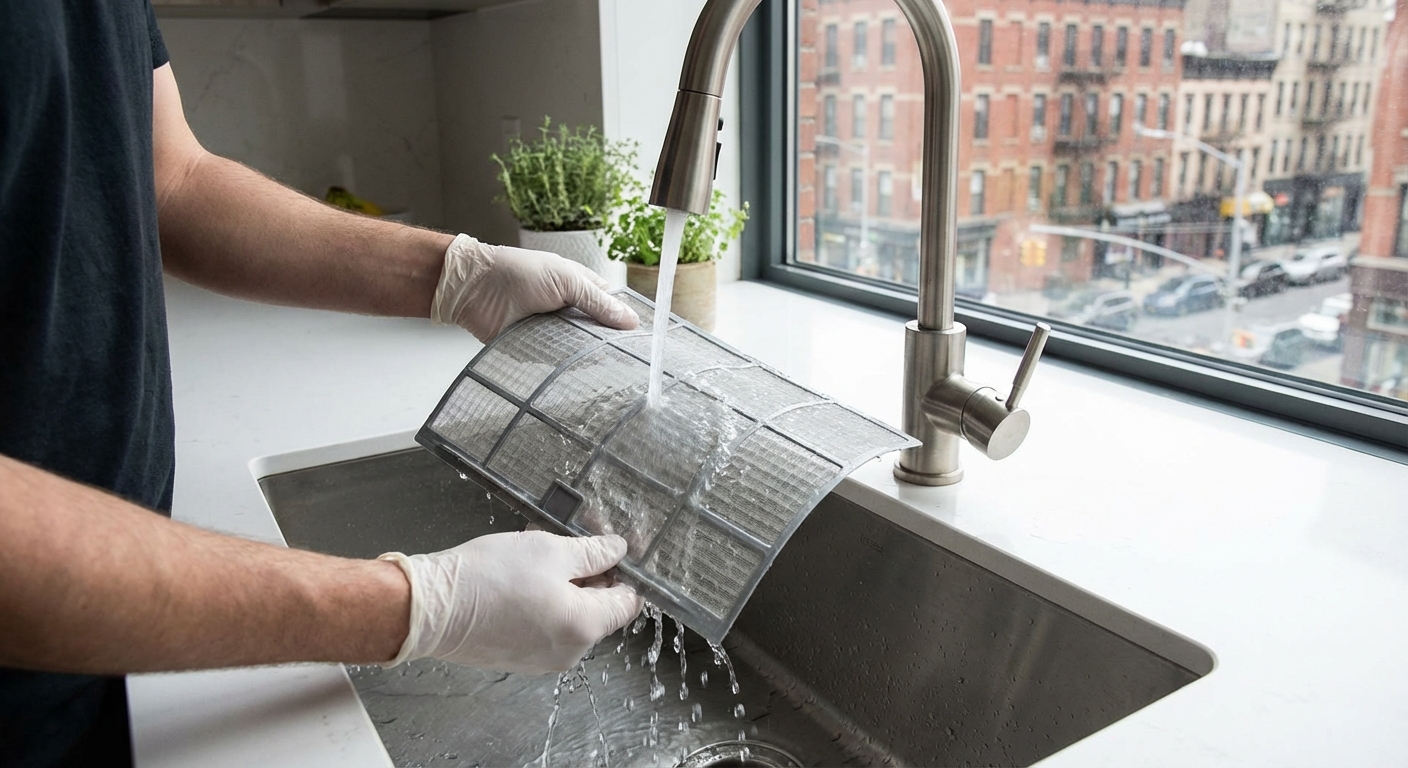
This is the most important maintenance task and takes under 5 minutes. Open the front panel of the indoor unit (it lifts up on hinges), slide out the mesh filters, rinse them under warm water, let them air dry completely, and slide them back in. During peak summer and winter months when the system runs daily, clean every 2 weeks. During shoulder seasons with lighter use, every 4 weeks is sufficient.
A dirty filter restricts airflow across the evaporator coil. The system compensates by running the fan harder and the compressor longer, which increases energy consumption by 5 to 15 percent and accelerates wear on both components. Keeping filters clean is the single easiest way to maintain efficiency and extend system life.
Condensate Drain Check (Monthly in Summer)
The indoor unit produces condensation when cooling (just like a cold glass of water on a humid day). This moisture drains through a small PVC hose to the exterior or to a plumbing drain. During NYC’s humid summer months, the system can produce 1 to 3 gallons of condensate per day.
Check the drain exit point monthly to make sure water is flowing freely. If the drain line becomes clogged (usually with dust, algae, or mold), water backs up into the indoor unit’s drain pan, which can overflow and damage walls or ceilings. A clogged drain is the most common cause of water leaks from mini splits.
To prevent clogs: pour a cup of distilled white vinegar into the drain pan every 3 months. The vinegar kills algae and mold growth inside the drain line.
Outdoor Unit Maintenance (Monthly)
The outdoor condenser needs clear airflow around all sides. Monthly, check for:
- Leaves, trash, or debris blocking the intake or exhaust grilles
- Plants or shrubs growing within 12 inches of the unit (trim back as needed)
- Snow or ice buildup during winter (clear any accumulation blocking the bottom intake)
- Visible dirt or grime on the aluminum fins (gentle rinse with a garden hose from top down)
Professional Service: What the Technician Does
Spring Tune-Up (April/May)
Before cooling season, a professional service visit includes:
- Evaporator coil cleaning. The indoor coil accumulates fine dust that passes through the mesh filter. A deep clean with a no-rinse coil cleaner or a rinse-and-drain cleaning restores full heat exchange efficiency.
- Condensate drain flush. The technician clears the drain line with compressed air or a wet/dry vacuum and treats it to prevent biological growth through the summer.
- Refrigerant pressure check. Verifying that the refrigerant charge is within manufacturer specifications. A system losing refrigerant has a leak that needs to be found and repaired before recharging.
- Electrical connection inspection. Checking terminal connections, wire condition, and contactor operation. Loose connections generate heat and can cause component failure.
- Thermostat and sensor calibration. Verifying that the thermostat reads accurately and the system responds correctly to temperature changes.
- Condenser coil cleaning. Washing the outdoor coil with water to remove pollen, dirt, and debris that reduce heat rejection efficiency.
Fall Tune-Up (September/October)
Before heating season, the visit includes everything above plus:
- Defrost cycle test. Heat pump mode causes frost to build on the outdoor coil during cold, humid weather. The system reverses briefly to defrost. Verifying the defrost cycle operates correctly prevents ice buildup that blocks airflow and reduces heating capacity.
- Reversing valve check. The reversing valve switches the system between heating and cooling modes. A sticking or failing reversing valve is one of the more expensive repairs ($400 to $800), and early detection during a tune-up can prevent mid-winter failure.
- Heating performance test. Running the system in heat mode and measuring supply air temperature and delta-T (difference between return and supply air) to verify the system is producing rated heating output.
What Happens When You Skip Maintenance
The consequences of neglected maintenance compound over time:
- Year 1 without maintenance: 5 to 10% efficiency loss from dirty filters and coils. Slightly higher energy bills. No visible problems.
- Year 2-3: 15 to 25% efficiency loss. Condensate drain may clog, causing water leaks. Evaporator coil develops a biofilm that restricts airflow and produces musty odors.
- Year 3-5: Compressor strain from restricted airflow and degraded heat exchange leads to premature wear. Electrical connections may loosen, causing intermittent operation or error codes. System lifespan reduced by 3 to 5 years.
The cost of two annual tune-ups ($200 to $400/year) is a fraction of an early compressor replacement ($1,500 to $3,000) or a premature system replacement ($3,000 to $10,000+).
AirSync Maintenance Plans
AirSync HVAC offers annual maintenance plans at $150 to $200 per system that include both the spring and fall tune-ups, priority scheduling, and a 10% discount on any repairs needed. Call (718) 619-4993 or request service online. For more on system longevity, see our guide on how long mini splits last in NYC.