Skip to content

Noise Levels That Actually Matter for Sleep and Work
The quietest mini split models for NYC bedrooms produce 19 to 22 decibels on their lowest fan setting. For context, a typical library is 40 dB, a whisper at three feet is 30 dB, and rustling leaves are 20 dB. At 19 dB, the indoor unit is functionally silent in a bedroom environment where ambient city noise (even in quiet neighborhoods) typically runs 30 to 45 dB at night.
The meaningful comparison for NYC homeowners is not between mini split brands (which differ by only 1 to 3 dB in practice) but between mini splits and the alternatives. A window AC unit at full speed produces 50 to 60 dB. A portable AC unit runs 52 to 65 dB. A box fan on medium is 55 dB. Switching from any of these to a mini split drops noise by 30 to 40 dB, which is perceived as roughly 8 to 16 times quieter.
Quietest Models by Brand
| Brand / Model | Indoor Low Speed | Indoor High Speed | Outdoor Unit |
|---|---|---|---|
| Mitsubishi MSZ-FH (Deluxe) | 19 dB | 44 dB | 56 dB |
| Mitsubishi MSZ-GL (Standard) | 21 dB | 46 dB | 58 dB |
| Daikin FTXS (Emura) | 19 dB | 43 dB | 54 dB |
| Daikin 17 Series | 23 dB | 45 dB | 56 dB |
| Fujitsu RLS3H (Halcyon) | 18 dB | 44 dB | 55 dB |
| Fujitsu LZAS (Compact) | 20 dB | 42 dB | 56 dB |
The Fujitsu RLS3H at 18 dB is the quietest indoor unit widely available in the NYC market. The Mitsubishi FH and Daikin Emura tie at 19 dB. All three are effectively inaudible during sleep. The differences between brands at low speed are imperceptible to the human ear (a 3 dB difference is barely detectable).
What Matters More Than Spec Sheet dB Ratings
Published noise ratings are measured in laboratory conditions at a specific distance and angle. Real-world noise depends on factors the spec sheet does not capture:
- Installation quality. A poorly mounted indoor unit can vibrate against the wall bracket, producing a hum or rattle that adds 5 to 10 dB. Proper mounting with vibration-isolating pads and secure bracket fastening eliminates this entirely.
- Refrigerant flow noise. When the system shifts between heating and cooling modes or adjusts compressor speed, refrigerant flow through the line set can produce a brief swooshing or gurgling sound. This is normal but can be minimized by proper line set routing and charge verification during installation.
- Outdoor condenser placement. The outdoor unit produces 54 to 58 dB, comparable to a normal conversation. If the condenser is mounted on the wall directly behind a bedroom, the vibration can transmit through the structure. Placing the condenser on a ground pad or on a wall adjacent to a non-sleeping room avoids this.
- Fan speed selection. The spec sheet quiet mode (19 dB) runs at the lowest fan speed. At this speed, cooling capacity is reduced by 30 to 40 percent compared to high speed. On hot days, the system may automatically increase fan speed to maintain the setpoint, which raises noise to 35 to 46 dB. Setting a slightly higher thermostat temperature (74°F instead of 70°F) keeps the system in quiet mode more consistently.
Best Setups for Specific Rooms
Nurseries
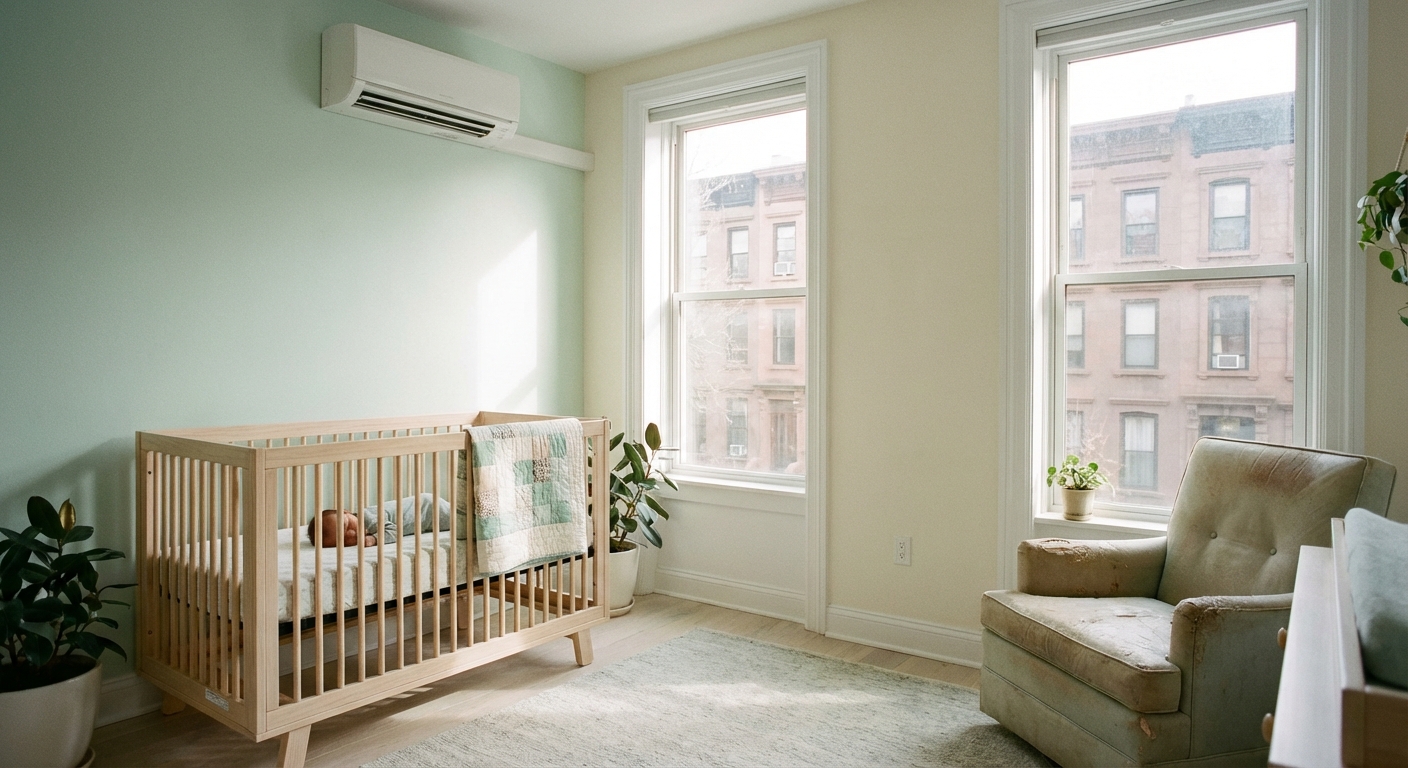
For nurseries, the priority is consistent, quiet operation during nap times and overnight. Recommended setup:
- Mitsubishi MSZ-FH or Fujitsu RLS3H for the lowest noise floor
- Set to “Quiet” or “Silent” mode, which locks the fan to low speed and limits compressor output
- Set temperature to 68°F to 72°F (the AAP recommended range for infant sleep)
- Mount the unit on the wall opposite the crib so airflow does not blow directly on the baby
- Use a smart thermostat app to monitor and adjust temperature without entering the room
Home Offices and Studios
For home offices where you take video calls, and recording studios where microphone pickup matters, the indoor unit noise is less important than the overall acoustic environment. At 19 to 22 dB, no mini split will be picked up by a standard headset or conferencing microphone. For sensitive recording work (voiceover, podcasting, music production), the unit can be set to “Quiet” mode during recording takes and returned to normal operation during breaks.
Bedrooms for Light Sleepers
Light sleepers should prioritize the unit’s operating mode at 2 AM, not just its low-speed spec. In “Auto” mode, the system may ramp up fan speed in the middle of the night if the room warms. Setting the unit to “Quiet” or “Sleep” mode prevents fan speed increases and allows the setpoint to gradually rise by 1 to 2 degrees over the night (matching your body’s natural temperature cycle during sleep).
Outdoor Unit Noise for Neighbors and Co-ops
In NYC’s dense housing, outdoor unit noise affects neighbors as much as the homeowner. A 56 dB condenser is roughly as loud as a normal conversation, which is well within NYC noise code limits but can be noticeable in quiet courtyards or light wells between buildings.
Strategies for minimizing outdoor noise impact:
- Choose a model with a lower outdoor dB rating (Daikin at 54 dB has a slight edge)
- Place the condenser on a vibration-dampening pad to prevent structure-borne noise
- Position the unit so the fan exhaust faces away from neighboring windows
- In co-ops and condos, submit noise specs with your board application to preempt objections
Schedule a Quiet Installation
AirSync HVAC recommends specific models and mounting strategies for noise-sensitive rooms during every free site assessment. We measure the room, evaluate wall construction for vibration transfer potential, and recommend the optimal unit placement for minimum noise. Call (718) 619-4993 or request a quote online. For more on mini split installations in apartments, see our NYC apartment installation guide.