Skip to content

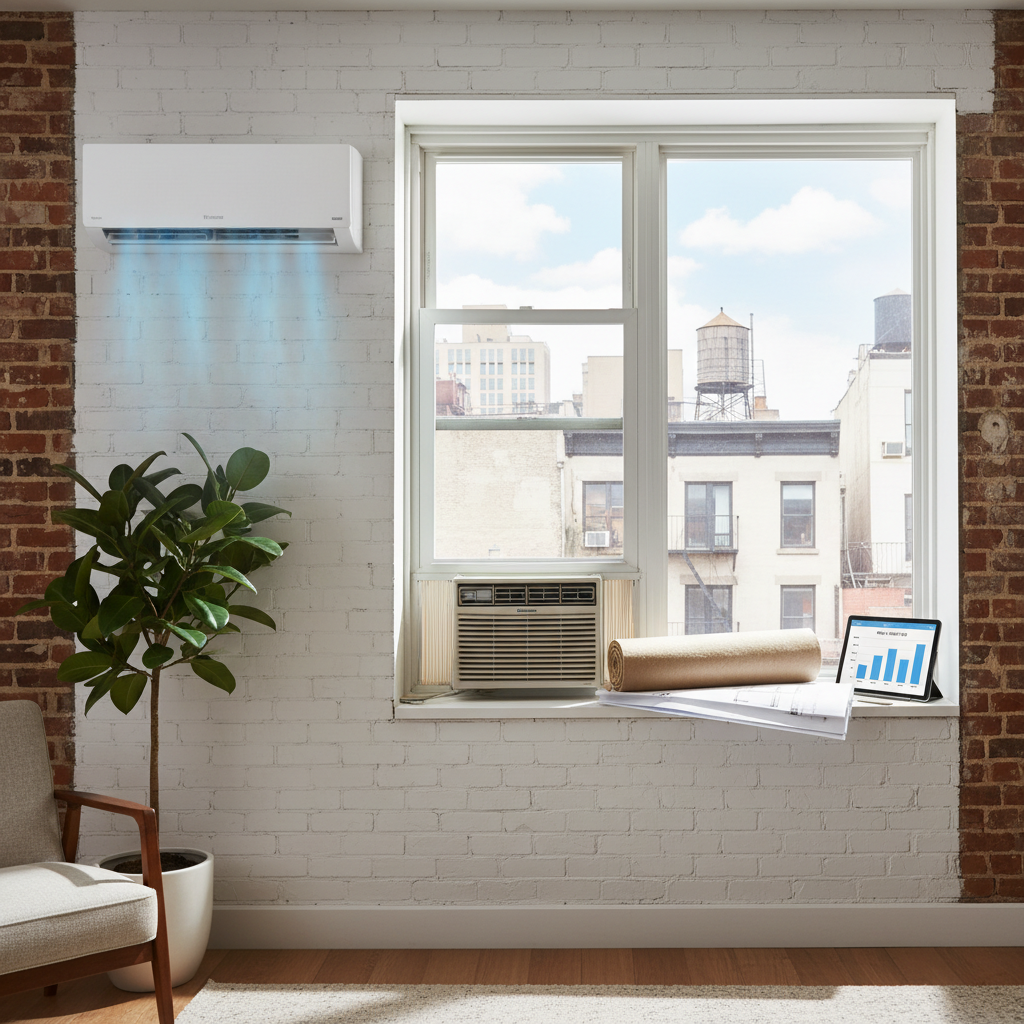
Quick, practical steps to estimate your true operating cost
Measure the room size, note the window orientation, and collect three months of summer electric bills before comparing mini split vs window ac cost nyc. Use a simple formula: estimate required BTUs (20 BTU per square foot for typical NYC rooms), choose a system with matching capacity, then calculate hourly energy draw and multiply by your utility rate to get a monthly cost estimate.
How to size and estimate energy use
Step 1: Measure room square footage. Step 2: Multiply by 20 to get a baseline BTU need. Step 3: Select equipment rated near that capacity but avoid oversizing. Step 4: For energy, convert the system power to kilowatts. For example, a 9,000 BTU window unit often draws about 0.9 to 1.2 kW while a comparable inverter-driven mini split averages 0.6 to 0.9 kW in real use. Multiply kW by hours per day and by your kWh rate to get daily cost.
Upfront cost comparison
Window AC units have the lowest purchase price. Small window units commonly cost from a few hundred dollars to about $700 for higher-efficiency models. Installation is often DIY or a modest fee for mounting and electrical work. Mini splits require a larger upfront investment. Single-zone ductless mini split systems including installation generally range from about $1,800 to $5,000 depending on capacity, brand, and wall modifications.
Breakdown of installation factors in NYC
- Permits and building rules: Many New York City buildings require permits or management approval for exterior penetrations. Expect additional time and possible fees.
- Electrical upgrades: Window units plug into existing circuits; mini splits often need a dedicated 220V circuit and professional electrical work.
- Wall work and mounting: Mini splits require a small wall hole and bracket for the outdoor unit, which can add labor if drilling through masonry.
Operating cost: energy use and efficiency
Operating cost depends on equipment efficiency, runtime, and local electricity price. A realistic approach compares seasonal energy use. Use these example steps to calculate an estimate: pick estimated daily runtime hours, use average watt draw, then multiply by the number of cooling days and your kWh price.
Example monthly estimates
| System | Average draw (kW) | 8 hours/day for 30 days at $0.25/kWh |
|---|---|---|
| 9,000 BTU window AC | 0.9–1.2 | $54–$72 |
| 9,000 BTU inverter mini split | 0.6–0.9 | $36–$54 |
These examples use $0.25 per kWh, which is a reasonable NYC residential estimate. If your rate is higher, multiply accordingly. In many cases a mini split will use 20 to 40 percent less energy for the same cooling load because inverter compressors modulate speed and avoid constant start-stop cycles.
Maintenance, lifespan, and total cost of ownership
Window units typically last 5 to 10 years with periodic cleaning. Mini splits commonly last 12 to 20 years with proper maintenance. Factor in annual cleaning and occasional refrigerant checks. Over a decade, lower operating costs and longer life can shift the total cost in favor of a mini split, especially when mini splits reduce heating load too, if used for heat pump operation.
When HVAC replacement and insulation change the math
Replacing an old central system or improving insulation alters both peak and total energy demand. Upgrading insulation reduces required BTUs and lets smaller, more efficient systems meet comfort needs. If your apartment or home has poor insulation, a portion of the benefit from a mini split will be lost to heat flow; invest in insulation improvements first or alongside a new system to shorten payback.
Permits, building rules, and practical limits in NYC
Many buildings prohibit through-window or exterior-mounted units. Co-op boards and landlords may restrict installations that change the facade. Window units are often easier in buildings that allow them; mini splits require management approval for the hole and exterior bracket but can be more acceptable long term because they avoid blocking windows and often look neater.
Financing, incentives, and HVAC replacement options
Financing spreads the mini split upfront cost into manageable payments. Options include personal loans, home improvement loans, contractor financing, and municipal or utility programs. Check local utility incentives and state efficiency programs for rebates on heat pumps and insulation. Many NY utilities and state programs offer rebates or low-interest financing for energy efficiency upgrades which will reduce the net cost of a mini split installation.
- Look for utility rebates before hiring an installer; some rebates require pre-approval.
- HVAC replacement contractors often offer financing or can guide on available incentives.
- Consider bundling insulation work with HVAC replacement to maximize incentives and energy savings.
Typical payback scenarios
Run a simple payback: subtract monthly operating cost of the mini split from the window AC cost, multiply the savings by months per cooling season, and divide the premium for the mini split installation. Example: if a mini split saves $30 per month over a window unit and costs $2,000 more to install, payback is about 67 months or roughly 5.5 years of cooling seasons. Adjust numbers for local electricity price, hours of use, and any rebates.
Checklist to decide between mini split and window AC
- Measure room size and compute BTU need.
- Obtain local electric rate from recent bills.
- Get three quotes for mini split installation and one for professional window AC installation if needed.
- Ask about permits, building approvals, and required electrical upgrades.
- Check available rebates, state and local incentives, and contractor financing.
- Estimate insulation condition and cost to improve it; include that in the ROI calculation.
Final considerations
Mini splits typically cost more upfront but reduce monthly energy use, improve comfort, and last longer. Window ACs cost less to buy and install but can cost more to run and need replacement sooner. In New York, where electricity rates and building rules vary, the right choice depends on localized electrical costs, permit and building restrictions, expected runtime, and whether you pair the new system with insulation or an HVAC replacement. Use the measurement and calculation steps at the start to create a personalized comparison and prioritize any available incentives to lower upfront expense.