

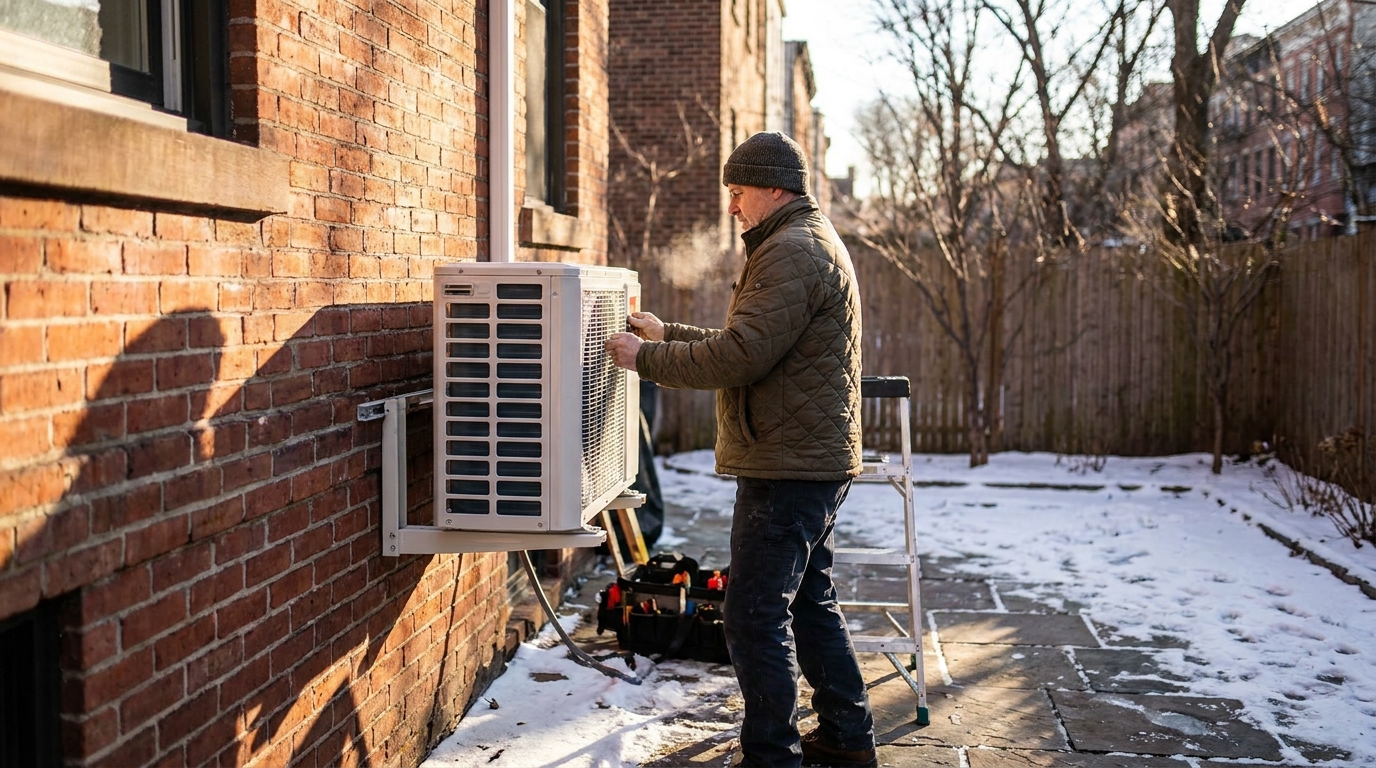
Why Mini Split Condenser Snow Line NYC Clean Heat Placement Affects Your Rebate
Placing your mini split condenser above the local snow line is not optional under the NYS Clean Heat program, it is an installation requirement tied directly to your Con Edison incentive. The program manual states that outdoor units should be installed above the local snow line, and that systems must pass the Program Administrator Field Inspection detailed in Section 5. If a post-install field inspector visits your Brooklyn or Queens property and finds the condenser sitting below that line, your incentive eligibility is at risk.
No local installer page connects this placement rule to the actual rebate inspection. That gap is what this guide fills.
How Do You Find Your Required Snow Line for a NYC Address?
The specific height you need is not a single statewide number. The NYS Clean Heat program manual directs contractors to use the NYS Clean Heat Prescriptive Categories Incentive Calculator and Design Temperature Lookup Tool to determine the required snow depth for each project address. Enter your zip code and the tool returns the design temperature and the corresponding snow depth used to set the minimum mounting height.
For most NYC zip codes, the expected maximum snow depth falls in the 16- to 24-inch range. HPD’s own technical requirements for split heat pump systems specify that outdoor units must be installed 18 inches above grade to avoid snow. The Clean Heat program requires the bottom of the condenser to clear the local historical maximum, not just the seasonal average, so a wall bracket or riser stand set at 24 inches above grade is the practical NYC minimum. The base should also be angled so defrost meltwater drains away and cannot refreeze at the unit’s feet.
What Do Field Inspection Checklist Items C15 and C15B Actually Check?
The Clean Heat field assessment uses a standardized checklist. Two items govern snow protection directly:
- C15, Snow protection from above: The inspector verifies that the condenser is not positioned where roof snow or ice can slide or drip onto it. A unit sitting at the gable end of a brownstone under a deep eave, or under a tightly framed deck with adequate clearance, typically passes. A unit under an open eave drip line does not pass without a snow deflector shield installed above it.
- C15B, Snow protection from below: The inspector confirms the condenser is mounted at or above the local snow line determined by the Design Temperature Lookup Tool for that zip code. A ground pad installation in a rear yard that puts the base at 4–6 inches off grade will fail this item in virtually every NYC borough.
Both items appear on the ASHP Field Assessment “Hot List”, the program’s top-priority checklist items most likely to trigger a “Below Program Standard” rating. A below-standard finding can result in the Program Administrator determining you do not meet incentive eligibility requirements.
The NYC Brownstone Rear-Yard Problem: Three Constraints at Once
Most competitors discuss LPC street-visibility rules or DEP’s 42 dBA noise limit in isolation. The real challenge in a brownstone or rowhouse rear yard is satisfying three overlapping rules with one placement decision.
| Constraint | What It Requires | NYC Authority |
|---|---|---|
| Snow line / ice drip (C15, C15B) | Unit above local max snow depth; no roof eave or deck drip onto unit | NYS Clean Heat / Con Edison Program Manual |
| Noise limit | 42 dBA at the property line; wall brackets move the unit away from fences and party walls | NYC DEP (Admin Code §24-218) |
| Landmark / street visibility | Condenser not visible from the street in LPC-designated districts | NYC Landmarks Preservation Commission |
A wall bracket or adjustable riser stand mounted on the rear brick facade, set at 24–30 inches above the patio slab, satisfies all three at once: it clears the snow line (C15B), keeps the unit away from the rear fence line to reduce noise at the property boundary, and keeps it out of any LPC street sightline. The gable end of a rowhouse, fully under a deep eave with no roof snowslide path, is the other winning option when the rear wall is unavailable.
For narrow side yards and light wells, neither option works cleanly. A side yard that funnels roof snowmelt directly onto the condenser puts you in C15 failure territory unless a properly rated deflector shield is added above the unit. See the section on deflectors below before choosing that path.
Snow Deflectors: Last Resort, Not a Fix
The Clean Heat program and best-practice guidance tell installers to avoid snow deflectors on vertical-discharge condensers when placement can solve the problem instead. The reason is efficiency: a deflector diverts exhaust air outward rather than straight up, pulling a portion of that warm discharge air back into the intake. Estimates put the resulting loss at 2 to 4 percent of heating and cooling efficiency for the life of the system, a real cost on a Con Edison bill across a 15-year equipment life.
Deflectors are appropriate and program-compliant when the unit is unavoidably positioned under an eave drip line or deck and there is no better placement option. In that scenario, C15 requires the shield; skipping it fails inspection. But if you can place the unit on a rear-wall bracket away from drip lines, you preserve full efficiency and satisfy C15 without added hardware.
Never wrap the condenser in a solid winter cover. A heat pump pulls outdoor air all winter for heating. Blocking airflow stalls the defrost cycle and can damage the compressor.
Placement Option Comparison for NYC Properties
| Placement Option | C15 (From Above) | C15B (Height) | Noise Risk | LPC Risk | Best For |
|---|---|---|---|---|---|
| Rear-wall bracket, 24–30 in. above grade | Pass (no eave drip) | Pass | Low | Low | Most brownstones and rowhouses |
| Gable-end, under deep eave | Pass (eave sheds snow away) | Pass if bracket used | Low–Medium | Low | Attached rowhouses with side clearance |
| Ground pad, rear yard | Conditional (no drip path) | Fail if under 18–24 in. | Medium | Low | Only with riser stand added |
| Side yard / light well | Fail (eave drip common) | Fail if at grade | High (echo) | Medium | Last resort; requires deflector + riser |
| Under tightly framed deck | Pass if deck boards are tight | Pass if bracket used | Low | Low | Properties with elevated rear decks |
Common Mistakes to Avoid
- Setting the condenser on a standard 3-inch equipment pad. A 3-inch concrete pad puts the base of the unit well below the 18–24 inch minimum. It fails C15B at inspection.
- Placing the unit under an open eave drip line without a shield. Even 6 inches of seasonal ice slide can block airflow and trigger a C15 fail. If you cannot relocate, add a rated deflector shield above the unit.
- Wrapping the unit in a solid cover for winter. Heat pumps run all winter. A solid wrap blocks airflow, traps frost, and can void the manufacturer warranty.
- Using the statewide average snow depth instead of the zip-code lookup. The program requires the Design Temperature Lookup Tool result for your specific address. Using a generic 12-inch number for all five boroughs misses the Clean Heat standard.
- Ignoring meltwater drainage angle. Even a correctly elevated unit will refreeze at its base if the mounting bracket is level. Angle the base pan slightly forward so defrost water runs away from the unit.
- Skipping the program’s field inspection prep. Clean Heat selects projects for post-install inspection. Participating contractors are required to meet installation best practices including “the appearance of the property upon project completion.” A rushed installation with poor placement can cost you the full incentive. For the broader permit and sign-off picture, see our guide to closing an open DOB permit before you sell or refinance.
How Does This Interact With the Con Edison Clean Heat Rebate Payment Process?
Con Edison pays the Clean Heat incentive after the program administrator confirms the installation meets all program requirements, including field inspection checklists. Program Administrators may verify adherence to these requirements and determine incentive eligibility based on their findings. A “Below Program Standard” finding on C15 or C15B does not automatically void your rebate, but it opens a deficiency process that can delay payment, require a corrective re-inspection, or result in a partial or denied incentive on a project already completed.
Pairing correct condenser placement with the right rate plan maximizes the financial return on the installation. Our guide to the Con Edison Smart Usage Rewards program for NYC mini splits covers how to stack demand-response payments on top of the Clean Heat rebate.
Frequently Asked Questions
How high above grade does my mini split condenser need to be in NYC to pass the Clean Heat inspection?
The minimum is determined by the NYS Clean Heat Design Temperature Lookup Tool for your specific zip code. For most NYC addresses, that works out to 18–24 inches above grade. Mount the condenser on a wall bracket or riser stand so the base clears the local historical maximum snow depth, not just the average. HPD’s own technical standards for split heat pump systems also specify a minimum of 18 inches above grade to avoid snow interference.
What is the difference between checklist items C15 and C15B?
C15 covers snow protection from above: the inspector confirms no roof snowslide, eave drip, or deck drip can reach the unit. C15B covers snow protection from below: the unit must be mounted at or above the local snow line height. A unit can pass C15 but fail C15B if it is shielded from above but still sitting too close to grade.
Is a snow deflector required, and does it affect my rebate?
A snow deflector is required only when the unit is under an eave or drip source and cannot be relocated. The program and best practice prefer placement over hardware, because deflectors on vertical-discharge units redirect warm exhaust air back into the intake, cutting heating and cooling efficiency by roughly 2–4%. Using a deflector when placement could have solved the issue is not a rebate violation, but it costs you efficiency for the life of the system.
Can I put the condenser on a ground pad in my brownstone rear yard?
Only if you add a riser stand that elevates the base of the unit to at least 18–24 inches above the patio slab. A bare ground pad at 3–6 inches off grade will fail checklist item C15B. The rear-wall bracket option, mounted on the brick facade at 24–30 inches, is cleaner, easier to angle for drainage, and satisfies all three NYC constraints (snow line, noise, LPC visibility) in one move.
Does the Clean Heat field inspection happen on every project?
Not every project, but the program conducts random post-install inspections across participating contractor portfolios. All new participating contractors have their first three projects selected for assessment. If your project is flagged, the inspector uses the same standardized checklist whether the inspection is routine or triggered by a complaint. Correct condenser placement from day one means you are inspection-ready at any point.