

What Is the TR8 Form and Why Does It Come Up in a Mini Split DOB Filing?
The TR8 is the Technical Report: Statement of Responsibility for Energy Code Progress Inspections, required under 1 RCNY §5000-01(h). It is the form that assigns a qualified progress inspector responsibility for verifying that construction meets the NYC Energy Conservation Code (NYCECC) at defined stages of the job. When your contractor files a DOB work permit for a mini split TR8 energy code NYC job, the TR1 form (which covers all special inspections) includes a line asking whether energy-code progress inspections are required. If the answer is yes, a TR8 must follow.
The key distinction most homeowners never hear: TR8 is exclusively an energy-code inspection tool, separate from the TR1 special-inspection and mechanical sign-off process. Confusing the two is the single most common misconception on permit forums and Reddit threads about NYC mini split permits. The TR1 covers structural and mechanical safety; the TR8 covers energy-code compliance items like air barriers, insulation, and HVAC controls.
Does a Residential Mini Split Installation Actually Require a TR8?
For most single-zone or multi-zone residential mini split alterations in NYC, the honest answer is: probably not a full TR8 progress inspection, but the form itself may still appear in the filing. Here is how the logic works.
The DOB’s own NYCECC FAQ makes this explicit. When a filing requires a TR8 for plan approval, the applicant can check “No” to every line of the energy-code progress-inspection table if none of those items apply to the scope of work, then sign, seal, and submit the form with the drawings. In that case, the form will not be required for permit or sign-off. In DOB NOW: Build, the equivalent step is selecting “Work does not require any TR8 Energy Code Progress Inspections” in the NYCECC Compliance section of the application. That option must be selected to remove the TR8 tab from the filing.
A standalone mini split alteration in an existing residential building typically does not trigger the energy-code progress-inspection items on the TR8 (such as air-barrier visual inspections or whole-building air-leakage testing), because those items are designed for new construction and major additions. What it does trigger are the NYCECC’s mandatory systems requirements, specifically the 7-day thermostat and line-set insulation rules discussed below, and those are verified by the inspector during the standard DOB inspection, not by a separate TR8 progress inspector.
TR8 vs. TR1: What Is the Difference for a Mini Split Job?
| Form | What It Covers | Who Signs It | When It Is Required |
|---|---|---|---|
| TR1 | Special inspections: structural, mechanical, electrical safety | Registered special inspector / approved agency | All permitted DOB jobs requiring special inspection |
| TR8 | Energy Code progress inspections only (NYCECC) | Registered energy-code progress inspector / approved agency | Jobs where TR1 Section 4 indicates energy-code progress inspections are required |
For a residential mini split alteration, your contractor typically files a TR1 to cover the mechanical special inspection, and then addresses the TR8 question by documenting that no energy-code progress inspections are triggered. For the full picture of what the TR1 sign-off involves for your mini split, see our guide on mini split special inspection NYC: TR1 form, who pays, and how it affects your DOB sign-off.
What Does the NYCECC Actually Check on a Mini Split Installation?
Even if no TR8 progress inspector sets foot on your job site, the NYCECC has mandatory requirements that apply to every permitted split-system heat pump or mini split in NYC. These items appear on your construction documents and are confirmed during the DOB inspection. Getting them wrong stalls your Equipment Use Permit.
7-Day Programmable Thermostat
A 7-day programmable thermostat is required, per the NYC Energy Conservation Code (NYCECC), installed and programmed to the requirements described in HPD guidance. The underlying code section is NYCECC R403.1.1, which requires that the thermostat controlling the primary heating or cooling system of the dwelling unit shall be capable of controlling the heating and cooling system on a daily schedule to maintain different temperature set points at different times of day and different days of the week. The NYCECC tabular analysis for residential buildings explicitly calls this out for mini split units: the thermostat shall have a minimum 7-day clock.
In practice, this means the standard infrared remote control that ships with most indoor mini split heads does not satisfy the code on its own. You need a wired or Wi-Fi wall thermostat with a 7-day scheduling capability, either a manufacturer-specific unit or a compatible third-party device, documented on your mechanical plans and present for inspection. This is also relevant if you want to enroll in the Con Edison Smart Thermostat Program, where a qualifying smart thermostat does double duty: it satisfies NYCECC R403.1.1 and earns you the $85 rebate.
Line-Set Insulation: Thickness, Continuity, and UV Protection
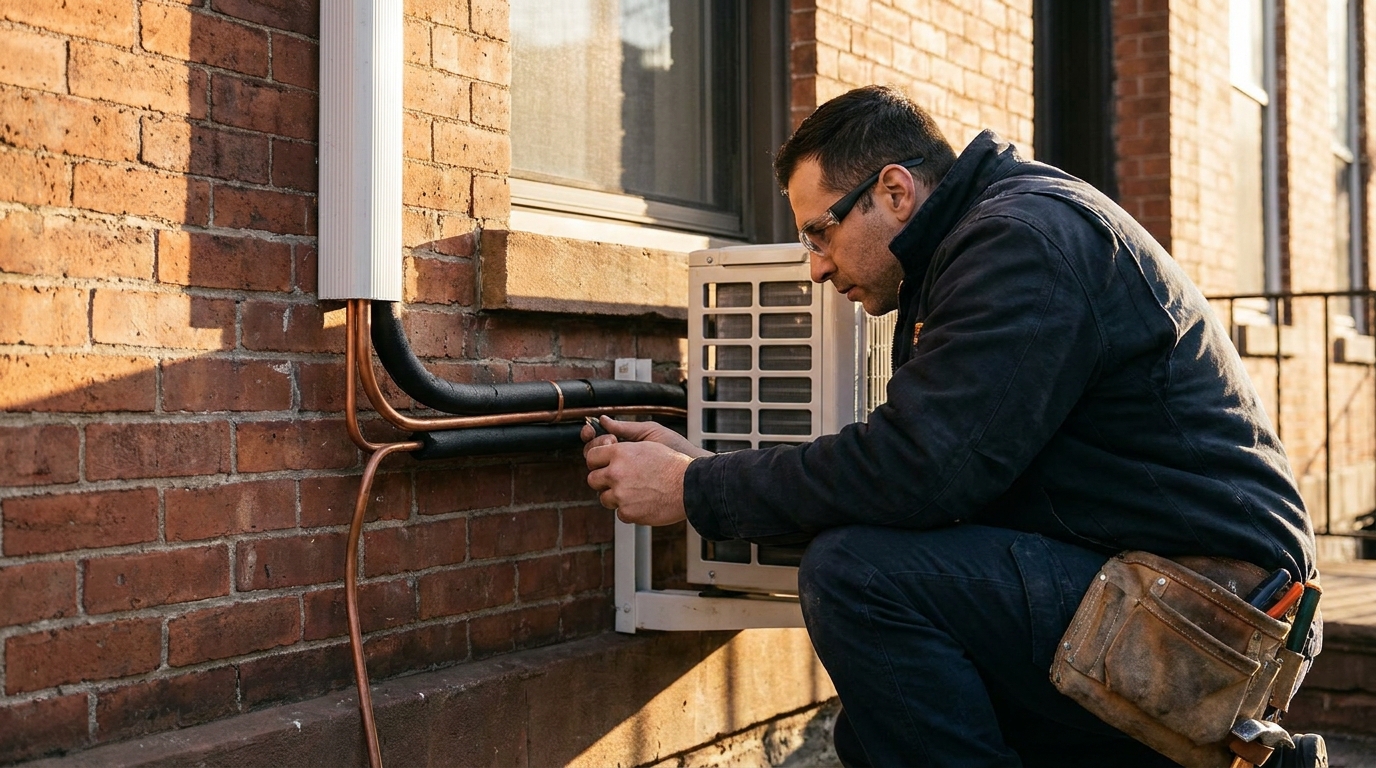
Outdoor piping must be insulated to meet NYCECC requirements specific to each installation. The March 2024 HPD guidance on heat pumps cites NYC ECC Section C403.11.3 for pipe insulation and notes that residential split systems typically use approximately 1/2 inch insulation on the smaller (liquid) line and approximately 1.5 inches on the larger (suction) line. The insulation must run the full length from the outdoor unit to the indoor unit without gaps, and must be protected from UV degradation, using a metal or UV-resistant plastic line-set cover, or UV-resistant paint applied directly to the insulation jacket.
Skipping the UV cover or leaving an uninsulated gap at a wall penetration are the two most common energy-code deficiencies flagged on mini split inspections in NYC. Both will hold up your sign-off.
Condensate Disposal and Vibration-Isolating Supports
HPD guidance also flags two items that fall within the broader DOB filing scope: condensate must have an approved place of disposal (not simply dripping onto a neighbor’s property or pooling on a parapet), and line-set supports must be vibration-isolating (resilient) rather than rigid metal straps. These are not strictly energy-code items, but they appear alongside the insulation and thermostat requirements in every HPD split-system technical review and will be part of your DOB inspection checklist.
NYCECC Mini Split Compliance Checklist at a Glance
| NYCECC Item | Code Reference | What to Verify Before Inspection |
|---|---|---|
| 7-day programmable thermostat | NYCECC R403.1.1 | Wired or Wi-Fi wall thermostat with 7-day scheduling installed and shown on mechanical plans |
| Suction-line insulation thickness | NYC ECC C403.11.3 | ~1.5 inch insulation on larger refrigerant line, continuous, no gaps |
| Liquid-line insulation thickness | NYC ECC C403.11.3 | ~1/2 inch insulation on smaller refrigerant line, continuous, no gaps |
| UV protection on outdoor line set | HPD guidance / C403.11.3 | Metal or UV-resistant PVC line-set cover, or UV-resistant paint on insulation jacket |
| Vibration-isolating line-set supports | HPD split-system requirements | Resilient (rubber-padded) hangers, not rigid metal straps |
| Condensate disposal | NYC Plumbing Code / HPD guidance | Condensate routed to an approved drain; no open discharge onto neighbors’ property |
Why an Unpermitted or DIY Mini Split Stalls at the Equipment Use Permit Stage
A mini split’s refrigerant lines cross an exterior wall, which means the installation requires a DOB work permit and, after a satisfactory inspection, an Equipment Use Permit (EUP) before the system can legally operate. This is unlike window air conditioners or PTACs, which are typically permit-exempt in NYC residential buildings.
When a DIY installer or an unlicensed contractor skips the permit, the building’s DOB record shows an open or missing permit. This becomes a problem at sale, refinancing, or co-op board review. For the full consequences, read our detailed guide on open DOB permit mini split NYC: how to close it out before you sell or refinance. More specifically, an unpermitted install bypasses the NYCECC thermostat and insulation inspections entirely, meaning the system may not qualify for utility rebates that require code-compliant installation documentation, and the homeowner is left holding liability if a deficiency causes damage.
If you are considering self-certification to speed the process, understand that the energy-code items on the plans must still be accurate: mini split self-certification at the NYC DOB shifts audit risk to the professional of record, not away from code compliance itself.
How the TR8 and Energy-Code Items Appear in a Co-op or Condo Alteration Package
If you live in a co-op or condo, your alteration agreement and board submission typically require a copy of the full DOB filing, including any energy compliance documentation. Boards in buildings with sophisticated managing agents, particularly in Manhattan or brownstone Brooklyn, increasingly check whether the thermostat specified on the mechanical plans meets the 7-day requirement and whether the line-set insulation details are shown on the drawings.
A common board-rejection scenario: an owner submits plans showing the standard infrared remote as the “thermostat.” The managing agent’s engineer flags it as non-compliant with NYCECC R403.1.1. The owner has to revise plans, re-submit to the board, and re-submit to the DOB, adding four to six weeks to the project. The fix is straightforward: specify a compliant 7-day programmable or smart thermostat on the mechanical plan from day one.
Common Mistakes to Avoid
- Assuming no TR8 means no energy-code obligations. The NYCECC thermostat and insulation requirements apply regardless of whether a TR8 progress inspector is engaged. They are mandatory code items, not optional progress-inspection items.
- Using only the infrared remote as the thermostat. The handheld remote does not satisfy NYCECC R403.1.1. A wall-mounted 7-day programmable or smart thermostat must be installed and documented on the mechanical plans.
- Leaving gaps in line-set insulation at wall penetrations. Any uninsulated section of outdoor refrigerant piping is a code deficiency that will hold up sign-off and the Equipment Use Permit.
- Skipping UV protection on exposed outdoor insulation. Foam insulation degrades within one to two seasons of direct sun exposure. A metal or UV-resistant PVC cover is required, not optional.
- Conflating TR8 with TR1. These are separate forms covering separate scopes. Your contractor needs to address both correctly in the DOB filing, not substitute one for the other.
- Going unpermitted to avoid the energy-code review. The EUP cannot be issued without an approved permit, and an open or missing permit is a material defect that surfaces at every real estate transaction.
- Not showing line-set insulation specs on the mechanical drawings. If the drawings say “insulate per code” without specifying thickness, the plan examiner may require a revision before issuing the permit.
Frequently Asked Questions
Does every NYC mini split installation need a TR8 form filed with the DOB?
Not necessarily as an active progress-inspection document. The TR8 question is triggered by the TR1 form’s Section 4. For most residential mini split alterations, no energy-code progress inspections are required, and when no progress inspections are required, the TR8 form should be completed by checking “No” for each energy-code progress inspection, then signed and sealed. The NYCECC mandatory requirements (7-day thermostat, line-set insulation) are still enforced but through the standard DOB inspection, not a separate TR8 progress inspector.
What is the 7-day thermostat requirement for a mini split in NYC?
The thermostat controlling the primary heating or cooling system of the dwelling unit must be capable of controlling the system on a daily schedule to maintain different temperature set points at different times of day and different days of the week, with the capability to set back or temporarily operate the system to maintain zone temperatures of not less than 55°F to not greater than 85°F. The handheld infrared remote that ships with most mini splits does not satisfy this requirement. A wired or Wi-Fi 7-day wall thermostat must be installed and documented on the mechanical plans.
How thick does line-set insulation have to be on a NYC mini split?
The March 2024 HPD guidance on heat pumps, citing NYC ECC Section C403.11.3, specifies approximately 1/2 inch of insulation on the smaller (liquid) refrigerant line and approximately 1.5 inches on the larger (suction) line. The insulation must be continuous from the outdoor unit to the indoor unit without gaps, and all outdoor sections must be protected from UV degradation with a metal or UV-resistant PVC line-set cover, or UV-resistant paint.
Can a DIY mini split install in NYC get an Equipment Use Permit?
No. A DIY install performed without a licensed contractor and without a DOB work permit has no approved inspection on record. The Equipment Use Permit requires a satisfactory DOB inspection, which includes verifying energy-code items. Beyond the permit problem, a DIY install in NYC typically voids the equipment warranty and can void homeowner’s insurance coverage. See our full breakdown at DIY mini split install NYC: why it voids your warranty, blows your DOB permit, and kills your insurance claim.
How does the energy-code thermostat requirement interact with Con Edison’s smart thermostat rebate?
The Con Edison smart thermostat program accepts qualifying Wi-Fi thermostats compatible with mini splits, and many of those devices also satisfy NYCECC R403.1.1’s 7-day scheduling requirement. Installing one device accomplishes both goals: code compliance for your DOB filing and eligibility for the utility rebate. For enrollment details and which thermostats qualify, see our guide on the Con Edison Smart Usage Rewards for mini splits in NYC.